Category: 5: Major Project

  • Artists’ statements

    Exercise 5.7 Prepare your artist’s statement

    An artist’s statement is sometimes referred to as a ‘statement of intent’. It can be seen as a marketing device, or simply as a means of describing practitioners’ interests. They:

    • vary in terms of their length and the details they cover.
    • may relate to a specific body of work or it may talk about practice more generally. probably contains information about any training (art college or other qualifications or experience relevant to their practice) and prizes, grants or awards that the artist has won, which are relevant to their practice. But is not the same thing as an artist’s CV, which lists any training, qualifications, awards, exhibitions and publications in much the same way as a conventional résumé.
    • huge variety in the style and format of artists’ statements; some will sound convoluted and esoteric and others will be more down to earth.

    The Artist Statement (UCA)

    A good artist statement will support your professional practice, for example:

    • Giving brief information to support an exhibition or catalogue
    • Submitting a proposal
    • Applying for a grant

    It should be:

    • Concise
    • Effective in communicating the details you wish to emphasize
    • Written in the first person
    • Written primarily in the present tense

    It should be adaptable in order to take into account:

    • Your audience
    • Your purpose or motivation for writing it

    It might contain information on:

    What your motivation is for the work you do:

    • What issues are you exploring and why?
    • What concepts, themes or convictions underpin your work?
    • How do your life experiences influence your work
    • How does your personality influence your work?
    • How have your ideas developed?

    The techniques and materials you use:

    •  How and why did you choose them?
    • What scale do you work in?
    • Do you have a particular process of working?
    • Do you intend to explore other techniques or materials?

    Your background:

    • Are you a student or a practicing artist?
    • Details of your educational history if you feel it appropriate
    • Have you contributed to any prestigious shows or events?

    How you contextualise your work:

    • Where do you feel you fit into the Contemporary Art World?
    • Does your work challenge the work of others?
    • Have you appropriated or referred to the work of others?
    • Your goals and aspirations and to what extent you have realised them
    • Personal reflections on your work

    Examples from coursebook

    On the front page of Alec Soth’s website he writes:

    “My name is Alec Soth (rhymes with ‘both’). I live in Minnesota. I like to
    take pictures and make books. I also have a business called Little Brown
    Mushroom.” (http://alecsoth.com/photography)

    This is clearly very understated, perhaps even flippant, and it takes a reputation that precedes oneself to be able to write something as laconic as this! Often, an artist’s statement is written by another person (or is designed to sound as if it is by being written in the third person), which adds gravitas.

    Jorma Puranen’s introduction to Imaginary Homecoming is somewhat more convoluted,
    although it provides a thoughtful definition of landscape:

    “A landscape is speechless. Day by day, its only idiom is the sensory
    experience afforded by the biological reality, the weather conditions, and
    the actions that take place in the environment. However, we can also
    assume that a landscape has another dimension: the potential but invisible
    field of possibilities nourished by everyday perceptions, lived experiences,
    different histories, narratives and fantasies. In fact, any understanding of
    landscape entails a succession of distinct moments and different points
    of view. The layeredness of landscape, in other words, forms part of our
    own projection. Every landscape is also a mental landscape.” (Jorma Puranen,1999, Foreword to Imaginary Homecoming, Oulu: Pohjoinen)

    This statement about the work of Ola Kolehmainen is a good example of how a method of
    presentation is linked to the concept of the work:
  • Denotation and connotation

    Denotation and connotation
    What level of denotation/connotation will your image have? You looked at this earlier in Part
    One in relation to Dorothea Lange’s image of the migrant mother.
    To give an example:
    • There are over 200 non-UK players in the Football League (negative – local players are
    being squeezed out).
    • There are 200 EU players in the Football League (neutral – bald fact).
    • There are only 200 EU players in the Football league. (positive – there could be many more).
    Project Altruism in practice

    The same information – 200 players – but a different inference depending on how you ‘spin’ it.
    And that’s just from the perspective of the football fan concerned for the future of the England
    team. Each of these statements would connote something quite different to a European player
    keen to play in the UK. And so it is with images. Small changes to an image can affect the
    meaning quite significantly and the same image will connote different things to viewers
    approaching it from a different cultural perspective.
    Skilled practitioners can bring a different sense to the images they offer, not by dramatic change
    but through viewpoint, composition and the content that they decide to deliver.
    Re-visit the case study on Lange’s Migrant Mother in your course reader and note the difference
    between it and other images from the shoot. Make notes on what each image denotes and what
    it connotes.

  • Documentary Integrity and Truth

    Being there

    How will you operate as a photographer?

    Will you ask permission or will you be a fly on the wall,
    a ghost who never affects the image? This is a major question relevant to your production ethics.
    If you tell people what you’re doing, then they’ll react differently to you; they may be guarded or
    wary of how you’ll portray them.

    Photographers who lived with the communities they were photographing:

    • Chris Killip with the sea coal gatherers in the North East
      of England
    • Martin Parr with the people of Hebden Bridge in Yorkshire.
    • Bruce Davidson has done a similar thing in New York.

    This is very different to the approach of Garry Winogrand or Cartier-Bresson, neither of whom interfered or announced their presence. Winogrand operated like a ghost but got quite close to the action to produce his wide-angle views, whereas Cartier-Bresson
    remained peripheral, on the edge, trying not to be important to the subject.

    Truth
    This is a big one for the social documentary practitioner. The image has to have integrity – it has to be honest and factual in order to validate it for the viewer as an accurate portrayal. This is arguably where the boundary lies between social documentary and photojournalism where the image has more of an editorial purpose. In photojournalism the choice of photographer and the style of image-making will always have to suit the editorial nature of the publication and this is perhaps a bridge too far for the documentary photographer. Most documentary photographers would have no objection to any magazine or media publishing their documentary images provided that they were published as the photographer intended the viewer to see them, not cropped or enhanced.

    Kendall Walton ‘Transparent Pictures’

    ‘Ambiguities and discontinuities’  Berger & Mohr 1995 p91.

    Bazin

    For the first time, between the originating object and its reproduction there intervenes only the instrumentality of a non-living agent. For the first time an image of the world is formed automatically, without the creative intervention of man…in spite of any objections our critical spirit may offer, we are forced to accept as real the existence of the object reproduced, actually, re-presented…’

    The Ontology of the Photographic Image 1945

    Sekula

    If we accept the fundamental premise that information is the outcome of a culturally determined relationship, then we can no longer ascribe an intrinsic or universal meaning to the photographic image.

    On the Invention of Photographic Meaning 1997 p454

  • Reality and hyperreality

    This is a practice-based course so we won’t be going into detail about the nature of truth,
    hermeneutics, reality and hyperreality. What follows is a very brief summary. However you may
    want to research some of these areas for yourself. You could start by looking at some of the titles
    in the reading list at the end of this course guide.
    We all feel that we’re aware of reality but what is ‘real’? If you live in a desert region perhaps
    access to a tap with fresh clean water within five minutes walk is fantasy. This is not the world
    of the suburb where everyone has several taps of their own. Therefore one person’s reality and
    normality is not that of another. The freedom to travel is a reality for most of us, but not in
    all countries. As a tourist it’s possible to travel from region to region in Cuba but for a Cuban
    national it isn’t – unless you’ve got the correct paperwork. If we see a travel programme on
    TV we see a reality for the tourist, for the paying visitor, a valued source of national income.
    There may be many issues that are a reality of life in the countries we visit that we’re not aware
    of and wouldn’t like if we were. This is not to say that there is a judgment to be made by us.
    As a tourist with a completely different set of values that underpin your reality, how can you
    make such a judgment? This is where the photographer living within a society must start to
    consider the nature of the imagery that is produced. How will it portray the subject – in reality
    or hyperreality?
    Philosophers and critics talk about hyperreality where the human mind can’t distinguish reality
    from a simulation of reality. Hyperreality is what our consciousness defines as ‘real’ in a situation
    where media shape or filter an original event or experience. In other words, it’s ‘reality by proxy’.
    As photographers we need to understand where we are with the images we produce in terms
    of their reality. Is the image reality, a representation of reality or a simulation of reality? Jean
    Photography 2 Gesture and Meaning 47
    Baudrillard (1929–2007) was a French philosopher who addressed hyperreality and who talked
    about the nature of reality in terms of simulacra and simulation.
    The link below will take you to an interview that discusses simulacra and simulation. It talks
    about the destabilisation of the media and our ability to identify what’s real and what’s not real.
    www.youtube.com/watch?v=80osUvkFIzI
    In a nutshell, simulation is the process whereby representations of things come to replace
    the things being represented and indeed become more important than the real thing. At the
    extreme, you end up with a simulacrum which has no relation to reality. So an image may:
    • truly reflect of reality
    • mask and pervert reality
    • mask the absence of reality
    • bear no relation to any reality – it is its own simulacrum.
    We need to be careful to avoid simulation lest we engage with hyperreality as a reality without
    recognising its values.
    Jorge Louis Borges (1899–1986) in his work An Exactitude of Science (1946) describes
    hyperreality as “a condition in which ‘reality’ has been replaced by simulacra.” Borges felt that
    language had nothing to do with reality. Reality is a combination of perceptions, emotions,
    facts, feeling, whereas language is a series of structured rules that we need to obey to help
    others perceive our reality. The same is true of visual language.
    Baudrillard argues that today we only experience prepared realities – edited war footage,
    meaningless acts of terrorism, the Jerry Springer Show:
    “The very definition of the real has become: that of which it is possible to give
    an equivalent reproduction… The real is not only what can be reproduced,
    but that which is always already reproduced: that is the hyperreal… which
    is entirely in simulation. Illusion is no longer possible, because the real is no
    longer possible.”
    Baudrillard argues that we must attain an understanding of our state of perception and the
    message content that is communicated in terms of the images we construct. Even if we see it as
    a straight record of what we saw on the day, can this be a reality and, if so, for whom?
    48 Photography 2 Gesture and Meaning
    Documentary photographers are entering a new age with a new set of criteria. The issue of
    technical quality is not relevant. Images from mobile phones that capture the ‘moment’ will
    be printed by newspapers if the image tells the story. Where then is the need for a bag full of
    cameras and kit? In a new age of photography the documentarist will need to engage with the
    issue of hyperreality by establishing credibility, motivation and integrity. The reputation or name
    is then the status giver, the endorser of reality and truth to the images produced and offered to
    the media and the public.

  • Landscape as a Call to Action

    Photography, and the manipulation of photographs, is often used to highlight and raise political questions. Landscape photography in particular is often used in environmental activism – images of environmental degradation, urban squalor. In NGO advertising (eg GreenPeace) photographs are often manipulated to juxtapose elements that are then countered by a caption.

    • Peter Kennard produces explicit political photomontage in the dadaist tradition linked to political campaigning organisations – for example his ‘Hay Wain with Cruise Missiles’ (1980)
    • Edward Burtynsky produces large-format photographs of industrial landscapes altered by industry – an ‘industrial sublime’ creating tension between awe-inspiring beauty and the compromised environments he depicts.
    • Mitch Epstein also uses large format, but less ‘beautiful’ images that do not aim to convey a specific message, and are more documentary in juxtaposing complex narratives.
    • Dana Lixenberg in works like the Last Days of Shishmaref uses landscape and portrait photography alongside working with environmentalists and local activists to produce powerful participatory social documentary.
    • Ikka Halso uses digital montage, including 3D, to build dystopian landscapes that raise questions about the ways in which human beings are attempting to control nature.

    Exercise 3.4: A persuasive image

  • Roland Barthes


    Roland Barthes was a structuralist, with a particular interest in the semiotics of language and images. Semiotics can be described as the ‘science of signs’. A semiotic analysis of an image or a piece of film is the quantification of how meaning is constructed or a message is communicated.
    Before writing ‘Rhetoric of the Image’ Barthes wrote the essay ‘Myth Today’ (1972), in which he described two levels of meaning: sign and myth.
    • The first level of meaning, sign, comprises a signifier and a signified – or a denoted object (the actual thing depicted) and the connoted message (what the thing depicted communicates).
    • The second level of meaning, myth, takes into account the viewer’s existing contextual knowledge that informs a reading of the image.
    This is a simplified description of Barthes’ system, which doesn’t apply exclusively to photographic images. In ‘Rhetoric of the Image’, Barthes uses the first level of meaning to read an advert for a French grocery company, Panzani.

    This table roughly summarises Barthes’ discussion of the signs he identifies in the Panzani advert. In his essay, Barthes doesn’t explicitly refer to the second level of meaning, myth, although he does mention cultural stereotypes or assumptions that inform the consumption of this advertisement: the more Mediterranean lifestyle of “shopping around” for fresh groceries, as opposed to “the hasty stocking up… of a more ‘mechanical’ civilisation”. Barthes also points
    out that:
    • Recognition of the still life tradition in this image is dependent upon particular cultural knowledge.
    • The image is read as an advert. The fact that the context is a magazine, and the pictorial emphasis on the product labels, influence how the overall picture is read.
    • These signs are “not linear”; they are consumed holistically (Barthes, 1977, pp. 32–37).
    Although the landscape doesn’t feature in this advert, it refers to the bounty of the countryside.
    Here we see the brand attempting to align itself to the stereotype of a lifestyle which is – as Barthes saw it – the very essence of the country, as summarised by his made-up word, ‘Italianicity’. It is very much an image of Italian identity, from a French perspective.

    An excellent example of the dissection of an advert is by Roland Barthes in his essay ‘Rhetoric of the Image’ (1977).
    See: http://98.131.80.43/home/wp-content/uploads/2011/06/barthes_rhetoricofimage.pdf

    The course so far has touched upon commercial applications of the landscape image, and how ideas and ideologies have been attached to particular landscapes. Nowhere are these two things conflated more explicitly than within the sphere of advertising, where landscape imagery is aligned with particular brand values and identities. Understanding how advertising imagery is constructed is essential if you intend to practise photography commercially. Even if you’re not interested in the commercial sector, exploring advertising imagery is a very good exercise in understanding how meaning is constructed and mediated by the photographic image.


  • Olivia Parker

    https://www.oliviaparker.com

    Olivia Parker (born 1941) is a Manchester-by-the-Sea-based American still-life photographer.

  • Clive Landen

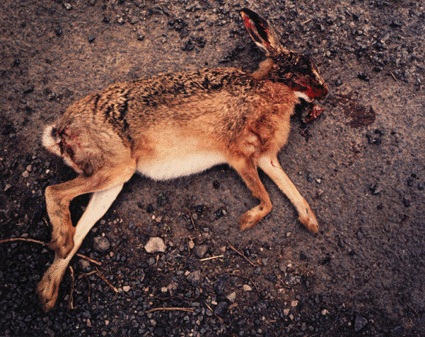
    Clive Landen is a British wildlife photographer concerned with our relationship with animals. His pictures are quite explicit and upsetting to view, but he photographs horror with profound sensitivity and an almost painterly quality that makes us really look at the subject matter.

    The Abyss  series about the 2001 Foot and Mouth outbreak (only one photograph now available on line?). Landen began this project because restrictions meant that he couldn’t pursue his work on the relationship between the land and hunting. The impetus also came from childhood memories of the foot and mouth outbreak of 1967. Whilst the body of work is a pertinent historical document, it is also a personal one. Landen collaborated with the military and was seconded to a regiment, which allowed him free rein to access the sites where cattle were being burned and buried. He describes a photograph of one dead sheep amongst many as a “portrait of the sheep which looks benign, at peace.” (Landen (2007) in Source no. 51.)   His landscape containing a row of dead dairy cows and skeletons of trees is one of the most moving of the series. The pall of smoke that clung to these sites is visible, providing an almost painterly, pictorialist quality.

    Familiar British Wildlife series of images of roadkills. Article Source magazine  Camera Club images


  • Helen Sear

    Creative Wales award.

    Not just the eye. Uses the hand to pain in parts. Sculptural and 3D form. Liberate from computer screen. Different types of paper. Or use CAD.

    Body in the landscape, or landscape in the body

    What does it mean to be both human and animal?

    Wants to concentrate on unremarkable landscape – portrait of a field over a year. Landscape as a living being. And walk to a particular part of forest that changes through being cut down and exposes a particular view suddenly.

    Inside the view

    Beyond the view

    Pond 2011  installation at Crescent Arts Scarborough, UK, March 2011. video of frozen winter pond and trees. Occasional birds. Sheep in silhouette on the horizon.