Alfred Stieglitz (1864–1946), for example, was active in New York in the late 1890s and was
initially a practitioner in the ‘artistic’ sense of documentary photography, trying to emulate
or deliver what drawing and painting had been delivering. Photography was viewed as a
replacement for painting so the thinking was that the practices and values of art should be
subsumed within photography. However the new century, especially after World War I, saw a
growing respect for photography as an independent medium that could offer something different
and this was reflected in the work undertaken by Stieglitz in documenting the ephemeral nature
of everyday life.
In the image above, Stieglitz portrays the crudity of a fledgling transport system. The destination
board – Harlem – tells us that this is harsh winter weather in a poor area of the city. The image
shows how much effort the driver and horses have to put in to be able to operate under such
conditions – note the steam coming off the horses. Stieglitz was prepared to wait for four hours
to capture this image. He wanted something different and he got it.
Stieglitz was very concerned about the initial
treatment of immigrants arriving in large numbers
from Ireland and Europe, hoping for a warm
welcome but receiving the opposite. The authorities
were concerned about typhoid and other infectious
diseases and most immigrants were held in isolation
for weeks before being allowed into America.
For a biography of Steiglitz visit: www.metmuseum.org/toah/hd/stgp/hd_stgp.htm
Alfred Stieglitz: The Eloquent Eye (1999), a Masters of Photography documentary video about
the ‘new way of seeing’ that Stieglitz wanted to bring to American photography:
www.youtube.com/watch?v=8YhwYgdtphE
Landscape photography and printmaking draws on a long tradition of landscape art that can inform different styles and approaches for my own work. I want to work more on the underlying theory of landscape composition and bridging elements, perspective etc. Abstraction. To make my landscape photography and printmaking more conscious of the influences on my work and thereby able to subvert and question to create something new.
Landscape painting, also known as landscape art, is the depiction of landscapes, natural scenery such as mountains, valleys, trees, rivers, and forests, and especially art where the main subject is a wide view, with its elements arranged into a coherent composition. In other works landscape backgrounds for figures can still form an important part of the work. Sky is almost always included in the view, and weather is often an element of the composition. Detailed landscapes as a distinct subject are not found in all artistic traditions, and develop when there is already a sophisticated tradition of representing other subjects.
The word “landscape” entered the modern English language as landskip (variously spelt), an anglicization of the Dutch landschap, around the start of the 17th century, purely as a term for works of art, with its first use as a word for a painting in 1598. Within a few decades it was used to describe vistas in poetry, and eventually as a term for real views. However the cognate term landscaef or landskipe for a cleared patch of land had existed in Old English, though it is not recorded from Middle English. Landscape views in art may be entirely imaginary, or copied from reality with varying degrees of accuracy. If the primary purpose of a picture is to depict an actual, specific place, especially including buildings prominently, it is called a topographical view. Such views, extremely common as prints in the West, are often seen as inferior to fine art landscapes, although the distinction is not always meaningful; similar prejudices existed in Chinese art, where literati painting usually depicted imaginary views, while professional court artists painted real views, often including palaces and cities.
The earliest forms of human art depict little that could really be called landscape, although ground-lines and sometimes indications of mountains, trees or other natural features are included. The earliest “pure landscapes” with no human figures are frescos from Minoan Greece of around 1500 BCE. Hunting scenes, especially those set in the enclosed vista of the reed beds of the Nile Delta from Ancient Egypt, can give a strong sense of place, but the emphasis is on individual plant forms and human and animal figures rather than the overall landscape setting.
The two main traditions spring from Western painting and Chinese art, going back well over a thousand years in both cases. The recognition of a spiritual element in landscape art is present form its beginnings in East Asian art, drawing on Daoism and other philosophical traditions, but in the West only becomes explicit with Romanticism.
Chinese and Japanese traditions
!!Possibly I will do a separate post on this as Japanese ink landscapes and monochrome styles have been important influences on my Black and White photography and printmaking.
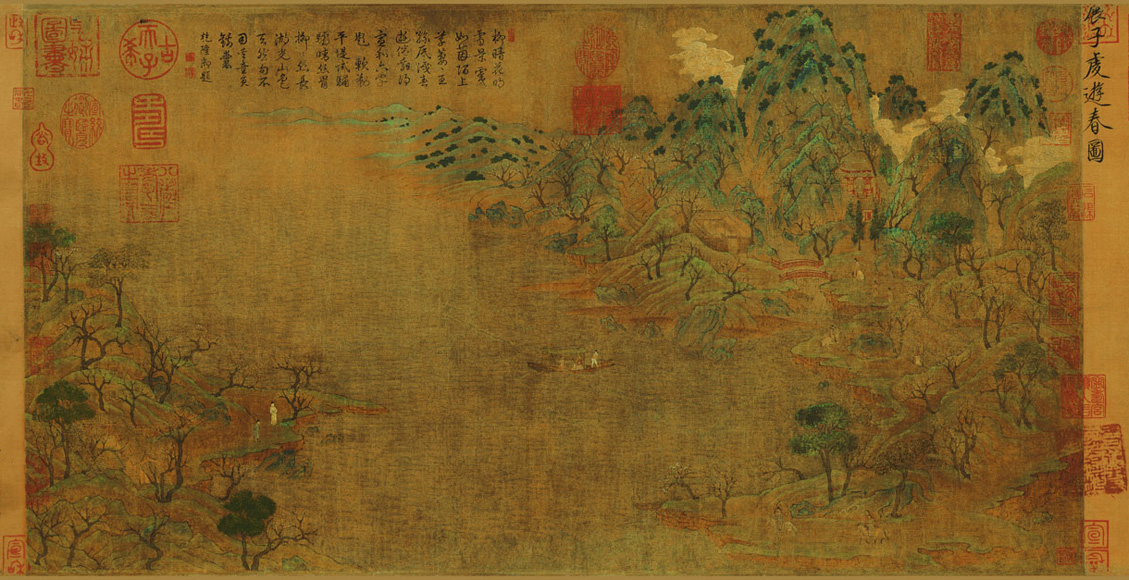
Zhan Ziqian, Strolling About in Spring, a very early Chinese landscape, c. 600. Landscape as a subject in itself
In East Asia famous practitioners of imaginary landscapes were highly respected, including several Emperors of both China and Japan. They were often also poets whose lines and images illustrated each other.
The Chinese ink painting tradition of shan shui (“mountain-water”), or “pure” landscape, in which the only sign of human life is usually a sage, or a glimpse of his hut, uses sophisticated landscape backgrounds to figure subjects, and landscape art of this period retains a classic and much-imitated status within the Chinese tradition. As in Roman traditions these typically show grand panoramas of imaginary landscapes, backed with a range of spectacular mountains. Sometimes they showed only a distant view, sometimes waterfalls, mist or dead ground bridged the gap between a foreground scene with figures and the distant panoramic vista.
Western tradition
It seems from literary evidence that some rough system of perspective, or scaling for distance was first been developed in Ancient Greece in the Hellenistic period, although no large-scale examples survive. Roman landscapes from the 1st century BCE onwards, especially frescos of landscapes decorating rooms, have been preserved at archaeological sites of Pompeii, Herculaneum and elsewhere, and mosaics. These typically show grand panoramas of imaginary landscapes, generally backed with a range of spectacular mountains, often including sea, lakes or rivers to bridge the gap between a foreground scene with figures and a distant panoramic vista.
History painting came to require an extensive landscape background where appropriate and for several centuries landscapes were regularly promoted to the status of history painting by the addition of small figures to make a narrative scene, typically religious or mythological. In Kenneth Clark’s analysis, underlying European ways to convert the complexity of landscape to an idea were four fundamental approaches:
the acceptance of descriptive symbols
curiosity about the facts of nature
creation of fantasy to allay deep-rooted fears of nature
belief in a Golden Age of harmony and order, which might be retrieved.
In early Western medieval art interest in landscape disappears almost entirely, kept alive only in copies of Late Antique works such as the Utrecht Psalter; the last reworking of this source, in an early Gothic version, reduces the previously extensive landscapes to a few trees filling gaps in the composition, with no sense of overall space.A revival in interest in nature initially mainly manifested itself in depictions of small gardens such as the Hortus Conclusus or those in millefleur tapestries. The frescos of figures at work or play in front of a background of dense trees in the Palace of the Popes, Avignon are probably a unique survival of what was a common subject.Several frescos of gardens have survived from Roman houses like the Villa of Livia.
During the 14th century Giotto di Bondone and his followers began to acknowledge nature in their work, increasingly introducing elements of the landscape as the background setting for the action of the figures in their paintings. Early in the 15th century, landscape painting was established as a genre in Europe, as a setting for human activity, often expressed in a religious subject, such as the themes of the Rest on the Flight into Egypt, the Journey of the Magi, or Saint Jerome in the Desert. Luxury illuminated manuscripts were very important in the early development of landscape, especially series of the Labours of the Months such as those in the Très Riches Heures du Duc de Berry, which conventionally showed small genre figures in increasingly large landscape settings. A particular advance is shown in the less well-knownTurin-Milan Hours, now largely destroyed by fire, whose developments were reflected in Early Netherlandish painting for the rest of the century. The artist known as “Hand G”, probably one of the Van Eyck brothers, was especially successful in reproducing effects of light and in a natural-seeming progression from the foreground to the distant view.This was something other artists were to find difficult for a century or more, often solving the problem by showing a landscape background from over the top of a parapet or window-sill, as if from a considerable height.
Italian Renaissance
Landscape backgrounds for various types of painting became increasingly prominent and skilful during the century. The period around the end of the 15th century saw pure landscape drawings and watercolours from Leonardo da Vinci, Albrecht Dürer, Fra Bartolomeo and others, but pure landscape subjects in painting and printmaking, still small, were first produced by Albrecht Altdorfer and others of the German Danube School in the early 16th century.
Landscapes were idealized, mostly reflecting a pastoral ideal drawn from classical poetry which was first fully expressed by Giorgione and the young Titian, and remained associated above all with hilly wooded Italian landscape, which was depicted by artists from Northern Europe who had never visited Italy, just as plain-dwelling literati in China and Japan painted vertiginous mountains. Though often young artists were encouraged to visit Italy to experience Italian light, many Northern European artists could make their living selling Italianate landscapes without ever bothering to make the trip. Indeed, certain styles were so popular that they became formulas that could be copied again and again. Salvator Rosa gave picturesque excitement to his landscapes by showing wilder Southern Italian country, often populated by banditi.
Dutch Landscape
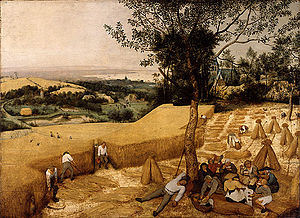
Pieter Brueghel the Elder, The Harvesters, 1565: Peace and agriculture in a pre-Romantic ideal landscape, without sublime terrors
Joachim Patinir in the Netherlands developed the “world landscape” a style of panoramic landscape with small figures and using a high aerial viewpoint, that remained influential for a century, being used and perfected by Pieter Brueghel the Elder. The Italian development of a thorough system of graphical perspective was now known all over Europe, which allowed large and complex views to be painted very effectively.
The publication in Antwerp in 1559 and 1561 of two series of a total of 48 prints (the Small Landscapes) after drawings by an anonymous artist referred to as the Master of the Small Landscapes signalled a shift away from the imaginary, distant landscapes with religious content of the world landscape towards close-up renderings at eye-level of identifiable country estates and villages populated with figures engaged in daily activities. By abandoning the panoramic viewpoint of the world landscape and focusing on the humble, rural and even topographical, the Small Landscapes set the stage for Netherlandish landscape painting in the 17th century. After the publication of the Small Landscapes, landscape artists in the Low Countries either continued with the world landscape or followed the new mode presented by the Small Landscapes.
Rembrandt, The Three Trees, 1643, etching
Dutch Golden Age painting of the 17th century saw the dramatic growth of landscape painting, in which many artists specialized, and the development of extremely subtle realist techniques for depicting light and weather. There are different styles and periods, and sub-genres of marine and animal painting, as well as a distinct style of Italianate landscape. Most Dutch landscapes were relatively small, but landscapes in Flemish Baroque painting, still usually peopled, were often very large, above all in the series of works that Peter Paul Rubens painted for his own houses. Landscape prints were also popular, with those of Rembrandt and the experimental works of Hercules Seghers usually considered the finest.
The Dutch tended to make smaller paintings for smaller houses. Some Dutch landscape specialties named in period inventories include the Batalje, or battle-scene; theManeschijntje, or moonlight scene; the Bosjes, or woodland scene; the Boederijtje, or farm scene,and the Dorpje or village scene.Though not named at the time as a specific genre, the popularity of Roman ruins inspired many Dutch landscape painters of the period to paint the ruins of their own region, such as monasteries and churches ruined after the Beeldenstorm.The popularity of landscapes in the Netherlands was in part a reflection of the virtual disappearance of religious painting in a Calvinist society, and the decline of religious painting in the 18th and 19th centuries all over Europe combined with Romanticism to give landscapes a much greater and more prestigious place in 19th-century art than they had assumed before.
Claude Lorrain, Ascanius Shooting the Stag of Sylvia, 1682. The landscape as history painting.
Compositional formulae using elements like the repoussoir were evolved which remain influential in modern photography and painting, notably by Poussin and Claude Lorrain, both French artists living in 17th century Rome and painting largely classical subject-matter, or Biblical scenes set in the same landscapes.
French painters were slower to develop landscape painting, but from about the 1830sJean-Baptiste-Camille Corot and other painters in the Barbizon School established a French landscape tradition that would become the most influential in Europe for a century, with the Impressionists and Post-Impressionists for the first time making landscape painting the main source of general stylistic innovation across all types of painting.
English landscape: 19th Century
In England, landscapes had initially been mostly backgrounds to portraits, typically suggesting the parks or estates of a landowner, though mostly painted in London by an artist who had never visited his sitter’s rolling acres; the English tradition was founded by Anthony van Dyck and other mostly Flemish artists working in England. In the 18th century,watercolour painting, mostly of landscapes, became an English speciality, with both a buoyant market for professional works, and a large number of amateur painters, many following the popular systems found in the books of Alexander Cozens and others. By the beginning of the 19th century the English artists with the highest modern reputations were mostly dedicated landscapists, showing the wide range of Romantic interpretations of the English landscape found in the works of John Constable, J.M.W. Turner and Samuel Palmer. However all these had difficulty establishing themselves in the contemporary art market, which still preferred history paintings and portraits.
The 18th century saw the rise of the topographical print, often intended to be framed and hung on a wall. These depicted more or less accurately a real view in a way that landscape painting rarely did. Initially these were mostly centred on a building, but over the course of the century, with the growth of the Romantic movement pure landscapes became more common. Landscapes in watercolour became a distinct specialism, above all in England.
Constable:
frequent use of the Golden ratio to position horizons at one or two thirds levels in paintings
uses a lanes, roads and other devices to lead the eye into the picture
interest in plays of light and naturalistic colour
linear as well as aerial perspective
use of triangles and implied triangles on foreground objects like carts, boats etc.
later starts to experiment with dynamic and impasto brushstrokes, as precursor to Impressionists
Turner tends to have his horizons lower, or non-existent. And makes lots of use of dramatic swirls for storms, and brilliant sunsets. But still positions vertical elements and objects around the thirds line.
Romantic movement
The Romantic movement intensified the existing interest in landscape art, and remote and wild landscapes, which had been one recurring element in earlier landscape art, now became more prominent. Caspar David Friedrich had a distinctive style, influenced by his Danish training, where a distinct national style, drawing on the Dutch 17th-century example, had developed. To this he added a quasi-mystical Romanticism.
TheTrees in the Moonlight Use of diagonals and muted colours.
Two Men by the Sea at Moonrise Use of strong horizontals with central horizon line. Silhouettes against an oval pool of light. ‘High Dynamic Range’.
Caspar David Friedrich, Wanderer above the Sea of Fog/Mists, 1818. A classic image of German Romanticism. Strong contrast in colours and between foreground and background with dramatic silhouette. Quasi symmetrical balance between right and left side of the image. Diagonals leading to the centre figure.
Since the very beginnings of human art, artists have been concerned with the relationship between human beings and their environment. That relationship has been perceived and portrayed in different ways in different cultures, all of which have potential to inform current photographic images particularly with the advances and freedom offered by digital cameras and processing.
Cave paintings: many early cave paintings were an attempt to tame the human environment, and particularly the animals in them. Many of these paintings simplified form, captured movement and superimposed images over time in a way whose power can only really be appreciated when visiting these very first art galleries. These painting are in warm earth colours and black because those were the pigments available.
Chinese and Japanese landscape: show a diversity of approaches to the relationship between people and their environment. Some were produced for the elite, many by monks as part of their religious practice and combined with calligraphy. Confucianism stressed human ability to control the landscape in an ordered and hierarchical manner. Taoism sees human beings as part of the landscape, needing to bend and flow with forces of nature. Zen Buddhism depicted the solitary human being confronted with unfathomable reality or flash of momentary enlightenment. Many of these images are black and white ink, others are in colours including blues and greens.
Indian and Persian miniatures : these were produced for a wealth elite showing the control over nature in gardens and idealised views. They are in full colour, including silver and gold.
Western landscape painting: in Western Art interest in landscape came quite late as the poor relation to religious and historical art. But from 18th century artists used the sophisticated techniques made possible by oil paint to depict dramatic plays of light on landscape backgrounds. Form the late 19th century landscape art, partly in reaction to the rise of photography, started to free itself from adherence to strict compositional rules and colour conventions and experiment with different ways of using paint to convey emotions and feelings.
Landscape photography, much longer than fine art, has continued to be constrained in traditions, conventions and preconceptions mostly derived from 19th Century Western art. Many people have very particular ideas about what may or may not be considered a piece of landscape art and these ideas are reflected in much of the photographic establishment eg rules and assessment by judges in landscape photography competitions and Royal Photographic Association qualifications . These preconceptions include:
suitable subject matter: eg do we include or cut out evidence of human industrial activity?
composition: eg canvas ratio and orientation, compositional depth, use of leading lines, golden ratio or rule of thirds.
where and how we see images of the landscape: eg what is appropriate for large or small prints as fine art in galleries, illustration in books, advertising or on-line.
From Alexander 2013 OCA material pp 23-36. To be rewritten, properly integrated and linked and follow up on these photographers (work out how to deal with copyright issues in linking images)
Early photography was related closely to painting.
Camera lucida and camera obscura already used by artists like Vermeer to get ‘photographic realism’. Also popular with upper class Victorian travellers.
William Henry Fox Talbot’s (1800-1877) calotype process. frustration at being unable to draw or paint with any degree of accuracy that the positive-negative analogue process underpinning modern photography was conceived. While in Lake Como in Italy on his grand tour of Europe in 1833, Fox Talbot decided he would find a way to fix the image within the camera lucida. – Calotype allowed mass production.
Niepce (1765-1833) and Daguerre (1787-1851)
Early photography was only accessible to those with quite specialist knowledge of optics and chemistry ( with the economic implications) and so was considered part of science. Fulfilled purpose of illustration, journalism, produce mementos, criminal mug shots and method of scientific inquiry eg eugenics.
Many painters made use of photography like Monet, Degas, Toulouse-Lautrec, Gauguin and Seurat. Also modern artists like Francis Bacon, David Hockney, Chuck Close and Gerhard Richter.
Eugene Atget (1857-1927) amassed an archive of many thousands of glass plate negatives with views of the street life and architecture of Paris.
Discussion of whether or not Atget’s photos merits a place in art galleries given he himself did not demonstrate artistic judgement in the wat he catalogued hos work see
Rosalind Krauss ‘Photography’s Discursive Spaces: Landscape/View’. Vs To Papageorge in Core Curriculum: Writings on Photography 2011
Pictorialism
“Pictorialism” is only an exaggeration of what the photograph thinks of itself. Barthes 1982 p31
The norm within pictorialism was, and remains, the production of singular, one-off pieces, designed to convey the maker’s mood at the moment it was made and to satisfy the eyes of the viewer.
Some early photographers believed that in addition to its practical applications as an objective recording or objects, photography also had potential as a means of expressing subjective impressions – as pictures.
Brotherhood of the Linked Ring
founded by Henry Peach Robinson. Philosophy that a photographic print could be considered as a work of art, despite the need for some kind of camera and related chemistry.They split from the organisation that would become the Royal Photographic Society because the organisation was too preoccupied with the scientific rather than the artistic side. RPS then adopted pictorialism.
Printing process: Instead of applying the photosensitive coatings to the surfaces of their prints as evenly and uniformly as possible to give continuous tones, pictorialists left visible brushstrokes and marks on the print surface. Bromoil, cyanotype and gum bichromate processes rendered images with less clarity and giving them more atmosphere like drawing, pastels and painting.
Multiple negatives and first photomontages: allowed the production of images that, especially in early days, could not have been produced indoors in low light, and it also made possible the creation of highly dramatic images, often in imitation of allegorical paintings.
Oscar Rejlander (1857-75) painter who saw the potential offered by photography. The Two Ways of Life (1857) allegorical scenario on a grand scale
Henry Peach Robinson (1830-1901) Fading Away. (1858) a typical sentimental narrative. Some of Robinson’s photographs were of twenty or more separate photographs combined to produce one image.
Peter Henry Emerson(1856-1936) strongly believed in a purer way of seeing, more akin to human vision. He accumulated a large body of work on traditional rural practices around the Norfolk Broads. Emerson championed technical excellence whilst working from life, in the field. He departed from making softer, stylised photographs and began to make images that were sharply focused throughout the image. ‘Democracy’ of the frame, where all of the subjects are on an equal footing in terms of their relation to other elements in the picture, and in their importance to the formation and interpretation of the scene. MetMuseum images.
Photo-Secessionists. US ‘straight photography’
ambition for photography to ‘secede’ from previously accepted ideas about photography serving purely practical purposes. Chose impressionistic style. Challenged pictorialism. Radical shift towards celebrating photography for what it really was.
Alfred Stieglitz (1864-1946) became editor if American Amateur Photographer 1893 and set up Camera Work in 1902.
1912 The Steerage depicts with clear photographic realism a group of refused would-be immigrants boarding the SSKaiser Wilhelm II to return to Europe. Image encapsulated an abstract collection on forms and tones alongside a sense of emotional response he felt towards the scene he witnessed. It retained the pictorialsis’ desire to render an emotional response within a photograph, but Steiglitz believed he had achieved this by embracing photography’s unique ability to reproduce optical clarity captured in a split second.
Edward Steichen (1879-1973)
Smaller apertures and visualisation. F/64 group formalised 1932. Dispersed 1935. The name referred to the minimum aperture of the lens which yields the greatest depth of field and best optical quality throughout the image. Using a 10″ x 8″ large format cameras (sometimes called ‘plate cameras’ which take a single image at a time as opposed to being loaded with film on which multiple frames can be shot). Negatives ‘contact-printed’ onto a sheet of high-quality commercially available photographic paper. The contact print is a precise analogy of the negative as made by the photographer.
It is different from enlarging images taken in smaller formats by projecting the image onto paper, which allows for greater manipulation of the print.
for the f/64 photographers, mastering exposure in the camera was essential to the creative process. Real artistry in photographic technique and pre-visualisation of the image. This approach differs significantly from the idea of roaming eye fixed to a camera viewfinder, waiting for pctures to jump i to it.understanding of different lenses of different focal lengths.knowledge of exposure to manage the different tones in a scene,
Edward Weston (1886-1958) an aspiring artist who survived by taking portraits professionally and churning out unchallenging picturesque pictorial works. After a meeting with Steiglitz, Weston changed direction, he took to the precisely composed, sharp and very photographic aesthetic as a valid form of artistic expression, and brought it back home to California. Crops into image to make more abstract.
dunes, oceano (1936) image explores much more than simply the texture and form of the landscaoe.
Ansel Adams (1902-1984) best known for his landscapes of Yosemite National Park. Exceptional technical skill. But The formal elements (eg use of perspective and composition) are mostly an extension of painterly traditions.
Imogen Cunningham (1883-1976) natural forms but more experimental in use of photography. Expanded photographic way of seeing by further cropping into views to make a more abstract photograph.