Author: lindamayoux

  • Steve McCurry

    “Look carefully, be mindfully attentive to what is in front of you“.

    In Steve McCurry: The Unguarded Moment, the photojournalist Steve McCurry notes how he was prepared to engage with a subject no matter what the time frame. He felt that knowing the area or the place meant it would eventually offer up what he was looking
    for. One of his most famous images is that of a young boy running.
    In his one-minute masterclass, McCurry talks about seizing the moment. In his book, however, he recalls staying in the same spot for more than four hours before this image was made. He felt that something would happen and was focused and ready to seize it when it did.

    interview with McCurry

  • Eugene Atget

    The French photographer Eugène Atget (1857–1927) produced documentary photography that
    was far removed from the frontier of photojournalism. During a working life that lasted from
    1890 to 1927, Atget produced 10,000 images of Paris, working with a large format 24x18cm
    wooden camera and making and coating his own large glass plate negatives. Atget cared deeply
    about the small traders, street musicians, actors, artists, ribbon sellers, etc., who were being
    squeezed out of their livings by modernisation. He also cared for the architecture of the republic,
    much of which was crumbling and in a state of squalor, just waiting to be demolished. Atget
    was motivated more by the need to re-create, preserve and document the old city’s existence
    than by a desire to create imagery for sale.
    It’s not difficult to imagine these
    works as paintings. (Compare Atget’s
    Bitumiers with Gustave Caillebotte’s The
    Floor Scrapers, for example.) You’ll find
    more Atget images in the Bridgeman
    Art Library. Follow the link on the OCA
    student website. Some of Atget’s work
    showed surrealist elements. Look at his
    famous ‘corset shop’ photograph, for
    example.
    Project Photography as art
    Water Lilies Eugène Atget. Not Paris this time, but recognisably
    in a fine art tradition i.e. Monet.
    Bitumiers

  • Frank Newbould


    One of the most striking campaigns in relation to the developing mythology of the British rural landscape was a series of posters painted during 1942 by Frank Newbould (1887–1951).The resemblance between Newbould’s posters and travel advertising of the time is also worth noting. Substituting strap lines encouraging would be holidaymakers to explore their country with a command to defend it was a novel strategy.

  • Paul Smith

    website

    Much of Smith’s work is an exploration of different aspects of masculinity and the merging of fantasy and reality, often using multiple self-portraits.

    In Artist Rifles he attempts to confront his own reasoning for joining the army. The multiple self-portraits emphasise the effect of the military structure on a person’s identity as it is subsumed into the unit, to become as it were, brothers in arms. The fantasy element draws on drama of childhood games and virtual reality of computer war games. Similar themes of male fantasy are found also in the later series on football ‘Robbie Williams’.

    Make My Night is ostensibly a record of a very laddish night out. In each meticulously researched scene he combines multiple self-portraits as the anonymous everyman but this time is more overtly the narrator as well as the protagonist of a frequently observed ritual. With a wry humour he depicts a familiar world governed by group approval and time honoured rites, a world of bravado and sexual tension vies with drunken frivolity and a certain vulnerability to occlude any notion of a new masculinity. He reproduces the variable quality that machine printing of snapshots taken with a standard point and shoot camera generate in the hands of revellers; bleached out faces, over cropped subject matter or the slight blur of the finger over the lens, the hallmarks of an impromptu celebration.

    ‘This is not pornographic’ is a statement not just a title.The bodily distortions and violent nature of some of the images is deliberately intended to have a rebarbative effect rather than appear erotic. This is probably most evident in the shaving shot; where the cut throat razor evokes the fear of castration and the blended bodies lose all their sexual function. Within other images in this series Paul observes the passivity of a relationship with pornography, that of the supine voyeur. The male figure left masturbating in his chair is seen as the weaker participant in the image.

    In ‘Mr Smith’ his self-portraits have a scientific precision that calls to mind nineteenth-century studies of physiognomy. In these intricate studies of celebrity, using existing visual references from popular culture, the artist’s skin becomes elastic, taking on the iconic facial features of the stars. From behind his own skin emerge the faces of some of the most iconic and celebrated men of our time including Elvis, Andy Warhol, David Beckham and Robbie Williams.In the duality of these faces, which are at once celebrity and something/someone else, we begin to realise that what we are encountering is not perhaps that which we initially perceived.

    The series ‘Impact’ is a set of photographic images of bullet shrapnel that has derived from criminal activity. The bullets have been gathered by police forensic teams in a variety of ways ranging from being extracted during autopsies or removed from a bulletproof vest after impact. Looking at these images, the viewer is reminded of the broader context of gun crime, not through reports of bloody violence but rather in the textures and details that constitute the individual narratives locked away within these images.

  • Marcus Bleasdale

    Marcus Bleasdale (born 1968) is a photojournalist, born in the UK to an Irish family. He spent over eight years covering the brutal conflict within the borders of the Democratic Republic of Congo and has worked in many other places. Much of his work is linked to fundraising for aid and human rights agencies and there is often a link to ways t donate. His videos are extremely powerful and also discuss what people can do to change the situations the are seeing.

    His images are in both black and white and colour and he also does video. They get their power because he is well informed about what he is shooting and knows why he wants hat shot and also has access to people and situations most outsiders would not. But he also has an extraordinary sense of composition and tone. Some of his images at composited (no examples available for download) but I generally find these less powerful.

    http://www.marcusbleasdale.com/sources/ipad/index.php#home

    Rape of a Nation.    http://mediastorm.com/publication/rape-of-a-nation

  • Matthew Brady

    Mathew B. Brady (ca. 1822 – January 15, 1896) was one of the most celebrated 19th century American photographers, best known for his portraits of celebrities and his documentation of the American Civil War. He is credited with being the father of photojournalism.

    short documentary film on Brady

    Brady was born in Warren County, New York, the youngest of three children of Irish immigrant parents. At age 16 he moved to Saratoga, New York, where he met famed portrait painter William Page. Brady became Page’s student. In 1839 the two traveled to Albany, New York, and then to New York City, where Brady continued to study painting with Page, and also with Page’s former teacher, Samuel F. B. Morse. Morse had met Louis Jacques Daguerre in France in 1839, and returned to the US to enthusiastically push the new daguerrotype invention of capturing images. He soon became the center of the New York artistic colony who wished to study photography. He opened a studio and offered classes; Brady was one of the first students.

    In 1844 Brady opened his own photography studio in New York, and by 1845 he began to exhibit his portraits of famous Americans. He opened a studio in Washington, D.C. in 1849.

    Brady’s early images were daguerreotypes, and he won many awards for his work; in the 1850s ambrotype photography became popular, which gave way to the albumen print, a paper photograph produced from large glass negatives most commonly used in the American Civil War photography. In 1850 Brady produced The Gallery of Illustrious Americans, a portrait collection of prominent contemporary figures. The album, which featured noteworthy images including the elderly Andrew Jackson at the Hermitage, was not financially rewarding but invited increased attention to Brady’s work and artistry. In 1854, Parisian photographer André-Adolphe-Eugène Disdéri popularized the carte de visite and these small pictures (the size of a visiting card) rapidly became a popular novelty as thousands of these images were created and sold in the United States and Europe.

    In 1856 Brady created the first modern advertisement when he placed an ad in the New York Herald paper offering to produce “photographs, ambrotypes and daguerreotypes.” His ads were the first whose typeface and fonts were distinct from the text of the publication and from that of other advertisements.

     Civil War documentation 

    He was head of a team of photographers who documented
    the American Civil War. Brady and his team recorded the cruelty and futility of war through photography of the dead.

    At first, the effect of the Civil War on Brady’s business was a brisk increase in sales of cartes de visite to transient soldiers. However, he was soon taken with the idea of documenting the war itself. He first applied for permission to travel to the battle sites to an old friend, General Winfield Scott, and eventually he made his application to President Lincoln himself. Lincoln granted permission in 1861 with the proviso that Brady finance the project himself. His efforts to document the American Civil War on a grand scale by bringing his photographic studio right onto the battlefields earned Brady his place in history. Despite the obvious dangers, financial risk, and discouragement of his friends, Brady is later quoted as saying “I had to go. A spirit in my feet said ‘Go,’ and I went.” His first popular photographs of the conflict were at the First Battle of Bull Run, in which he got so close to the action that he barely avoided capture.

    He employed Alexander Gardner, James Gardner, Timothy H. O’Sullivan, William Pywell, George N. Barnard, Thomas C. Roche, and seventeen other men, each of whom was given a traveling darkroom, to go out and photograph scenes from the Civil War. Brady generally stayed in Washington, D.C., organizing his assistants and rarely visited battlefields personally. This may have been due, at least in part, to the fact that Brady’s eyesight had begun to deteriorate in the 1850s.

    In October 1862 Brady opened an exhibition of photographs from the Battle of Antietam in his New York gallery titled “The Dead of Antietam.” Many images in this presentation were graphic photographs of corpses, a presentation new to America. This was the first time that many Americans saw the realities of war in photographs as distinct from previous “artists’ impressions”.

    Mathew Brady, through his many paid assistants, took thousands of photos of American Civil War scenes. Much of the popular understanding of the Civil War comes from these photos. There are thousands of photos in the National Archives taken by Brady and his associates, Alexander Gardner, George Barnard, and Timothy O’Sullivan. The photographs include Lincoln, Grant, and common soldiers in camps and battlefields. The images provide a pictorial cross reference of American Civil War history. Brady was not able to photograph actual battle scenes as the photographic equipment in those days was still in the infancy of its development and required that a subject be still in order for a clear photo to be produced.Like Fenton, Brady and his colleagues moved people and objects
    to create a more graphic or telling image.

    Following the conflict a war-weary public lost interest in seeing photos of the war, and Brady’s popularity and practice declined drastically.

    During the war, Brady spent over $100,000 to create over 10,000 plates. He expected the U.S. government to buy the photographs when the war ended, but when the government refused to do so he was forced to sell his New York City studio and go into bankruptcy. Congress granted Brady $25,000 in 1875, but he remained deeply in debt. Depressed by his financial situation, loss of eyesight and devastated by the death of his wife in 1887, he became very lonely. He died penniless in the charity ward of Presbyterian Hospital in New York City on January 15, 1896, from complications following a streetcar accident.

    Brady can be considered a pioneer in the orchestration of a “corporate credit line.” In this practice, every image produced in his gallery was labeled “Photo by Brady;” however, Brady dealt directly with only the most distinguished subjects and most portrait sessions were carried out by others.

  • Jo Spence

    Jo Spence (1934–92) had a highly politicised approach to photography, creating photographs that run counter to the idealised imagery offered by advertising. Spence often worked collaboratively and sought alternative distribution models, laminating work for durability and renting out her photography to conferences, libraries, universities and public spaces to broaden its audience. She also documented her own struggles with cancer. Website: http://www.jospence.org   ‘Putting Myself in the Picture’ (Camden Press 1986) brought together her raw and confessional works to inspire a younger generation of photographers. Remodelling Photo History (1982)  a series of self-portraits in collaboration with Terry Dennett. The work consists of a series of diptychs where two photographs of Spence are juxtaposed. In some pairs, the first is a parody of a more traditional pictorial image; the second shot is less conventionally framed and the irony is articulated with less subtlety.
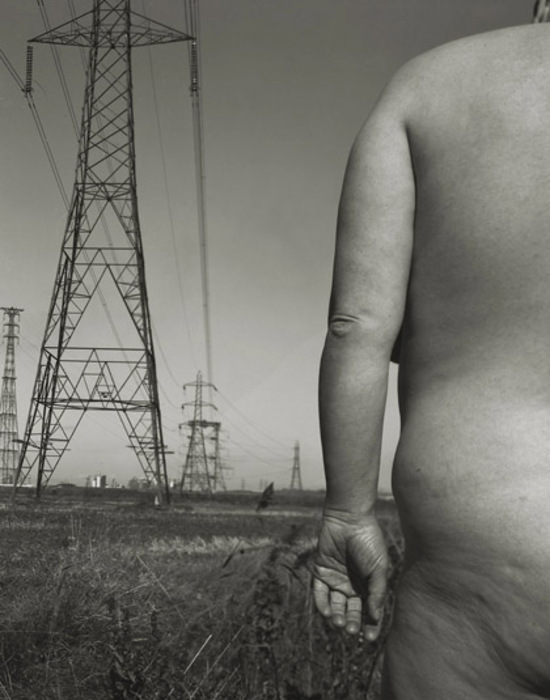
    ‘Industrialisation’ places the female figure between the viewer and the view beyond, challenging the male gaze and the objectification of women.
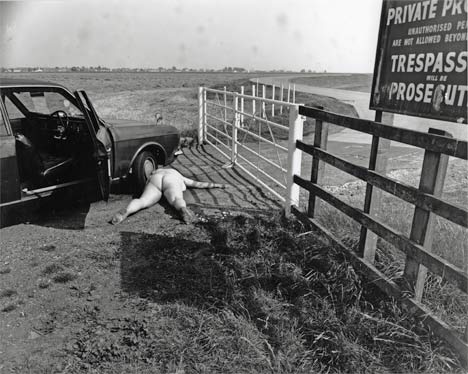
    ‘Victimisation’ “Here we see that the estate will not admit trespass, and that it stands in for the heroic (male) defender of the ground, repelling weak opposition at its border. Jo Spence failed to cross the barrier, allowing the absent landowner (through his gate and sign) to become hero, male, the creator of difference… her mockery diminishes the victory won by the landowner.” (John Taylor 1994, p.282 quoted Alexander p133)   ————————————-

    Jo Spence (1934–92) had a highly politicised approach to photography, creating photographs that run counter to the idealised imagery offered by advertising. Spence often worked collaboratively and sought alternative distribution models, laminating work for durability and renting out her photography to conferences, libraries, universities and public spaces to broaden its audience. She also documented her own struggles with cancer.

    Website: http://www.jospence.org


    ‘Putting Myself in the Picture’ (Camden Press 1986) brought together her raw and confessional works to inspire a younger generation of photographers.
    Remodelling Photo History (1982)  a series of self-portraits in collaboration with Terry Dennett. The work consists of a series of diptychs where two photographs of Spence are juxtaposed. In some pairs, the first is a parody of a more traditional pictorial image; the second shot is less conventionally framed and the irony is articulated with less subtlety.
    ‘Industrialisation’ places the female figure between the viewer and the view beyond, challenging the male gaze and the objectification of women.


    ‘Victimisation’ “Here we see that the estate will not admit trespass, and that it stands in for the heroic (male) defender of the ground, repelling weak opposition at its border. Jo Spence failed to cross the barrier, allowing the absent landowner (through his gate and sign) to become hero, male, the creator of difference… her mockery diminishes the victory won by the landowner.” (John Taylor 1994, p.282 quoted Alexander p133)

  • Dana Lixenberg

    My work is partly about the inevitable downside and consequences of capitalism which can result in a sense of alienation…actually I am part of it, and even people I photograph are part of this system and keep it going. I think [capitalism] has become a given because you can see how former and current communist countries are going the same way. I’m really aware of that, and want to face the realities and the downsides of that system that I find also attractive.

    I find that the [documentary] portraits and landscapes are really about slowing down, cutting out all the noise and really taking time to contemplate the world around me every time with new eyes. The plain and the everyday is often very exciting to me. It can reveal a lot about life. I’m really inspired by details and I am usually more inspired by non-dramatic settings. Some of my images may seem boring, where there is nothing obvious going on, but I like playing with that, being on the fringes of boring.

    While I have no expectation that I can influence social change or that I can ever make a concrete impact with the photographs, I do feel it’s kind of empowering to give the people you photograph a timeless presence in the larger world.

    Google images


    Interview for Mossless magazine

    Overview: http://www.thelastdaysofshishmaref.com/shishmaref3/cms/cms_module/index.php

    Film presentation:  http://www.thelastdaysofshishmaref.com/shishbook/shishbook_release-1.1.11/MainView.html 

    The Last Days of Shishmaref (2008) by Dana Lixenberg mixes landscape with formal portraits and still life to create a dynamic portrait of an Alaskan community that is under imminent threat from the sea due to the increasingly later freeze of the protective permafrost that encircles the island. The traditions of this community, mostly of Inuit origin, are just as much under threat as the precarious strip of land. The images in the book are informed with essays by geographers and environmentalists.

    Lixenberg’s trademark is a 4×5 camera and tripod. This gives an intensity of experience between the photographer and those she photographs that she feels is not there with other types of cameras. She enjoys illustrating contrast in her work and portraying people in pure form.

    Biography

    Dana Lixenberg (born in Amsterdam, The Netherlands,1964) lives and works in New York and Amsterdam. Lixenberg originally went to New York to become an au pair and then discovered photography at a night school class. She studied Photography at the London College of Printing in London (1984-1986) and at the Gerrit Rietveld Academie in Amsterdam (1987-1989).

    Her breakthrough in the U.S. came in 1993, when she was awarded a project grant by the Fonds BKVB (The Netherlands Foundation for Visual Arts, Design and Architecture) for a series of portraits at the Imperial Courts Housing Project in Los Angeles,CA. She was soon getting commissions from a wide variety of magazines such as Vibe, The New York Times Magazine, The New Yorker, Newsweek and The Telegraph magazine amongst many others.

    Lixenberg continuously worked on long term personal projects, mostly focused on individuals and communities on the margins of society. Lixenberg has been the recipient of several project and publication grants in the Netherlands.

    • 1999 she was the subject of a documentary titled: Dana Lixenberg, thru dutch eyes 
    • 2005 she was featured in an episode of the documentary series ‘Hollands Zicht’ (Dutch Vision) both for Dutch television.
    • 2005 Jeffersonville, Indiana was awarded Best Dutch Book Design,
    • 2008 The Last Days of Shishmaref, was also awarded Best Dutch Book Design, 2008.

    Since 2008 Lixenberg has been revisiting the Imperial Courts Housing Project in Los Angeles for a follow up to the series from 1993. In spring 2015 Huis Marseille, Amsterdam will organize a large scale exhibition of Imperial Courts coinciding with the release of a publication.

    Other work

    Lixenberg photographs people from all social classes.

    I’ve never taken a different  approach between photographing celebrities and un-known individuals,  The fragility of life is experienced by all. ..When shooting people who have had a lot of media exposure I’m not interested in reinforcing their public image. I try to really see the person that’s in front of me, the way they are at that particular moment stripped from all the surrounding distractions like their entourage and to slowly bring them to a place where they don’t present a persona basically where they don’t try to hard. 

    In addition to ordinary people, Lixenberg has photographed a number of American celebrities, including Prince and Whitney Houston.

    Lixenberg is also a film director and directed the Dutch singer Anouk’s 2005 video ‘One Word’


  • Brassai

    The flâneur archetype takes different forms but can easily be identified in the figure of Brassaï (1899–1984) who embodies Rebecca Solnit’s description of the flâneur as “… the image of an observant and solitary man strolling about Paris” (Solnit, 2001, p.198). Brassaï photographed, in both senses, the darker side of Paris. He photographed transvestites and homosexuals at underground bars and clubs, and he photographed the streets of Paris extensively at night, published in the celebrated Paris by Night (1933).

    Brassaï (1899-1984) was a Hungarian-born French photographer who created countless iconic images of 1920s Parisian life.

    He moved to Paris in 1924, working as a journalist and joined a circle of Hungarian artists and writers. His seminal book Paris de Nuit (Paris by Night 1933) documented the nightlife of prostitutes, street cleaners, and other scenes in his neighborhood of Montparnasse.

    He also documented high society, including the ballet, opera, and intellectuals—among them his friends and contemporaries, Pablo Picasso, Salvador Dalí, Alberto Giacometti, and Henri Matisse. He was also interested in graffiti, seeing it as a form of Outsider Art that could open the door for new artistic expression.

    His black and white images are very dark and moody with large areas of clipped black with rim lighting have influenced my work in Assignment 2.1 Bridge.

    Showcases some of his most iconic photos

  • Gillian Wearing

    https://www.tate.org.uk/art/artists/gillian-wearing-cbe-2648

    Gillian Wearing is a contemporary British artist whose conceptually driven photographs and videos investigate power dynamics and voyeurism in everyday life. Focused more on capturing the self-awareness of her subjects than on issues of aesthetics, Wearing employs prosthetic masks, voice dubbing, altered photographs, in her portraits of herself, individuals, and groups. This is especially notable in her series of work Signs that Say What You Want Them To Say and Not Signs that Say What Someone Else Wants You To Say (1992-1993), in which the artist confronted strangers and asked them write what they were thinking, then photographed them holding the sign. “It’s always important as an artist to find a unique language, and that’s why the Signs excited me,” she said of her series. “They felt new. But I didn’t realize they were going to be so influential, on everything from advertising to people doing signs for their Facebook page.” Born in 1963 in Birmingham, United Kingdom, she moved to London in 1983, studying first at the Chelsea School of Art then Goldsmiths College where she became a part of the Young British Artists generation alongside Damien Hirst. In 1997, the artist was the winner of the prestigious Turner Prize for her 1996 piece “60 Minutes Silence“. She currently lives and works in London, UK. Today, Wearing’s works are held in the collections of The Museum of Modern Art in New York, the Tate Gallery in London, the Hammer Museum in Los Angeles, and the Hirshhorn Museum and Sculpture Garden in Washington D.C., among others. http://www.artnet.com/artists/gillian-wearing/

    https://awarewomenartists.com/en/artiste/gillian-wearing/

    https://www.theguardian.com/artanddesign/video/2012/mar/26/gillian-wearing-dancing-peckham-video