Category: Inspiration

  • Jacob Riis

    Danish-born Jacob Riis (1849–1914) was a pioneer in social documentary photography which included identifiable people and was one of the first photographers to use the new technology of magnesium flash. Riis photographed the flop houses where people were stacked at night
    on every available horizontal space. Again these were usually immigrants and Riis showed the squalor they inhabited in his book How the Other Half Lives (1890) which featured the infamous Mulberry tenements in New York.

    For a New York Times (2008) article on Riis visit:
    http://www.nytimes.com/2008/02/12/opinion/12tue4.html?th&emc=th

    Watch a 10-minute film clip about Riis and his use of the new magnesium flash:
    http://www.youtube.com/watch?v=EACoIbokOcc

  • Shirley Baker

    Images on Mary  Evans Picture Library

    Google Images

    Shirley Baker, (1932-2014), was one of the rare female photographers who chronicled life in the north of England from the 1950s onwards. Her street photography was in the ‘flaneuse’ tradition of Henri Cartier-Bresson and Robert Frank, whom she named as influences. Unposed snapshots of people going about their business were juxtaposed with telling graffiti. She had a great eye for composition that has been under-appreciated next to her compassionate documentation and concern for social injustice, with a particular focus on women and children.

    From the 60s, Baker taught photography at Salford College of Art and would always carry her camera modestly stowed in her handbag. In free periods, she began a body of work, spanning 15 years, of the social housing in the area that was being demolished as people lived in semi-derelict slums. Shirley’s work in Salford and Manchester (shot mainly between 1960 and 1973) captured a time of rapid social and economic change in the lives of working class people in Manchester and Salford.”It was a time of much change: people were turfed out of their homes and some squatted in old buildings, trying to hang on to the traditional life they knew.”

    Slum clearances, started in the 1930s, resumed in earnest in the 1950s, and in the twenty years between 1955 and 1975, around 1.3 million homes were demolished nationwide. When Shirley Baker began photographing the streets of her native Salford, it seemed that no-one was interested in recording the human story of these soon-to-be demolished communities. Old ladies sitting on doorsteps in a row of condemned houses, men with handcarts searching for refuse to be recycled, children playing inventively among rubble and abandoned cars. That she chose to preserve these moments on film, now seems like the only perceptive response to a vanishing environment. It was not until 1989 that her first book, Street Photographs: Manchester and Salford, was published and Baker began to be more widely appreciated.

    In addition to her work in Manchester and Salford, she spent a considerable amount of time capturing Camden Market at the height of punk. Her work was often humorous and she added over the years to collections such as owners who look like their dogs and people falling asleep in public.

    Remembering the work of Shirley Baker Phil Coomes  BBC

    Life

    (from Guardian Obituary)

    Born in Salford, to Alec, a furniture maker, and Josephine, a housewife, Shirley had an identical twin, Barbara, who would also become an artist. They both went as boarders to Penrhos College, in Colwyn Bay, from where during the second world war they were evacuated to Chatsworth House, in Derbyshire. Their parents were unfazed by their daughters pursuing the arts professionally after they left school.

    Baker married Tony Levy, a GP, in 1957, and the couple eventually settled in Wilmslow, Cheshire, where their daughter, Nan, was born in 1963. Baker never displayed any of her photographs around their home, although she did like to take pictures of the family. This perhaps summed up the private, almost secretive, nature of her work.

    When Baker studied  photography at Manchester College of Technology, there was only one other woman on the course. On finishing, Baker’s plan was to work in-house at a company, recording processes and producing promotional images. She started at Courtaulds fabric manufacturers before freelancing for other businesses and doing some journalism, including for the Guardian. Baker encountered difficulties getting a press card, so was unable to pursue photojournalism seriously, and believed she was only given the assignments deemed unsuitable for men. From the 60s, Baker taught photography at Salford College of Art.

    Baker kept photographing in later life and completed an MA in critical history and the theory of photography at the University of Derby in 1995. She joined the Mary Evans Picture Library in 2008, and in 2012 had solo shows in Oldham and Salford, with another planned for 2015 at the Photoraphers’ Gallery in London. She was always pleased when people who featured in her work came along to exhibitions. At the opening of the Lowry Gallery in 2000, the Queen not only viewed Baker’s photographs but met some of Baker’s subjects, too.


  • Documentary typologies for Eugenics

    Documentary typologies for Eugenics

    There was widespread interest in eugenics in Europe during the first half of the twentieth century. Eugenics is based on the idea that some characteristics are ‘better’ than others and that you can improve the human gene pool by encouraging reproduction between people with desirable genetic traits and discouraging reproduction amongst those with less desirable traits. Clearly the belief that some groups were inherently genetically inferior could be used as a justification for all kinds of behaviour, from colonial rule to modern day racism.

    Scientific Racism: The Eugenics of Social Darwinism.  one-hour BBC4 documentary

    Implicit in eugenics was the idea of classification or objective measuring – pigeon-holing people into particular groups according to their genetic characteristics and treating them accordingly. The Victorians, for example, believed that you could identify criminal ‘types’ through their facial characteristics.

    Photography was adopted as a useful tool to facilitate classification.It was manipulated and used by racists and propagandists  to endorse a ‘science’ to the public.  Such photography effectively dehumanised its subjects and turned them into research objects although its creators might have argued that it was simply documentary – showing what was there. It also served a journalistic function, publicising and legitimising racist organisations and ‘celebrities’ like Margaret Sanger.

    In America the eugenics movement was well funded and they produced plenty of indicative material.

    Francis Galton photographed immigrants as they arrived in America, often at Ellis Island. He identified 46 different races through measurement and through facial characteristics on photographs.  Charts were compiled to show what to expect visually of the Negroid Insane Criminal and the Negroid Criminal.  Margaret Sanger’s ‘Negro Project’ sought to restrict the black population, and thus improve the American population, through ‘planned parenthood’ masquerading as health care and family planning.

    For more on Malthusian eugenics and the Harlem Project,
    visit:

    The Nazis took this to the extreme by exterminating groups who failed to match the Aryan ideal – Jews, black people, homosexuals, Roma, people with learning disability – and eugenics fell into disfavour after World War II as a result.

    The Baldwin lecture and a perspective on post genome race:

    http://www.princeton.edu/president/speeches/20100309/

  • Luc Delahaye

    !!To be done

    Luc Delahaye (born France 1962) also describes history painting as a point of reference to his practice, although his process is very different to Wall’s. Delahaye, whose earlier career was in photojournalism, continues to make work around current, ‘newsworthy’ stories across the globe. Throughout his ongoing History series, Delahaye has attended political ceremonies and meetings, as well as recent and current war zones. Instead of using high-end digital equipment
    and hurrying to transmit his images to agencies before his competitors in the field, Delahaye uses large format analogue cameras to make large-scale gallery prints. His approach goes very much against the grain of modern photojournalism. While his images are not typically as sparse of people as the work of ‘late photographers’ working with similar equipment, they all have the
    presence and communicate the gravitas of the scenarios he depicts. Unlike photojournalism, there is no conspicuous attempt to reveal a ‘decisive moment’. Delahaye photographs at a discrete, but not disengaged, distance:
    “As Delahaye points out, his pictures highlight ‘the insignificance of my
    own position.’ They also entail a reversal of the history paintings they
    call upon, where the grandeur, spectacle and glory of war and figures
    of power were celebrated. There is little that is glorious here. Instead, his
    views show up the scale of things, very often putting them in perspective.”
    (Mark Durden ‘Global Documentary’ (2005) in Deutsche Börse Photography Prize 2005. London: The Photographers’ Gallery, p.13)

  • Jeff Wall

    Jeffrey “Jeff” Wall, OC, RSA (born September 29, 1946) is a Canadian artist best known for his large-scale back-lit cibachrome photographs and art history writing. Wall experimented with conceptual art while an undergraduate at UBC.

    Wall  produced his first backlit phototransparencies in 1977. Many of these are staged and refer to the history of art and philosophical problems of representation – our collective need to visualise and have our past confirmed. He creates cinema-like tableaux – singular images with large production values, which employ actors and set designers, and are meticulously constructed over time, often combining multiple negatives. Their compositions often allude to artists like Delacroix, Delaroche, Goya, Diego Velázquez, Hokusai, and Édouard Manet, or to writers such as Franz Kafka, Yukio Mishima, and Ralph Ellison.

    Dead Troops Talk

    In her final book Regarding the Pain of Others (2003) Susan Sontag uses Wall’s Dead Troops Talk (1992) – a tableau created in the studio with the help of actors – to conclude her discussion on the effects, or rather the ineffectiveness, of images of pain, suffering and violence. She writes:
    “Engulfed by the image, which is so accusatory, one could fantasize that
    the soldiers might turn and talk to us. But no, no one is looking out of
    the picture. There’s no threat of protest. They are not about to yell at us to
    bring a halt to that abomination which is war. They haven’t come back
    to life in order to stagger off to denounce the war-makers who sent them
    to kill and be killed. And they are not represented as terrifying to others,
    for among them (far left) sits a white-garbed Afghan scavenger, entirely
    absorbed in going through somebody’s kit bag, of whom they take no
    note, and entering the picture above them (top right) on the path winding
    down the slope are two Afghans, perhaps soldiers themselves, who, it
    would seem from the Kalashnikovs collected near their feet, have already
    stripped the dead soldiers of their weapons. These dead are supremely
    uninterested in the living: in those who took their lives; in witnesses – and
    in us. Why should they seek our gaze? What would they have to say to
    us? ‘We’ – this ‘we’ is everyone who has never experienced anything like
    what they went through – don’t understand . We don’t get it. We truly
    can’t imagine what it was like. We can’t imagine how dreadful, how
    terrifying war is; and how normal it becomes. Can’t understand, can’t
    imagine. That’s what every soldier, and every journalist and aid worker
    and independent observer who has put in time under fire, and had the
    luck to elude the death that struck down others nearby, stubbornly feels.
    And they are right.”
    (Sontag [2003] 2004, pp.112–13) quoted Alexander 2013 p??

    I begin by not photographing

    [wpdevart_youtube]2yG2k4C4zrU[/wpdevart_youtube]

     Pictures like poems

    [wpdevart_youtube]HkVSEVlqYUw[/wpdevart_youtube]

    Other work

    Wall has been a key figure in Vancouver’s art scene since the early-1970s. Early in his career, he helped define the Vancouver School and he has published essays on the work of his colleagues and fellow Vancouverites Rodney Graham, Ken Lum and Ian Wallace. His photographic tableaux often take Vancouver’s mixture of natural beauty, urban decay and postmodern and industrial featurelessness as their backdrop.

    http://whitecube.com/channel/in_the_studio/jeff_wall_in_the_studio_part_i/

     Presenting his first gallery exhibition in 1978 as an “installation” rather than as a photography show, Wall placed The Destroyed Room in the storefront window of the Nova Gallery, enclosing it in a plasterboard wall.

    Mimic (1982) typifies Wall’s cinematographic style. A 198 × 226 cm. colour transparency, it shows a white couple and an Asian man walking towards the camera. The sidewalk, flanked by parked cars and residential and light-industrial buildings, suggests a North American industrial suburb. The woman is wearing red shorts and a white top displaying her midriff; her bearded, unkempt boyfriend wears a denim vest. The Asian man is casual but well-dressed in comparison, in a collared shirt and slacks. As the couple overtake the man, the boyfriend makes an ambiguous but apparently obscene and racist gesture, holding his upraised middle finger close to the corner of his eye, “slanting” his eye in mockery of the Asian man’s eyes. The picture resembles a candid shot that captures the moment and its implicit social tensions, but is actually a recreation of an exchange witnessed by the artist.
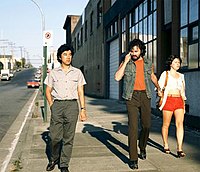
    Mimic (1982)

    First shown at documenta 11, After “Invisible Man” by Ralph Ellison, the Preface (1999–2001) represents a well-known scene from Ellison’s classic novel. Wall’s version shows us the cellar room, “warm and full of light,” in which Ellison’s narrator lives, complete with its 1,369 lightbulbs.[10]

    Picture for Women (1979). Art critic Jed Perl describes Picture for Women as Wall’s signature piece.

    Picture for Women is a 142.5 × 204.5 cm cibachrome transparency mounted on a lightbox. Along with The Destroyed Room, Wall considers Picture for Women to be his first success in challenging photographic tradition. According to Tate Modern, this success allows Wall to reference “both popular culture (the illuminated signs of cinema and advertising hoardings) and the sense of scale he admires in classical painting. As three-dimensional objects, the lightboxes take on a sculptural presence, impacting on the viewer’s physical sense of orientation in relationship to the work.”

    There are two figures in the scene, Wall himself, and a woman looking into the camera. In a profile of Wall in the The New Republic, art critic Jed Perl describes Picture for Women as Wall’s signature piece, “since it doubles as a portrait of the late-twentieth-century artist in his studio.”[12] Art historian David Campany calls Picture for Women an important early work for Wall as it establishes central themes and motifs found in much of his later work.[13]

    A response to Manet’s Un bar aux Folies Bergère, the Tate Modern wall text for Picture of Women, from the 2005-2006 exhibition Jeff Wall Photographs 1978–2004, outlines the influence of Manet’s painting:

    In Manet’s painting, a barmaid gazes out of frame, observed by a shadowy male figure. The whole scene appears to be reflected in the mirror behind the bar, creating a complex web of viewpoints. Wall borrows the internal structure of the painting, and motifs such as the light bulbs that give it spatial depth. The figures are similarly reflected in a mirror, and the woman has the absorbed gaze and posture of Manet’s barmaid, while the man is the artist himself. Though issues of the male gaze, particularly the power relationship between male artist and female model, and the viewer’s role as onlooker, are implicit in Manet’s painting, Wall updates the theme by positioning the camera at the centre of the work, so that it captures the act of making the image (the scene reflected in the mirror) and, at the same time, looks straight out at us.

    [14]

    Wall’s work advances an argument for the need for pictorial art. Some of Wall’s photographs are complicated productions involving cast, sets, crews and digital postproduction. They have been characterized as one-frame cinematic productions. Susan Sontag ended her last book, Regarding the Pain of Others (2003), with a long, laudatory discussion of one of them, Dead Troops Talk (A Vision After an Ambush of a Red Army Patrol near Moqor, Afghanistan, Winter 1986) (1992), calling Wall’s Goya-influenced depiction of a made-up event “exemplary in its thoughtfulness and power.”

    Jeff Wall A Sudden Gust of Wind (after Hokusai), 1993
    Katsushika Hokusai Yejiri Station, Province of Suruga, ca. 1832

    While Wall is known for large-scale photographs of contemporary everyday genre scenes populated with figures, in the early 1990s he became interested in still lifes. He distinguishes between:

    unstaged “documentary” pictures, like Still Creek, Vancouver, winter 2003

    “cinematographic” pictures, produced using a combination of actors, sets, and special effects, such as A Sudden Gust of Wind (after Hokusai), 1993. Based on Yejiri Station, Province of Suruga (ca. 1832) a woodprint by Katsushika Hokusai, A Sudden Gust of Wind recreates the depicted 19th-century Japanese scene in contemporary British Columbia, utilizing actors and took over a year to produce 100 photographs in order “to achieve a seamless montage that gives the illusion of capturing a real moment in time.”

    Since the early 1990s, Wall has used digital technology to create montages of different individual negatives, blending them into what appears as a single unified photograph. His signature works are large transparencies mounted on light boxes; he says he conceived this format when he saw back-lit advertisements at bus stops during a trip between Spain and London. In 1995, Wall began making traditional silver gelatin black and white photographs, and these have become an increasingly significant part of his work.

    http://whitecube.com/channel/in_the_gallery_past/jeff_wall_on_boy_falls_from_tree/


  • Shimon Attie

    website

    Wikipedia:

    Shimon Attie (born Los Angeles in 1957 ) is an American visual artist. He was awarded a Guggenheim Fellowship in 2008, The Rome Prize in 2001 and a Visual Artist Fellowship from Harvard University’s Radcliffe Institute for Advance Study in 2007. His work spans a variety of media, including photography, site-specific installation, multiple channel immersive video installation, performance, and new media. Much of Attie’s practice explores how a wide range of contemporary media may be used to re-imagine new relationships between space, time, place, and identity. Much, though not all, of Attie’s work in the 90s dealt with the history of the second world war. He aims to engage his audience in a direct confrontation with collective memory and the historical narrative of a place.

    The Writing on the Wall (1992–94)

    The work explores loss and trauma in relation to place. It consisted of a series of site-specific projections in Scheunenviertel, which was Berlin’s Jewish quarter. Through meticulous research, Attie used images from before the 1930s and projected these onto the remains of buildings, which have since been demolished as the area has been redeveloped. These ‘montages’ are very carefully arranged, so that pictorial elements from the projected photographs complement architectural details, such as windows and doorways. The resulting effects are provocative, ghost-like tableaux in a temporal transgression, where fractured narratives converge unnaturally in one space.

    See images

    Recent work

    More recent projects have involved using a range of media to engage local communities to find new ways of representing their history, memory and potential futures. Attie’s artworks and interventions are site-specific and immersive in nature, and tend to engage subject matter that is both social, political and psychological. In 2013, Shimon Attie was awarded the Lee Krasner Award for Lifetime Achievement in Art.

    See: http://www.shimonattie.net/index.php?option=com_content&view=article&id=13

    Lots of You Tube videos but rather long lectures

  • Peter Kane

    Significant Space (2005)

    See some of the images

    As part of the resolution to his Photography degree, Peter Kane revisited places depicted in his family’s photo album, which included himself as a boy. He travelled back to particular locations – some specific landmarks, others more non-descript parts of the landscape – and re-photographed the space according to the composition of the original photograph.

    In the bottom left of the frame of Kane’s new images, he holds the original photograph. The inclusion of Kane’s hand makes a physical connection between himself and the photograph. This is in sharp focus, and the space beyond, which he has revisited, falls out of focus. On a visual level, this split between the two focal planes instantly draws the viewer to the ‘vintage’ photograph. This strategy creates a deliberate dichotomy between the photograph that Kane presents – literally from his own ‘point of view’ – and the scenery beyond. It is as if the actual space beyond is eclipsed; it has lost its relevance and no longer bears any relation to Kane’s actual sense of the place.

    (Alexander 2013 p107)

    (I could not find anything more on the web.)


  • Eugene Atget

    The French photographer Eugène Atget (1857–1927) produced documentary photography that
    was far removed from the frontier of photojournalism. During a working life that lasted from
    1890 to 1927, Atget produced 10,000 images of Paris, working with a large format 24x18cm
    wooden camera and making and coating his own large glass plate negatives. Atget cared deeply
    about the small traders, street musicians, actors, artists, ribbon sellers, etc., who were being
    squeezed out of their livings by modernisation. He also cared for the architecture of the republic,
    much of which was crumbling and in a state of squalor, just waiting to be demolished. Atget
    was motivated more by the need to re-create, preserve and document the old city’s existence
    than by a desire to create imagery for sale.
    It’s not difficult to imagine these
    works as paintings. (Compare Atget’s
    Bitumiers with Gustave Caillebotte’s The
    Floor Scrapers, for example.) You’ll find
    more Atget images in the Bridgeman
    Art Library. Follow the link on the OCA
    student website. Some of Atget’s work
    showed surrealist elements. Look at his
    famous ‘corset shop’ photograph, for
    example.
    Project Photography as art
    Water Lilies Eugène Atget. Not Paris this time, but recognisably
    in a fine art tradition i.e. Monet.
    Bitumiers

  • Frank Newbould


    One of the most striking campaigns in relation to the developing mythology of the British rural landscape was a series of posters painted during 1942 by Frank Newbould (1887–1951).The resemblance between Newbould’s posters and travel advertising of the time is also worth noting. Substituting strap lines encouraging would be holidaymakers to explore their country with a command to defend it was a novel strategy.

  • Marcus Bleasdale

    Marcus Bleasdale (born 1968) is a photojournalist, born in the UK to an Irish family. He spent over eight years covering the brutal conflict within the borders of the Democratic Republic of Congo and has worked in many other places. Much of his work is linked to fundraising for aid and human rights agencies and there is often a link to ways t donate. His videos are extremely powerful and also discuss what people can do to change the situations the are seeing.

    His images are in both black and white and colour and he also does video. They get their power because he is well informed about what he is shooting and knows why he wants hat shot and also has access to people and situations most outsiders would not. But he also has an extraordinary sense of composition and tone. Some of his images at composited (no examples available for download) but I generally find these less powerful.

    http://www.marcusbleasdale.com/sources/ipad/index.php#home

    Rape of a Nation.    http://mediastorm.com/publication/rape-of-a-nation