
Category: UK

  • Justin Partyka

    website

    Summer Days in the Stour Valley

    Wander the path of a winding river and it will take you deeply into the experience of landscape. Through the summer days I walked the footpaths, fields, meadows and farm tracks of this bucolic river valley. The Stour Valley remains a timeless landscape that continues to be rooted to its past. In places it has remained relatively unchanged for centuries by escaping the impact of industrial agriculture. Of course, this is “Constable Country:” the heart of English landscape art. People come to this part of East Anglia to literally step into the scenes of Constable’s paintings, but I set out to find my own way of seeing the Stour Valley. I discovered it can be a place of wonderful afternoon light and this inspired the photographs I made. These photographs largely reject the celebrated grand vistas of the Stour Valley and instead offer an alternative way of looking at this landscape. They bring attention to the particular, the peculiar, and the poetic – highlighting the hidden places and scenes that are so often overlooked. But as I worked, the spirit of Constable was always there, lingering behind me in the fields.

    [These photographs were made during the summer months of 2012-2013.]

    Some Country

    “When we walk, we naturally go to the fields and woods….”
    (Henry David Thoreau, ‘Walking,’ 1862)

    Some Country continues my commitment to photographing rural East Anglia. Following the decade long work photographing the agrarian farmers of the region (Field Work), this new ongoing series explores the contemporary rural agricultural landscape of Norfolk and Suffolk. Moving beyond the farmer’s connection to the landscape, Some Country is reveals my own connection to rural East Anglia and includes photographs from the same fields and farm tracks that I explored during childhood. Once again, these photographs show my fascination with how man shapes the landscape, but they are also photographs about memory, personal experience, and how a prolonged connection to the landscape around us, makes us and shapes us.

    Some Trees

    As I have wandered the East Anglian landscape making the photographs for Some Country occasionally I have encountered trees that are so particular in their diginity and presence in the landscape that they suggest something beyond the country and become themselves the subject of a photograph.

    Fieldwork

    Gallery

    One of England’s most rural and agricultural regions, East Anglia is a place with a long history of people working the land. Here the Romans grew their wheat and barley, and a culture of family owned agrarian farms developed and flourished, continuing an agricultural tradition with a lineage extending back to the region’s peasant farmers of the early Middle Ages. But during the last 50 years things have changed. Most of the small farms are now gone.

    These photographs are from the East Anglian counties of Norfolk and Suffolk. They tell the story of those that remain – the stoical small-time farmers who continue to work the fields because it is all they know. They are the forgotten people of the flatlands, whose identity is intimately shaped by the landscape that surrounds them. Theirs is a way of life that is deeply rooted in the past. Traditional methods and knowledge are still very much depended upon. How best to plough, sow, hoe, and harvest a field to reap the best from it. The detailed histories and biographies of the local landscape. Farmers who have come and gone, from what direction the fox will come to steal a chicken, and who planted a particular oak tree and when. The old ways continue to work, so there is no need to change.

    For ten years Justin Partyka has been photographing throughout the East Anglian counties of Norfolk and Suffolk, exploring a world of rabbit catchers, reed cutters, and the region’s small-scale agrarian farmers. He calls them “the forgotten people of the flatlands,” who have an intimate relationship with the landscape that surrounds them. It is a way of life that is deeply rooted to the past and its traditional methods and knowledge. These photographs tell the story of these farmers and the fields they work, and clearly illustrate Partyka’s dedicated immersion into their world. His painterly use of colour and the unique qualities of the East Anglian light beautifully captures this timeless way of rural life.

    Field Work: Photographs from East Anglia is published in a limited edition of 100 signed and numbered books. Each book comes with a specially embossed slipcase and a 10 x 12

    Black Fen

    Black fen they call it round here. Black — for the peaty soil; black — for the mood of the area, for its history and for its future.
    — Mary Chamberlain, Fenwomen, 1975

    Black Fen is an ongoing series of photographs exploring the mysterious flatlands of the Fens. To drive across this landscape feels like crossing a great sea. The road undulates from the ever-shifting land, tossing the car like a small boat. Occasionally an unpaved drove branches off providing access to a house, farm buildings or fields deep in the middle of the fen. The presence of water is constant. A complex network of dykes and drains criss-crosses the fields, the murky waters rising and falling as the fenland locks and pumping stations work to prevent the water from taking back the land. All around is an abundance of crops which fight for space with an encroaching wildness of weeds and bushes that grow thick and fast out of the fertile earth. Once a place of swamps and marshes, this landscape exists because of the pioneering work of Cornelius Vermuyden and his fellow Dutch engineers, who in 1626 began draining the fens with the support of King Charles I. Today covering an area of almost 1,500 square miles in Eastern England, the Fens are one of the world’s largest areas of reclaimed land.

    Fen Women

    Fenwomen by Mary Chamberlain is a classic work of oral history. It was the first book by the feminist publisher Virago Press in 1975. Fenwomen is a unique documentary of women’s lives in the village of Isleham in the Cambridgeshire Fens. It tells the story of “women as labourers and labourers’ wives, whose daily toil for the survival of themselves and their families had never been acknowledged, much less lauded.”

    This new edition of the book by Full Circle Editions features 23 new photographs by Justin Partyka specially commissioned for this publication. Taken in and around Isleham during 2010, these photographs present a portrait of the village over thirty years since the oral history was originally collected. Much has changed in the village, but as these photographs reveal, Isleham’s strong sense of place is still intimately shaped by the mysterious flat fenlands that surround it.

    Saskatchewan

    Covering an area of 251, 700 square miles, the province of Saskatchewan is almost three times the size of Great Britain, yet it has a population of only 1, 010, 146. For such a big place, the rest of the world seems to know very little about Saskatchewan, if anything at all. Even in Canada, the majority of Canadians asked about Saskatchewan have never been there and have no desire to go. Those that have driven through the province say that, “there is nothing there, just endless wheat fields.”
    Saskatchewan is the place you pass through to get somewhere else. But hidden amongst the wheat fields is a rich and diverse, deeply traditional prairie culture. It is an eclectic mix of Hutterite colonies, Indian reservations, stock car racing, and cowboys; towns and cities which rise out of the landscape with their seductive names like Moose Jaw, Big Beaver, and Buffalo Gap, along with the main industry of grain farming.
    In 2005 Saskatchewan celebrated its centennial year. But as the pioneering spirit of the province’s founders is remembered, rural life is experiencing a major decline. The many abandoned farms which scar the landscape are a testimony to this. Although Saskatchewan is still predominately agricultural, today seventy percent of the population live in towns and cities. Many years of poor grain prices, along with the dominance of corporate agribusiness are destroying the cultural landscape of the province, where 20,000 small farms have closed since 1986 alone. As DeNeen Brown highlights in a story in the Washington Post (Oct 25, 2003): ‘Towns throughout Canada’s prairies are dying slow deaths. All along the highways of Saskatchewan abandoned buildings lean against the prairie wind, which blows through the cracked windows of houses deserted by the families who traded them for a few thousand dollars or for the cars they drove away.’

    However, the people that remain and call Saskatchewan home express a deep passion for and understanding of prairie life: an acceptance of the endless space and the loneliness it brings, but also the importance of community in a world of rural isolation. And underlying it all is a deep sense of place–an intimate relationship with the inescapable open landscape which surrounds everything and everyone.

    [This project has developed into a collaboration with the Saskatchewan writer Ken Mitchell, taking the form of an image and word performance and a future book. In 2015 – 2016 Justin will be returning to Saskatchewan to make new photographs.]
  • British Landscape Photography

    ‘Landscape for Everyone’, published in John Taylor (1994) A Dream of England: Landscape, Photography and the Tourist’s Imagination.

    In this piece Taylor discusses the ways in which symbolism of the ‘timeless’ and ‘infinitely different and varied’ English landscape was used during World War II to encourage patriotic emotion and resistance against German ‘industrialisation gone riot’. In 1940 many restrictions were imposed on movement around the countryside and measures were taken to make the geography ‘illegible’ to any invading force. At the same time “the mythic history of the country ‘unconquered for a thousand years’ was central to patriotic propaganda which imagined England to be magical, and centred on the village, the squire and the sense of a community close to the past and to nature. This variegated but close-knit aspect of the English landscape meant that it would ‘triumph’ even if the enemy invaded. ‘ (p198)

    Images of the countryside in books and magazines like ‘Picture Post’ emphasised its wholeness ‘belonging to everyone’, underplaying pre-war class conflicts over rights of access. Pictures of ‘sublime’ mountains now had city children evacuees to emphasise the disruption of ‘nature’. Particular landmarks took on symbolic meaning – people looking up for signs of threat and salvation at the cliffs of Dover.“The cliffs at Dover came to stand for a complete ring of natural bulwarks. Moreover, the white cliffs remained unsullied. The barrier of the cliffs also stood in for a message of farewell and recognition as airmen, and troops later, left them behind and returned to them as a marker of what was to be the absolute and inviolate boundary of the country.” 

    What really strikes me on re-reading this article after the Brexit campaign, is how these same images of the British countryside are still manipulated as a symbol of independence and freedom. European regulation and migrants coming in and taking over our green and pleasant land. Whereas heartlands of Brexit like East Anglia – which felt like a very hostile place and not at all ‘my country’ (though I am white British and lived here all my life though partly French) would come to a complete standstill without the (very exploited) migrant labour. Big farms (some owned by Arab princes it seems) replacing this Eastern European labour with technology is likely to be far more environmentally disruptive, let alone removal of the many EU environmental protections seen as ‘red tape’.

    This is more than a romantic need to hark back to some mythical past in the midst of chaotic change (which has always occurred, starting with prehistoric forest clearances, let alone Viking and medieval carnage, then the Tudor enclosures). A means by which privileged classes in the countryside can protect their interests through creating a common identity of ‘countryfolk’.  It also reflects the need of urban populations (including those living in areas of serious deprivation) to think that somewhere else is cleaner and more healthy – lungs somewhere else to make the urban pollution and waste somehow sanitised and acceptable (despite all the scientific evidence that our whole lifestyle needs urgently to change).


  • Clive Landen

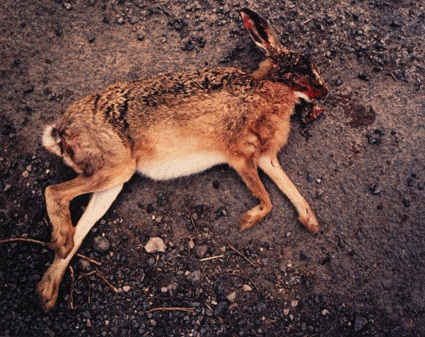
    Clive Landen is a British wildlife photographer concerned with our relationship with animals. His pictures are quite explicit and upsetting to view, but he photographs horror with profound sensitivity and an almost painterly quality that makes us really look at the subject matter.

    The Abyss  series about the 2001 Foot and Mouth outbreak (only one photograph now available on line?). Landen began this project because restrictions meant that he couldn’t pursue his work on the relationship between the land and hunting. The impetus also came from childhood memories of the foot and mouth outbreak of 1967. Whilst the body of work is a pertinent historical document, it is also a personal one. Landen collaborated with the military and was seconded to a regiment, which allowed him free rein to access the sites where cattle were being burned and buried. He describes a photograph of one dead sheep amongst many as a “portrait of the sheep which looks benign, at peace.” (Landen (2007) in Source no. 51.)   His landscape containing a row of dead dairy cows and skeletons of trees is one of the most moving of the series. The pall of smoke that clung to these sites is visible, providing an almost painterly, pictorialist quality.

    Familiar British Wildlife series of images of roadkills. Article Source magazine  Camera Club images


  • Ingrid Pollard

    Website

    Through her practice, Guyanese-born artist Ingrid Pollard addresses her feelings towards the rural countryside as a non-white British subject, articulating her profound sense of being an outsider to these spaces. In some of her projects, Pollard hand tints black-and-white prints. This strategy has a dual purpose: firstly, it is a play on the idea of ‘colour’ in terms of race; and secondly, the use of this antiquated process immediately refers to nostalgic, romanticised ideals of the British landscape.

    In Miss Pollard’s Party (1993), Pollard parodies the tourist postcard, placing her own hand-tinted images on a template depicting ‘Wordsworth Heritage’.

    In Pastoral Interlude (1987) Pollard juxtaposes photographs of figures in the landscape (some of which are herself) with more subversive captions, such as: “It’s as if the Black experience is only lived within an urban environment. I thought I liked the Lake District; where I wandered lonely as a Black face in a sea of white. A visit to the countryside is always accompanied by a feeling of unease; dread.”

    Ingrid Pollard is unusual in that her practice addresses not only her sense of identity as a nonwhite British subject in the UK, but also her experience in relation to the countryside. What Pollard’s work also shows is that the concept of ‘environment’ in relation to the influence of a sense of place transcends geographical concerns alone. Whether a more deep-seated dichotomy exists between the interests of those from or living in the countryside and those in the towns is also a question that extends beyond UK borders.

    Listen to Ingrid Pollard talking about her work and landscape

    Source: Alexander p123

  • Nadav Kander

    Kander’s website (flash based)

    Nadav Kander (born December 1, 1961) is a London-based photographer, artist and director, known for his portraiture and landscapes.

    Kander was born in Tel Aviv, Israel. His father flew Boeing 707s for El-Al but lost his eye and was unable to continue flying. His parents decided to start again in South Africa and moved to Johannesburg in 1963. Kander began taking pictures when he was 13 on a Pentax camera. He states the pictures that he took then and until he was 17, although unaccomplished, have the same sense of quiet and unease that is part of his work today. After being drafted into the South African Air Force, Kander worked in a darkroom printing aerial photographs. It was there he became certain he wanted to be a Photographer. He moved to London in 1986, where he still resides with his wife Nicole and their three children.

     Yangtze – The Long River (2010)

    Kander is best known for his Yangtze – The Long River series, for which he earned the Prix Pictet Prize. See images

    [wpdevart_youtube]QHZ5VhYveKg[/wpdevart_youtube]

    Kander uses the course of the Yangtze as a strategy to travel through the hugely diverse topography and geography of China. Kander made several voyages along the course of China’s Yangtze River, travelling upstream from mouth to source over a period of three years.

    The actual river features prominently. Using the river as a metaphor the journey begins at the coastal estuary, where thousands of ships leave and enter each day, and moves past renowned suicide bridges, coal mines and the largest dam in the world – the Three Gorges Dam. Further inland we encounter Chongqing – the fastest-growing urban centre on the planet. Kander never photographed further than twenty miles from the river itself. In the shadow of epic construction projects we see workers, fishermen, swimmers and a man washing his motorbike in the river. Dense architecture gives way to mountains in the upper reaches towards the river’s Tibetan source – a sparsely populated area where the stream is mostly broken ice and just ankle deep. The photographs are dominated by immense architectural structures where humans are shown as small in their environment. Figures are dwarfed by landscapes of half completed bridges and colossal Western-style apartment blocks that are rapidly replacing traditional Chinese low-rise buildings and houseboats.

    In Kander’s images, we are also confronted with a terrifying reality: this time it is not the feral landscape that startles us, but the bleak facts about man’s unstoppability. Kander manages to communicate a sense of its epic scale, and also the environmental impact the habitations along its banks are having upon the climate more generally. His murky, smog-filled scenes are unashamedly value-laden – to show how Kander feels China is losing its roots.

    His working method: he does not plan everything in advance. But uses the photographic process as a means of discovering more and more what resonates with him. He went back to China 5 times, taking fewer but more focused pictures each time.

    Other works

    In 2010- 2012 Kander photographed a series of nudes – Bodies. 6 Women. 1 Man – in his London studio. Coated in white marble dust and set against the void of the photographer’s studio the subjects serve as a study of the human condition.

    Rooted in an interest in the ‘aesthetics of destruction’ Kander’s most recent project Dust explores the vestiges of the Cold War through the radioactive ruins of secret cities on the border between Kazakhstan and Russia. Will Self has said These images do not make beautiful what is not, they ask of us that we repurpose ourselves to accept a new order of both the beautiful and the real.

    On 18 January 2009 Kander had 52 full colour portraits published in one issue of The New York Times Magazine. These portraits were of the people surrounding US President Barack Obama, from Joe Biden (Vice President) toEugene Kang (Special Assistant to The President). This is the largest portfolio of work by the same photographer The New York Times Magazine has showcased in one single issue.[3]

    In July 2012 Kander exhibited at the National Portrait Gallery in London with a series of portraits celebrating London’s hosting of the 2012 Summer Olympics. In 2014 Nadav was among the 18 photographers chosen to be a part of Constructing Worlds: Photography and Architecture in the Modern Age, an exhibition at the Barbican Centre in London, and toured, which explored the ability of architectural photography to reveal wider truths about our society.

    Kander is a Trustee of the The Lowry. He is represented by Flowers Gallery – London, M97 Gallery – Shanghai, Blindspot Gallery – Hong Kong and Camera Work Photographie – Berlin.

    Publications

  • Chris Coekin

    Chris Coekin website

    [wpdevart_youtube]PLiBW7cX26I[/wpdevart_youtube]

    Chris Coekin’s monograph The Hitcher (2007) documents several years of hitchhiking throughout the UK. Coekin was drawn to hitchhiking as a unique form of transport, which relies upon the generosity of strangers and demands relinquishing some control over route or even destination. The Hitcher comprises self-portraits and incidental details that illuminate his journey (rubbish, mushrooms, prophylactics…), taken on a compact consumer camera, the quality of which reflects the impromptu nature of the project.

    The Hitcher series 1

    The Hitcher series 2 focuses on portraits of the drivers

    The Hitcher series 3 focuses on objects along the way – dead rabbits, cigarette packets

    These anecdotal images perhaps illustrate the sense of pace of the road, which is subverted by drawing upon details of litter and other detritus that are impossible to take in when travelling in a car at speed. Coekin also used hitchhiking as a means to collect portraits. After drivers dropped him off, he would ask to take their portrait. For Coekin, what was so distinctive about this approach was the fact that the process removed responsibility from the photographer to select whom he wanted to photograph.

    In the book’s introductory essay, Camilla Brown contrasts Coekin’s method to traditional approaches in documentary, which, in spite of photographers’ best efforts to the contrary, invariably remain voyeuristic: “They [the drivers] effectively selected themselves to become part of the work, through their split-second decision to give him a ride. This is interesting when one compares it to other journeys recorded by photographers who are part of the social documentary tradition, in which it is the photographer who decides whom and what to photograph. The subjects are usually unaware that they have become part of a body of work. Even those that are called ‘concerned photographers’, who live in amongst the people they photograph, remain in a voyeuristic perspective – outside of, and separate to, the subjects of the work. Coekin’s project is by its very nature much more participative, and there is a different level of exchange between the photographer and those who are photographed. They all have the choice to take part, and invariably they are happy to oblige.”

    Source Alexander 2013.

  • Paul Graham

    Paul Graham website

    Paul Graham archive Great North Road

    Great North Road Vimeo

    Paul Graham (UK, 1956) belongs to that generation of photographers who were amongst the last to engage with the medium before it became part of the broader contemporary art world.

    At the beginning of the 1980’s Graham was among the first photographers to unite contemporary colour practise with the ‘documentary’ genre. In 1981/2 he completed ‘A1 – The Great North Road‘– The Great North Road (1983) , a series of colour photographs from the length of the British A1 road, which had a transformative effect on the black and white tradition that dominated British photography to that point. A1  is held up as a turning point within British documentary photography – when it became legitimate to use colour instead of black-and-white. The road itself features rarely in the 41 plates that make up the monograph; much of Graham’s attention is drawn to the various cafés and service stations along the route. The series is almost completely devoid of any recognisable landmarks (i.e. places of social or historical significance), and might easily be taken for any major British road. Rather than the A1 as simply an object of study, Graham uses it to transect the north / south divide: the road becomes a means of investigation.

    This work, along with his other photographs of the 1980’s – the colour images of unemployment offices in ‘Beyond Caring‘ (1984-85), and the sectarian marked landscape of Northern Ireland in ‘Troubled Land‘ (1984-86) – were pivotal in reinvigorating and expanding this area of photographic practice, by both broadening it’s visual language, and questioning how such photography might operate. Many UK photographers moved to colour soon after, and a new school of British Photography evolved with the subsequent colour work of Richard Billingham, Tom Wood, Paul Seawright, Anna Fox, Simon Norfolk, Nick Waplington, etc.

    Since then Graham moved outside of his UK roots, but continued to explore the fertile territory where the descriptive and artistic aspects of photography coalesce, often tackling difficult subject matter for a medium that engages with the observable world.

    ‘New Europe‘ (1988-1993) used a poetic flow of images to look at the tension between the shadow of history and the rush to an economic superstate in Western Europe.

    ‘Empty Heaven‘ (1989-1995), considers the relationship between historical trauma and the child-like fantasy world in Japan – themes that would later become central to the ‘Superflat’ movement of contemporary Japanese art.  in

    ‘End of an Age‘ (1996-98)More recently his work has reflected an examination of what we expect from a photographic image, be it a portrait – as in these hard:soft images of young people

    ‘American Night‘ (1998-2003) reflects the landscape and social fracture of America through overexposed, near invisible white images. Examining what actually registers in our sight with

    Graham moved to the United States in 2002, where he completed ‘a shimmer of possibility‘ (2004-2006) which embraces everyday moments of life in todays United States, whilst embracing time’s flow as a part of still photographic work through extended sequences of images.

    Most recently, ‘The Present‘, completed this trilogy of works in the USA, with doubled moments taken unstaged from the streets of New York. These diptych works are separated only by a fraction of a second, yet highly specific focus shifts awareness between the images.

    This unofficial trilogy of USA works – ‘American Night‘, ‘a shimmer of possibility‘ and ‘The Present‘, each embrace one of the 3 principle controls of the camera: Aperture, Shutter and Focus. As the aperture controls the light, the shutter controls time, and focus specifies what we look at, the trilogy of American works could also be described as engaging with Light, Time and Consciousness.


  • Francis Frith

    Francis Frith postcards website

    edited from Wikipedia article

    Francis Frith Images

    Francis Frith  (1822 –1898) was an English photographer of the Middle East and many towns in the United Kingdom. Frith was born in Chesterfield, Derbyshire.  In 1850 he started a photographic studio in Liverpool, known as Frith & Hayward. A successful grocer, and later, printer, Frith fostered an interest in photography, becoming a founding member of the Liverpool Photographic Society in 1853. Frith sold his companies in 1855 in order to dedicate himself entirely to photography.

    Frith was “recorded” as a Quaker minister in 1872 (at this time there were little more than 250 recorded ministers in England and Wales). He served on numerous committees, and frequently spoke in favour of pacifism and abstinence.  In 1884, he published (with William Pollard and William Turner) A Reasonable Faith, a highly controversial pamphlet which challenged evangelical orthodoxy by questioning the factuality of the Bible. Francis Frith and his co-authors who began the liberalisation of the Quaker movement and paved the way for the philanthropic and educational reforms for which the movement is well known today.

    Middle East Travels

    He journeyed to the Middle East on three occasions, the first of which was a trip to Egypt in 1856 with very large cameras (16″ x 20″). He used the collodion process, a major technical achievement in hot and dusty conditions.

    During his travels he noted that tourists were the main consumers of the views of Italy, but armchair travellers bought scenes from other parts of the world in the hope of obtaining a true record, “far beyond anything that is in the power of the most accomplished artist to transfer to his canvas.” These words express the ambitious goal that Frith set for himself when he departed on his first trip to the Nile Valley in 1856.

    Restored albumen print of the Suez Canal at Ismailia, c. 1860

    The Hypaethral Temple, Philae, by Francis Frith, 1857; from the collection of the National Galleries of Scotland


    He also made two other trips before 1860, extending his photo-taking to Palestine and Syria.

    In addition to photography, he also kept a journal during his travels elaborating on the difficulties of the trip, commenting on the “smothering little tent” and the collodion fizzing – boiling up over the glass. Frith also noticed the compositional problems regarding the point of view from the camera. According to Frith, “the difficulty of getting a view satisfactorily in the camera: foregrounds are especially perverse; distance too near or too far; the falling away of the ground; the intervention of some brick wall or other common object… Oh what pictures we would make if we could command our point of views.” An image he took known as the “Approach to Philae” is just one example which elaborates his ability to find refreshing photographic solutions to these problems. (cited from “A World History of Photography”)

    Survey of Britain and Francis Frith & Co. 

    When he had finished his travels in the Middle East in 1859, he opened the firm of Francis Frith & Co. in Reigate, Surrey, as the world’s first specialist photographic and postcard publisher, a firm that became one of the largest photographic studios in the world. In 1860, he married Mary Ann Rosling (sister of Alfred Rosling, the first treasurer of the Photographic Society).

    The same year he embarked upon a colossal project—to photograph every city, town and village in the United Kingdom; in particular, notable historical or interesting sights. Initially he took the photographs himself, but as success came, he hired people to help him. Frith’s ‘views’ were predominantly of places with social or historical significance but also included a great number of more mundane but equally valuable street scenes.

    Frith died in Cannes, France at his villa on 25 February 1898.

    The ten-part BBC series Britain’s First Photo Album, presented by John Sergeant, was first shown on BBC2 in March 2012 and takes a look at the history of Francis Frith’s pioneering photographic work. A 320 page book also entitled Britain’s First Photo Album has been published. The Frith and Co. brand continues today, and it’s possible to purchase prints and other merchandise from the online store.

    Graham Clark (1997, p.73) remarks:
    “… the landscape photograph implies the act of looking as a privileged observer so that, in one sense, the photographer of landscapes is always the tourist, and invariably the outsider. Francis Frith’s images of Egypt, for example, for all their concern with foreign lands, retain the perspective of an Englishman looking out over the land. Above all, landscape photography insists on the land as spectacle and involves an element of pleasure.”


  • John Thomson

    edited from Wikipedia article

    Google images

    John Thomson (14 June 1837 – 29 September 1921) was a pioneering Scottish photographer, geographer and traveller. He was an accomplished photographer in many areas: landscapes, portraiture, street-photography, architectural photography. He was one of the first photographers to travel to the Far East, documenting the people, landscapes and artifacts of eastern cultures for his Victorian audience.  He was however more concerned with the socio-economic situation of the people whose land he visited than landscape as a subject in  itself (Jeffrey, 1981, p. 64).

    On his return home, his pioneering work documenting the social conditions of the street  is regarded as a classic instance of social documentary which laid the foundations for photojournalism.  He went on to become a portrait photographer of High Society in Mayfair, gaining the Royal Warrant in 1881. His publishing activities mark him out as an innovator in combining photography with the printed word.

    The son of William Thomson, a tobacco spinner and retail trader, and his wife Isabella, Thomson was born the eighth of nine children in Edinburgh.  After his schooling in the early 1850s, he was apprenticed to a local optical and scientific instrument manufacturer, thought to be James Mackay Bryson. During this time, Thomson learned the principles of photography and completed his apprenticeship around 1858. In 1861 he became a member of the Royal Scottish Society of Arts.

    South East Asia 1862-1872: Singapore, Malaya, Sumatra, Siam, Cambodia and China

    Singapore

    In April 1862, Thomson left Edinburgh for Singapore to join his older brother William, a watchmaker and photographer, beginning a ten-year period spent travelling around the Far East. Initially, he established a joint business with William to manufacture marine chronometers and optical and nautical instruments. He also established a photographic studio in Singapore, taking portraits of European merchants, and he developed an interest in local peoples and places. He travelled extensively throughout the mainland territories of Malaya and the island of Sumatra, exploring the villages and photographing the native peoples and their activities.

    Siam and Cambodia

    [wpdevart_youtube]N1dC5fy4Phw[/wpdevart_youtube]

    After visiting Ceylon and India from October to November 1864 to document the destruction caused by a recent cyclone, Thomson sold his Singapore studio and moved to Siam. After arrival in Bangkok in September 1865, Thomson undertook a series of photographs of the King of Siam and other senior members of the royal court and government.

     Prea Sat Ling Poun, Angkor Wat, 1865.

    Inspired by Henri Mouhot’s account of the rediscovery of the ancient cities of Angkor in the Cambodian jungle, Thomson embarked on what would become the first of his major photographic expeditions. He set off in January 1866 with his translator H. G. Kennedy, a British Consular official in Bangkok, who saved Thomson’s life when he contracted jungle fever en route. The pair spent two weeks at Angkor, where Thomson extensively documented the vast site, producing some of the earliest photographs of what is today a UNESCO World Heritage Site.

    Thomson then moved on to Phnom Penh and took photographs of the King of Cambodia and other members of the Cambodian Royal Family, before travelling on to Saigon. From there he stayed in Bangkok briefly, before returning to Britain in May or June in 1866.

    While back home, Thomson lectured extensively to the British Association and published his photographs of Siam and Cambodia. He became a member of the Royal Ethnological Society of London and was elected a Fellow of the Royal Geographical Society in 1866, and published his first book, The Antiquities of Cambodia, in early 1867.

    There have however been accusations of plagiarism. In 2001 Phiphat Phongraphiphon, a Thai independent researcher in historical photography, published claims that Thomson plagiarised works by Thai court photographer Khun Sunthornsathitsalak (Christian name: Francis Chit) and published them as his own. Evidence to Phiphat’s claims include an analysis of a photograph in which the temple Wat Rajapradit, which was built before Thomson arrived in Bangkok, is missing.

    Travels in China 1868-1872

    Island Pagoda, about 1871, from the album, Foochow and the River Min


    Images from Travels in China

    [wpdevart_youtube]RXPC31yH1pQ[/wpdevart_youtube]

    [wpdevart_youtube]FV-13nn1aAE[/wpdevart_youtube]

    [wpdevart_youtube]v=zGgrQ6QKaGo[/wpdevart_youtube]

    After a year in Britain, Thomson again felt the desire to return to the Far East. He returned to Singapore in July 1867, before moving to Saigon for three months and finally settling in Hong Kong in 1868. He established a studio in the Commercial Bank building, and spent the next four years photographing the people of China and recording the diversity of Chinese culture.

    Thomson travelled extensively throughout China, from the southern trading ports of Hong Kong and Canton to the cities of Peking and Shanghai, to the Great Wall in the north, and deep into central China. From 1870 to 1871 he visited the Fukien region, travelling up the Min River by boat with the American Protestant missionary Reverend Justus Doolittle, and then visited Amoy and Swatow.

    He went on to visit the island of Formosa with the missionary Dr. James Laidlaw Maxwell, landing first in Takao in early April 1871. The pair visited the capital, Taiwanfu, before travelling on to the aboriginal villages on the west plains of the island. After leaving Formosa, Thomson spent the next three months travelling 3,000 miles up the Yangtze River, reaching Hupeh and Szechuan.

    Thomson’s travels in China were often perilous, as he visited remote, almost unpopulated regions far inland. Most of the people he encountered had never seen a Westerner or camera before. His expeditions were also especially challenging because he had to transport his bulky wooden camera, many large, fragile glass plates, and potentially explosive chemicals. He photographed in a wide variety of conditions and often had to improvise because chemicals were difficult to acquire. His subject matter varied enormously: from humble beggars and street people to Mandarins, Princes and senior government officials; from remote monasteries to Imperial Palaces; from simple rural villages to magnificent landscapes.

    Street Life in London

    Thomson returned to England in 1872, settling in Brixton, London and, apart from a final photographic journey to Cyprus in 1878, Thomson never left again. Over the coming years he proceeded to lecture and publish, presenting the results of his travels in the Far East. His publications started initially in monthly magazines and were followed by a series of large, lavishly illustrated photographic books. He wrote extensively on photography, contributing many articles to photographic journals such as the British Journal of Photography. He also translated and edited Gaston Tissandier’s 1876 History and Handbook of Photography, which became a standard reference work.
    In London, Thomson renewed his acquaintance with Adolphe Smith, a radical journalist whom he had met at the Royal Geographical Society in 1866. Together they collaborated in producing the monthly magazine, Street Life in London, from 1876 to 1877. The project documented in photographs and text the lives of the street people of London, establishing social documentary photography as an early type of photojournalism. The series of photographs was later published in book form in 1878.

    The Crawlers, London, 1876-1877


    He was elected a member of the Photographic Society, later the Royal Photographic Society, on 11 November 1879. With his reputation as an important photographer well established, Thomson opened a portrait studio in Buckingham Palace Road in 1879, later moving it to Mayfair. In 1881 he was appointed photographer to the British Royal Family by Queen Victoria, and his later work concentrated on studio portraiture of the rich and famous of High Society, giving him a comfortable living. From January 1886 he began instructing explorers at the Royal Geographical Society in the use of photography to document their travels.

    After retiring from his commercial studio in 1910, Thomson spent most of his time back in Edinburgh, although he continued to write papers for the Royal Geographical Society on the uses of photography. He died of a heart attack in 1921 at the age of 84. In recognition of his work, one of the peaks of Mount Kenya was named “Point Thomson”.

    A large collection of his glass negatives was donated to the Wellcome Library.  Some of Thomson’s work may be seen at the Royal Geographical Society’s headquarters in London.

    [wpdevart_youtube]1iHxiVW3wjA[/wpdevart_youtube]

    Selected publications

    • China Through the Lens of John Thomson 1868 -1872, River Books 2010.
    • The antiquities of Cambodia, 1867
    • Views on the North River, 1870.
    • Foochow and the River Min, 1873.
    • Illustrations of China and its people, 1873-1874 [1]
    • Street life in London, 1878
    • Through Cyprus with a camera in the autumn of 1878, 1879
    • Through China with a Camera,[7] 1898


  • Willie Doherty

    Willie Doherty (born 1959) is an artist from Northern Ireland, who has mainly worked in photography and video.

    His website images

    Doherty was born in Derry, Northern Ireland, and from 1978 to 1981 studied at Ulster Polytechnic in Belfast. Many of his works deal with The Troubles. As a child he witnessed Bloody Sunday in Derry, and much of his work stems from the knowledge that many photos of the incident did not tell the whole truth. Some of his pieces take images from the media and adapt them to his own ends.

    His works explore the multiple meanings that a single image can have. Some of Doherty’s earliest works are of maps and similar images accompanied by texts in a manner similar to the land art of Richard Long, except that here the text sometimes seems to contradict the image.

    Doherty’s video pieces are often projected in a confined space, giving a sense of claustrophobia. The videos themselves sometimes create a mood that has been compared to film noir.

    Doherty has acknowledged the importance of the Orchard Gallery in Derry as a venue where he could see modern art in his formative years. Doherty was shortlisted for the Turner Prize in 1994 and 2003, and has represented Ireland at the Venice Biennale in 1993, Great Britain at the São Paulo Art Biennial in 2003 and Northern Ireland at the 2007 Venice Biennale. He was a participant in dOCUMENTA