One of the most striking campaigns in relation to the developing mythology of the British rural landscape was a series of posters painted during 1942 by Frank Newbould (1887–1951).The resemblance between Newbould’s posters and travel advertising of the time is also worth noting. Substituting strap lines encouraging would be holidaymakers to explore their country with a command to defend it was a novel strategy.
Marcus Bleasdale (born 1968) is a photojournalist, born in the UK to an Irish family. He spent over eight years covering the brutal conflict within the borders of the Democratic Republic of Congo and has worked in many other places. Much of his work is linked to fundraising for aid and human rights agencies and there is often a link to ways t donate. His videos are extremely powerful and also discuss what people can do to change the situations the are seeing.
His images are in both black and white and colour and he also does video. They get their power because he is well informed about what he is shooting and knows why he wants hat shot and also has access to people and situations most outsiders would not. But he also has an extraordinary sense of composition and tone. Some of his images at composited (no examples available for download) but I generally find these less powerful.
Jo Spence (1934–92) had a highly politicised approach to photography, creating photographs that run counter to the idealised imagery offered by advertising. Spence often worked collaboratively and sought alternative distribution models, laminating work for durability and renting out her photography to conferences, libraries, universities and public spaces to broaden its audience. She also documented her own struggles with cancer.
Website: http://www.jospence.org‘Putting Myself in the Picture’ (Camden Press 1986) brought together her raw and confessional works to inspire a younger generation of photographers.
Remodelling Photo History (1982) a series of self-portraits in collaboration with Terry Dennett. The work consists of a series of diptychs where two photographs of Spence are juxtaposed. In some pairs, the first is a parody of a more traditional pictorial image; the second shot is less conventionally framed and the irony is articulated with less subtlety.
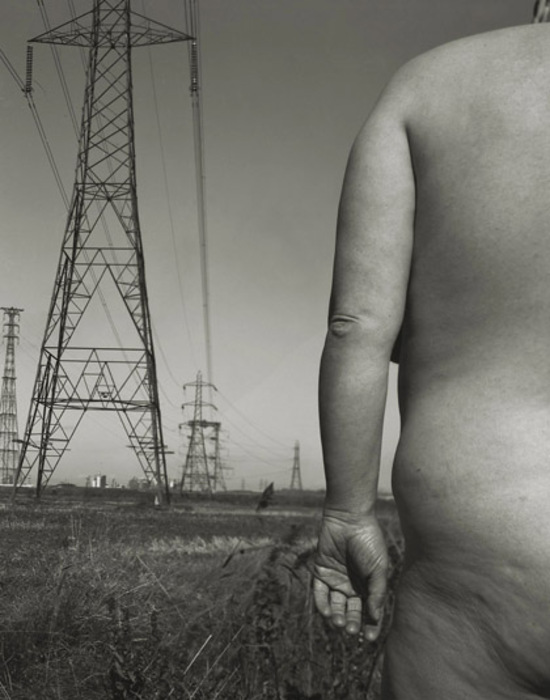
‘Industrialisation’ places the female figure between the viewer and the view beyond, challenging the male gaze and the objectification of women.
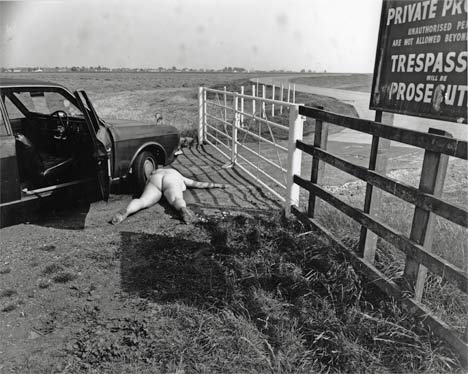
‘Victimisation’ “Here we see that the estate will not admit trespass, and that it stands in for the heroic (male) defender of the ground, repelling weak opposition at its border. Jo Spence failed to cross the barrier, allowing the absent landowner (through his gate and sign) to become hero, male, the creator of difference… her mockery diminishes the victory won by the landowner.” (John Taylor 1994, p.282 quoted Alexander p133)
————————————-
Jo Spence (1934–92) had a highly politicised approach to photography, creating photographs that run counter to the idealised imagery offered by advertising. Spence often worked collaboratively and sought alternative distribution models, laminating work for durability and renting out her photography to conferences, libraries, universities and public spaces to broaden its audience. She also documented her own struggles with cancer.
‘Putting Myself in the Picture’ (Camden Press 1986) brought together her raw and confessional works to inspire a younger generation of photographers. Remodelling Photo History (1982) a series of self-portraits in collaboration with Terry Dennett. The work consists of a series of diptychs where two photographs of Spence are juxtaposed. In some pairs, the first is a parody of a more traditional pictorial image; the second shot is less conventionally framed and the irony is articulated with less subtlety.
‘Industrialisation’ places the female figure between the viewer and the view beyond, challenging the male gaze and the objectification of women.
‘Victimisation’ “Here we see that the estate will not admit trespass, and that it stands in for the heroic (male) defender of the ground, repelling weak opposition at its border. Jo Spence failed to cross the barrier, allowing the absent landowner (through his gate and sign) to become hero, male, the creator of difference… her mockery diminishes the victory won by the landowner.” (John Taylor 1994, p.282 quoted Alexander p133)
Jonathan Miller writing about the book in the Independent
the capacity to resolve fine detail is confined to a surprisingly small area of the retina, the fovea, around which visual acuity falls off so steeply that it’s impossible to take in the details of a whole scene at a single glance. Try fixing your eyes on the last word of this sentence and see how difficult it is to read the surrounding text. The result of this restricted acuity is that our perception of the visual world has to be assembled in discrete installments. Although we are not explicitly aware of doing so we are constantly flicking our gaze from one part of the visual field to the next, and by bringing the specialised centre of the retina to bear on one sector of the scene after another we collect an anthology of sporadic snapshots from which we build up an apparently detailed picture of the world around us.
John Thomson (14 June 1837 – 29 September 1921) was a pioneering Scottish photographer, geographer and traveller. He was an accomplished photographer in many areas: landscapes, portraiture, street-photography, architectural photography. He was one of the first photographers to travel to the Far East, documenting the people, landscapes and artifacts of eastern cultures for his Victorian audience. He was however more concerned with the socio-economic situation of the people whose land he visited than landscape as a subject in itself (Jeffrey, 1981, p. 64).
On his return home, his pioneering work documenting the social conditions of the street is regarded as a classic instance of social documentary which laid the foundations for photojournalism. He went on to become a portrait photographer of High Society in Mayfair, gaining the Royal Warrant in 1881. His publishing activities mark him out as an innovator in combining photography with the printed word.
The son of William Thomson, a tobacco spinner and retail trader, and his wife Isabella, Thomson was born the eighth of nine children in Edinburgh. After his schooling in the early 1850s, he was apprenticed to a local optical and scientific instrument manufacturer, thought to be James Mackay Bryson. During this time, Thomson learned the principles of photography and completed his apprenticeship around 1858. In 1861 he became a member of the Royal Scottish Society of Arts.
South East Asia 1862-1872: Singapore, Malaya, Sumatra, Siam, Cambodia and China
Singapore
In April 1862, Thomson left Edinburgh for Singapore to join his older brother William, a watchmaker and photographer, beginning a ten-year period spent travelling around the Far East. Initially, he established a joint business with William to manufacture marine chronometers and optical and nautical instruments. He also established a photographic studio in Singapore, taking portraits of European merchants, and he developed an interest in local peoples and places. He travelled extensively throughout the mainland territories of Malaya and the island of Sumatra, exploring the villages and photographing the native peoples and their activities.
After visiting Ceylon and India from October to November 1864 to document the destruction caused by a recent cyclone, Thomson sold his Singapore studio and moved to Siam. After arrival in Bangkok in September 1865, Thomson undertook a series of photographs of the King of Siam and other senior members of the royal court and government.
Prea Sat Ling Poun, Angkor Wat, 1865.
Inspired by Henri Mouhot’s account of the rediscovery of the ancient cities of Angkor in the Cambodian jungle, Thomson embarked on what would become the first of his major photographic expeditions. He set off in January 1866 with his translator H. G. Kennedy, a British Consular official in Bangkok, who saved Thomson’s life when he contracted jungle fever en route. The pair spent two weeks at Angkor, where Thomson extensively documented the vast site, producing some of the earliest photographs of what is today a UNESCO World Heritage Site.
Thomson then moved on to Phnom Penh and took photographs of the King of Cambodia and other members of the Cambodian Royal Family, before travelling on to Saigon. From there he stayed in Bangkok briefly, before returning to Britain in May or June in 1866.
While back home, Thomson lectured extensively to the British Association and published his photographs of Siam and Cambodia. He became a member of the Royal Ethnological Society of London and was elected a Fellow of the Royal Geographical Society in 1866, and published his first book, The Antiquities of Cambodia, in early 1867.
There have however been accusations of plagiarism. In 2001 Phiphat Phongraphiphon, a Thai independent researcher in historical photography, published claims that Thomson plagiarised works by Thai court photographer Khun Sunthornsathitsalak (Christian name: Francis Chit) and published them as his own. Evidence to Phiphat’s claims include an analysis of a photograph in which the temple Wat Rajapradit, which was built before Thomson arrived in Bangkok, is missing.
Travels in China 1868-1872
Island Pagoda, about 1871, from the album, Foochow and the River Min
Images from Travels in Chinahttps://www.youtube.com/embed/RXPC31yH1pQ?autoplay=0&theme=dark&loop=0&fs=1&showinfo=1&modestbranding=0&iv_load_policy=3&color=red&autohide=1&disablekb=0&enablejsapi=1&version=3 https://www.youtube.com/embed/FV-13nn1aAE?autoplay=0&theme=dark&loop=0&fs=1&showinfo=1&modestbranding=0&iv_load_policy=3&color=red&autohide=1&disablekb=0&enablejsapi=1&version=3 https://www.youtube.com/embed/v=zGgrQ6QKaGo?autoplay=0&theme=dark&loop=0&fs=1&showinfo=1&modestbranding=0&iv_load_policy=3&color=red&autohide=1&disablekb=0&enablejsapi=1&version=3
After a year in Britain, Thomson again felt the desire to return to the Far East. He returned to Singapore in July 1867, before moving to Saigon for three months and finally settling in Hong Kong in 1868. He established a studio in the Commercial Bank building, and spent the next four years photographing the people of China and recording the diversity of Chinese culture.
Thomson travelled extensively throughout China, from the southern trading ports of Hong Kong and Canton to the cities of Peking and Shanghai, to the Great Wall in the north, and deep into central China. From 1870 to 1871 he visited the Fukien region, travelling up the Min River by boat with the American Protestant missionary Reverend Justus Doolittle, and then visited Amoy and Swatow.
He went on to visit the island of Formosa with the missionary Dr. James Laidlaw Maxwell, landing first in Takao in early April 1871. The pair visited the capital, Taiwanfu, before travelling on to the aboriginal villages on the west plains of the island. After leaving Formosa, Thomson spent the next three months travelling 3,000 miles up the Yangtze River, reaching Hupeh and Szechuan.
Thomson’s travels in China were often perilous, as he visited remote, almost unpopulated regions far inland. Most of the people he encountered had never seen a Westerner or camera before. His expeditions were also especially challenging because he had to transport his bulky wooden camera, many large, fragile glass plates, and potentially explosive chemicals. He photographed in a wide variety of conditions and often had to improvise because chemicals were difficult to acquire. His subject matter varied enormously: from humble beggars and street people to Mandarins, Princes and senior government officials; from remote monasteries to Imperial Palaces; from simple rural villages to magnificent landscapes.
Street Life in London
Images from Street Life in LondonThomson returned to England in 1872, settling in Brixton, London and, apart from a final photographic journey to Cyprus in 1878, Thomson never left again. Over the coming years he proceeded to lecture and publish, presenting the results of his travels in the Far East. His publications started initially in monthly magazines and were followed by a series of large, lavishly illustrated photographic books. He wrote extensively on photography, contributing many articles to photographic journals such as the British Journal of Photography. He also translated and edited Gaston Tissandier’s 1876 History and Handbook of Photography, which became a standard reference work.
In London, Thomson renewed his acquaintance with Adolphe Smith, a radical journalist whom he had met at the Royal Geographical Society in 1866. Together they collaborated in producing the monthly magazine, Street Life in London, from 1876 to 1877. The project documented in photographs and text the lives of the street people of London, establishing social documentary photography as an early type of photojournalism. The series of photographs was later published in book form in 1878.
The Crawlers, London, 1876-1877
He was elected a member of the Photographic Society, later the Royal Photographic Society, on 11 November 1879. With his reputation as an important photographer well established, Thomson opened a portrait studio in Buckingham Palace Road in 1879, later moving it to Mayfair. In 1881 he was appointed photographer to the British Royal Family by Queen Victoria, and his later work concentrated on studio portraiture of the rich and famous of High Society, giving him a comfortable living. From January 1886 he began instructing explorers at the Royal Geographical Society in the use of photography to document their travels.
After retiring from his commercial studio in 1910, Thomson spent most of his time back in Edinburgh, although he continued to write papers for the Royal Geographical Society on the uses of photography. He died of a heart attack in 1921 at the age of 84. In recognition of his work, one of the peaks of Mount Kenya was named “Point Thomson”.
A large collection of his glass negatives was donated to the Wellcome Library. Some of Thomson’s work may be seen at the Royal Geographical Society’s headquarters in London.https://www.youtube.com/embed/1iHxiVW3wjA?autoplay=0&theme=dark&loop=0&fs=1&showinfo=1&modestbranding=0&iv_load_policy=3&color=red&autohide=1&disablekb=0&enablejsapi=1&version=3
Selected publications
China Through the Lens of John Thomson 1868 -1872, River Books 2010.
The antiquities of Cambodia, 1867
Views on the North River, 1870.
Foochow and the River Min, 1873.
Illustrations of China and its people, 1873-1874 [1]
Street life in London, 1878
Through Cyprus with a camera in the autumn of 1878, 1879

 One of the most striking campaigns in relation to the developing mythology of the British rural landscape was a series of posters painted during 1942 by Frank Newbould (1887–1951).The resemblance between Newbould’s posters and travel advertising of the time is also worth noting. Substituting strap lines encouraging would be holidaymakers to explore their country with a command to defend it was a novel strategy.