Now that you’ve reached the end of this project on photography and feminism, try and produce an image that illustrates your feelings or approach to feminism using the technique of photomontage. It doesn’t matter whether you’re an active feminist or feel ambivalent or even hostile towards feminism in terms of producing this piece. Show your view!
Have a look at some Martha Rosler photos and photomontage to give you some ideas:
http://home.earthlink.net/~navva/photo/index.html
Choose a range of items that represent feminism as you see it and make a collage from photographs of your chosen items. Play with scale, perspective and colour. Black and white – spot colour – it’s your choice.
Feel free to use text to illustrate, i.e. as image rather than text. You can use parts of found images as long as the concept and major images are your own.
Produce one photo collage digitally.
Produce a second photo collage in a different, more tactile and responsive manner. Rephotograph the result.
Your collages should be 2:1 ratio, i.e. twice as long as wide.
Write up the experience in your learning log or blog and comment on how well the two production methods worked.
In this exercise you’ll consider stereotypes and how they come into being – nurses are kind and caring, youths in hoodies are waiting to break into your car.
Use the same person to model several different roles, as Cindy Sherman has done in some of her photo-series. You’ll decide what they will be but one of them must be genuine. The aim here is to get people to question what a doctor or a student or a politician looks like. If you can, provide suitable outfits – from your own wardrobe, borrowed from friends or bought from a charity shop.
Produce a set of three images, two false, one true. Show them to as many people you can and keep a track on the results. Can people spot the genuine image? Look for a pattern. Do people want the person to be something other than what they actually are?
Write around 250 words in your learning log or blog reflecting on what you’ve found out about stereotypes and our need to ascribe characteristics to particular roles.
Guerrilla Girls, a feminist group fighting sexism in arts practice. Formed in New York in 1985, the
group maintain their anonymity by wearing gorilla masks and using the names of dead female artists as pseudonyms, e.g. Frida Kahlo and Hannah HÖch. They put pressure on organisations such as the Metropolitan Museum of Art in New York by uncovering statistics that reveal the extent of patriarchy in the art world past and present. The original group disbanded in 2001 but several Guerrilla Girl spin-offs still exist. Recent campaigns include ‘Unchain female directors’ targeted at the male-dominated world of the Hollywood film studio.
One of the most striking campaigns in relation to the developing mythology of the British rural landscape was a series of posters painted during 1942 by Frank Newbould (1887–1951).The resemblance between Newbould’s posters and travel advertising of the time is also worth noting. Substituting strap lines encouraging would be holidaymakers to explore their country with a command to defend it was a novel strategy.
Much of Smith’s work is an exploration of different aspects of masculinity and the merging of fantasy and reality, often using multiple self-portraits.
In Artist Rifles he attempts to confront his own reasoning for joining the army. The multiple self-portraits emphasise the effect of the military structure on a person’s identity as it is subsumed into the unit, to become as it were, brothers in arms. The fantasy element draws on drama of childhood games and virtual reality of computer war games. Similar themes of male fantasy are found also in the later series on football ‘Robbie Williams’.
Make My Night is ostensibly a record of a very laddish night out. In each meticulously researched scene he combines multiple self-portraits as the anonymous everyman but this time is more overtly the narrator as well as the protagonist of a frequently observed ritual. With a wry humour he depicts a familiar world governed by group approval and time honoured rites, a world of bravado and sexual tension vies with drunken frivolity and a certain vulnerability to occlude any notion of a new masculinity. He reproduces the variable quality that machine printing of snapshots taken with a standard point and shoot camera generate in the hands of revellers; bleached out faces, over cropped subject matter or the slight blur of the finger over the lens, the hallmarks of an impromptu celebration.
‘This is not pornographic’ is a statement not just a title.The bodily distortions and violent nature of some of the images is deliberately intended to have a rebarbative effect rather than appear erotic. This is probably most evident in the shaving shot; where the cut throat razor evokes the fear of castration and the blended bodies lose all their sexual function. Within other images in this series Paul observes the passivity of a relationship with pornography, that of the supine voyeur. The male figure left masturbating in his chair is seen as the weaker participant in the image.
In ‘Mr Smith’ his self-portraits have a scientific precision that calls to mind nineteenth-century studies of physiognomy. In these intricate studies of celebrity, using existing visual references from popular culture, the artist’s skin becomes elastic, taking on the iconic facial features of the stars. From behind his own skin emerge the faces of some of the most iconic and celebrated men of our time including Elvis, Andy Warhol, David Beckham and Robbie Williams.In the duality of these faces, which are at once celebrity and something/someone else, we begin to realise that what we are encountering is not perhaps that which we initially perceived.
The series ‘Impact’ is a set of photographic images of bullet shrapnel that has derived from criminal activity. The bullets have been gathered by police forensic teams in a variety of ways ranging from being extracted during autopsies or removed from a bulletproof vest after impact. Looking at these images, the viewer is reminded of the broader context of gun crime, not through reports of bloody violence but rather in the textures and details that constitute the individual narratives locked away within these images.
Marcus Bleasdale (born 1968) is a photojournalist, born in the UK to an Irish family. He spent over eight years covering the brutal conflict within the borders of the Democratic Republic of Congo and has worked in many other places. Much of his work is linked to fundraising for aid and human rights agencies and there is often a link to ways t donate. His videos are extremely powerful and also discuss what people can do to change the situations the are seeing.
His images are in both black and white and colour and he also does video. They get their power because he is well informed about what he is shooting and knows why he wants hat shot and also has access to people and situations most outsiders would not. But he also has an extraordinary sense of composition and tone. Some of his images at composited (no examples available for download) but I generally find these less powerful.
Jo Spence (1934–92) had a highly politicised approach to photography, creating photographs that run counter to the idealised imagery offered by advertising. Spence often worked collaboratively and sought alternative distribution models, laminating work for durability and renting out her photography to conferences, libraries, universities and public spaces to broaden its audience. She also documented her own struggles with cancer.
Website: http://www.jospence.org‘Putting Myself in the Picture’ (Camden Press 1986) brought together her raw and confessional works to inspire a younger generation of photographers.
Remodelling Photo History (1982) a series of self-portraits in collaboration with Terry Dennett. The work consists of a series of diptychs where two photographs of Spence are juxtaposed. In some pairs, the first is a parody of a more traditional pictorial image; the second shot is less conventionally framed and the irony is articulated with less subtlety.
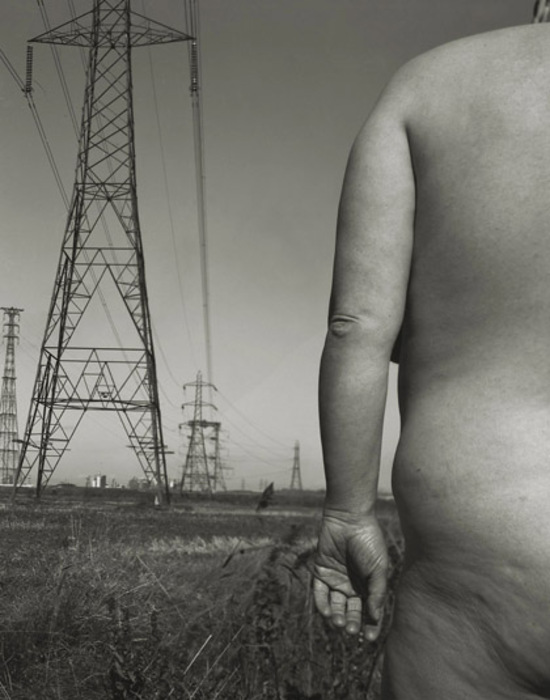
‘Industrialisation’ places the female figure between the viewer and the view beyond, challenging the male gaze and the objectification of women.
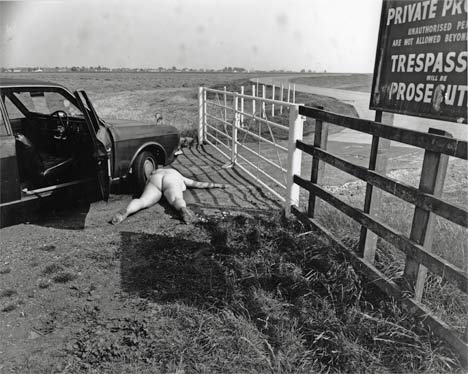
‘Victimisation’ “Here we see that the estate will not admit trespass, and that it stands in for the heroic (male) defender of the ground, repelling weak opposition at its border. Jo Spence failed to cross the barrier, allowing the absent landowner (through his gate and sign) to become hero, male, the creator of difference… her mockery diminishes the victory won by the landowner.” (John Taylor 1994, p.282 quoted Alexander p133)
————————————-
Jo Spence (1934–92) had a highly politicised approach to photography, creating photographs that run counter to the idealised imagery offered by advertising. Spence often worked collaboratively and sought alternative distribution models, laminating work for durability and renting out her photography to conferences, libraries, universities and public spaces to broaden its audience. She also documented her own struggles with cancer.
‘Putting Myself in the Picture’ (Camden Press 1986) brought together her raw and confessional works to inspire a younger generation of photographers. Remodelling Photo History (1982) a series of self-portraits in collaboration with Terry Dennett. The work consists of a series of diptychs where two photographs of Spence are juxtaposed. In some pairs, the first is a parody of a more traditional pictorial image; the second shot is less conventionally framed and the irony is articulated with less subtlety.
‘Industrialisation’ places the female figure between the viewer and the view beyond, challenging the male gaze and the objectification of women.
‘Victimisation’ “Here we see that the estate will not admit trespass, and that it stands in for the heroic (male) defender of the ground, repelling weak opposition at its border. Jo Spence failed to cross the barrier, allowing the absent landowner (through his gate and sign) to become hero, male, the creator of difference… her mockery diminishes the victory won by the landowner.” (John Taylor 1994, p.282 quoted Alexander p133)
My work is partly about the inevitable downside and consequences of capitalism which can result in a sense of alienation…actually I am part of it, and even people I photograph are part of this system and keep it going. I think [capitalism] has become a given because you can see how former and current communist countries are going the same way. I’m really aware of that, and want to face the realities and the downsides of that system that I find also attractive.
I find that the [documentary] portraits and landscapes are really about slowing down, cutting out all the noise and really taking time to contemplate the world around me every time with new eyes. The plain and the everyday is often very exciting to me. It can reveal a lot about life. I’m really inspired by details and I am usually more inspired by non-dramatic settings. Some of my images may seem boring, where there is nothing obvious going on, but I like playing with that, being on the fringes of boring.
While I have no expectation that I can influence social change or that I can ever make a concrete impact with the photographs, I do feel it’s kind of empowering to give the people you photograph a timeless presence in the larger world.
The Last Days of Shishmaref (2008) by Dana Lixenberg mixes landscape with formal portraits and still life to create a dynamic portrait of an Alaskan community that is under imminent threat from the sea due to the increasingly later freeze of the protective permafrost that encircles the island. The traditions of this community, mostly of Inuit origin, are just as much under threat as the precarious strip of land. The images in the book are informed with essays by geographers and environmentalists.
Lixenberg’s trademark is a 4×5 camera and tripod. This gives an intensity of experience between the photographer and those she photographs that she feels is not there with other types of cameras. She enjoys illustrating contrast in her work and portraying people in pure form.
Biography
Dana Lixenberg (born in Amsterdam, The Netherlands,1964) lives and works in New York and Amsterdam. Lixenberg originally went to New York to become an au pair and then discovered photography at a night school class. She studied Photography at the London College of Printing in London (1984-1986) and at the Gerrit Rietveld Academie in Amsterdam (1987-1989).
Her breakthrough in the U.S. came in 1993, when she was awarded a project grant by the Fonds BKVB (The Netherlands Foundation for Visual Arts, Design and Architecture) for a series of portraits at the Imperial Courts Housing Project in Los Angeles,CA. She was soon getting commissions from a wide variety of magazines such as Vibe, The New York Times Magazine, The New Yorker, Newsweek and The Telegraph magazine amongst many others.
Lixenberg continuously worked on long term personal projects, mostly focused on individuals and communities on the margins of society. Lixenberg has been the recipient of several project and publication grants in the Netherlands.
1999 she was the subject of a documentary titled: Dana Lixenberg, thru dutch eyes
2005 she was featured in an episode of the documentary series ‘Hollands Zicht’(Dutch Vision) both for Dutch television.
2005 Jeffersonville, Indiana was awarded Best Dutch Book Design,
2008 The Last Days of Shishmaref, was also awarded Best Dutch Book Design, 2008.
Since 2008 Lixenberg has been revisiting the Imperial Courts Housing Project in Los Angeles for a follow up to the series from 1993. In spring 2015 Huis Marseille, Amsterdam will organize a large scale exhibition of Imperial Courts coinciding with the release of a publication.
Other work
Lixenberg photographs people from all social classes.
I’ve never taken a different approach between photographing celebrities and un-known individuals, The fragility of life is experienced by all. ..When shooting people who have had a lot of media exposure I’m not interested in reinforcing their public image. I try to really see the person that’s in front of me, the way they are at that particular moment stripped from all the surrounding distractions like their entourage and to slowly bring them to a place where they don’t present a persona basically where they don’t try to hard.
In addition to ordinary people, Lixenberg has photographed a number of American celebrities, including Prince and Whitney Houston.
Lixenberg is also a film director and directed the Dutch singer Anouk’s 2005 video ‘One Word’
Gillian Wearing is a contemporary British artist whose conceptually driven photographs and videos investigate power dynamics and voyeurism in everyday life. Focused more on capturing the self-awareness of her subjects than on issues of aesthetics, Wearing employs prosthetic masks, voice dubbing, altered photographs, in her portraits of herself, individuals, and groups. This is especially notable in her series of work Signs that Say What You Want Them To Say and Not Signs that Say What Someone Else Wants You To Say (1992-1993), in which the artist confronted strangers and asked them write what they were thinking, then photographed them holding the sign. “It’s always important as an artist to find a unique language, and that’s why the Signs excited me,” she said of her series. “They felt new. But I didn’t realize they were going to be so influential, on everything from advertising to people doing signs for their Facebook page.” Born in 1963 in Birmingham, United Kingdom, she moved to London in 1983, studying first at the Chelsea School of Art then Goldsmiths College where she became a part of the Young British Artists generation alongside Damien Hirst. In 1997, the artist was the winner of the prestigious Turner Prize for her 1996 piece “60 Minutes Silence“. She currently lives and works in London, UK. Today, Wearing’s works are held in the collections of The Museum of Modern Art in New York, the Tate Gallery in London, the Hammer Museum in Los Angeles, and the Hirshhorn Museum and Sculpture Garden in Washington D.C., among others. http://www.artnet.com/artists/gillian-wearing/