websiteGoogle images
from Wikipedia:
Sugimoto has spoken of his work as an expression of ‘time exposed’, or photographs serving as a time capsule for a series of events in time. His work also focuses on transience of life, and the conflict between life and death. Sugimoto is also deeply influenced by the writings and works of Marcel Duchamp, as well as the Dadaist and Surrealist movements as a whole. He has also expressed a great deal of interest in late 20th century modern architecture.
His use of an 8×10 large-format camera and extremely long exposures have given Sugimoto a reputation as a photographer of the highest technical ability. He is equally acclaimed for the conceptual and philosophical aspects of his work.
Exerpts from his description of selected works from his website:
Joe: Like a work of architecture, this sculpture has to be experienced by walking around and through it… Joe is different according to the time of the day, the season, and the viewer’s position. It is in the visitor’s memory that the sculpture “takes shape” in the most complete way…Using a photographic technique involving areas of extremely soft light and blurred darkness, he sculpted views that seem like aspects of visual memory: the arts of photography and sculpture overlap and memories of the two-and the three-dimensional mix.
Revolution: For a long time it was my job to stand on cliffs and gaze at the sea, the horizon where it touches the sky. The horizon is not a straight line, but a segment of a great arc. One day, standing atop a lone island peak in a remote sea, the horizon encompassing my entire field of vision, for a moment I was floating in the centre of a vast basin. But then, as I viewed the horizon encircle me, I had a distinct sensation of the earth as a watery globe, a clear vision of the horizon not as an endless expanse but the edge of an oceanic sphere…There remains… a great divide between comprehending (i.e.explaining) the world and being able to explain what we ourselves are. And even then, what we can explain of the world is far less than what we cannot ― though people tend be more attracted by the unexplained. In all this, I somehow feel we are nearing an era when religion and art will once again cast doubts upon science, or else an era when things better seen through to a scientific conclusion will bow to religious judgement.
Seascapes: Water and air. So very commonplace are these substances, they hardly attract attention―and yet they vouchsafe our very existence…Let’s just say that there happened to be a planet with water and air in our solar system, and moreover at precisely the right distance from the sun for the temperatures required to coax forth life. While hardly inconceivable that at least one such planet should exist in the vast reaches of universe, we search in vain for another similar example. Mystery of mysteries, water and air are right there before us in the sea. Every time I view the sea, I feel a calming sense of security, as if visiting my ancestral home; I embark on a voyage of seeing.
Lightning sheets: The idea of observing the effects of electrical discharges on photographic dry plates reflects my desire to re-create the major discoveries of these scientific pioneers in the darkroom and verify them with my own eyes.
Architecture: I decided to trace the beginnings of our age via architecture. Pushing my old large-format camera’s focal length out to twice-infinity―with no stops on the bellows rail, the view through the lens was an utter blur―I discovered that superlative architecture survives, however dissolved, the onslaught of blurred photography. Thus I began erosion-testing architecture for durability, completely melting away many of the buildings in the process.
Chamber of Horrors: People in olden times were apparently less fearful and grievous of death than we are today. To some it was even an honor to be chosen by the gods as a sacrificial victim, a liberation from the sufferings and strife of this life…Must we moderns be so sheltered from death?
—————————————
A sensitive and comprehensive portrait made with Sugimoto that discusses his life, vision and focuses particularly on his recent works on ‘Lightning Fields’ and electricity, sculpted and photographed forms from mathematical formulae, reviving ancient Japanese traditions from Shinto and theatre and a gallery to communicate his vision to next generations.
Hiroshi Sugimoto is a contemporary Japanese photographer, born in 1948 and dividing his time between Japan and New York. His use of an 8×10 large-format camera and extremely long exposures have given Sugimoto a reputation as a photographer of the highest technical ability. He has spoken of his work as an expression of ‘time exposed’, or photographs serving as a time capsule for a series of events in time. His work focuses on transience of life, and the conflict between life and death. A lot of his work also relates to scientific concepts – electricity and origins of life and visual forms from mathematical formulae. His work has been a key inspiration for by black and white photography in:
2.2.1 Bridge where in my treatment of the bridge shapes I am inspired by the dramatic black white contrasts of his Conceptual Forms and Joe, and his work on the branching forms of electricity has influenced my working of the algae and other textures.
[Photography is] a kind of contrivance to externalize my internal vision. The world exists and so do I. But does the world exist as I see it? It may be that each individual is seeing the world differently. And all share the same fantasy of how this world should look like.
Thousands of years of history are in me.
We see what must be seen. Then disappear into the sea.
‘Capitalism won’t stop until we have depleted all resources….my work hopefully gives us an opportunity to think before destroying ourselves’
He works in series projects. The images that have been most influential on my own work are those that are highly abstract, dealing with light, dark and time as a way of making us think about life and our place in a fragile world in an immediate and haunting way.
Discussion by Sugimoto of the evolution of his photographic approach and concept, particularly towards his seascapes and more minimalist works. The underpinnings are not just meditative awe at the beauty of minimalist landscapes and a wish to reflect on what is timeless – we have been changing the land, but seascapes are what our earliest ancestors saw. He links this to our responsibility for our future ‘Capitalism won’t stop until we have depleted all resources….my work hopefully gives us an opportunity to think before destroying ourselves’
A catalogue of some of Sugimoto’s best known work by Ted Forbes, explaining his aims and techniques: Movie Theatres, Seascapes, Chamber of Horrors, Architecture, In Praise of Shadows – a series of abstract images of candles burning down and picures of wax works.
The series that have been most influential on my own work are those that are highly abstract, dealing with light and time as a way of making us think about life and our place in a fragile world.
Seascapes
The seascapes are a series of very large black and white prints all have the same middle horizon line. These images have inspired my reworking of:
So very commonplace are these substances, they hardly attract attention―and yet they vouchsafe our very existence…Let’s just say that there happened to be a planet with water and air in our solar system, and moreover at precisely the right distance from the sun for the temperatures required to coax forth life. While hardly inconceivable that at least one such planet should exist in the vast reaches of universe, we search in vain for another similar example. Mystery of mysteries, water and air are right there before us in the sea. Every time I view the sea, I feel a calming sense of security, as if visiting my ancestral home; I embark on a voyage of seeing.
This beautiful series of very large black and white prints all have the same middle horizon line. When presented here as an on-line presentation the different light and weather conditions around the same horizon line merge into each other in a really haunting way.
Their minimalist abstraction and meditative impact has been compared to that of Rothko’s paintings – but strangely the painting appear more ‘realistic’ than the photographs.
A discussion of a Pace exhibition in London and catalogue comparing the work of Hiroshi Sugimoto and Mark Rothko in terms of compositions.
Revolution
In this series he is at his most minimalist: ‘horizontality’, verticality and diagonals of Angst. With dramatic, eerie splashes of light.
For a long time it was my job to stand on cliffs and gaze at the sea, the horizon where it touches the sky. The horizon is not a straight line, but a segment of a great arc. One day, standing atop a lone island peak in a remote sea, the horizon encompassing my entire field of vision, for a moment I was floating in the centre of a vast basin. But then, as I viewed the horizon encircle me, I had a distinct sensation of the earth as a watery globe, a clear vision of the horizon not as an endless expanse but the edge of an oceanic sphere…There remains… a great divide between comprehending (i.e. explaining) the world and being able to explain what we ourselves are. And even then, what we can explain of the world is far less than what we cannot ― though people tend be more attracted by the unexplained. In all this, I somehow feel we are nearing an era when religion and art will once again cast doubts upon science, or else an era when things better seen through to a scientific conclusion will bow to religious judgement.
This French video discusses Sugimoto’s approach to time and abstraction. In this series he is at his most minimalist: ‘horizontality’, verticality and diagonals of Angst. With splashes of light.
Joe and Conceptual Forms
Like a work of architecture, this sculpture has to be experienced by walking around and through it… Joe is different according to the time of the day, the season, and the viewer’s position. It is in the visitor’s memory that the sculpture “takes shape” in the most complete way…Using a photographic technique involving areas of extremely soft light and blurred darkness, he sculpted views that seem like aspects of visual memory: the arts of photography and sculpture overlap and memories of the two-and the three-dimensional mix.
The idea of observing the effects of electrical discharges on photographic dry plates reflects my desire to re-create the major discoveries of these scientific pioneers in the darkroom and verify them with my own eyes. His process is discussed in detail in
I decided to trace the beginnings of our age via architecture. Pushing my old large-format camera’s focal length out to twice-infinity―with no stops on the bellows rail, the view through the lens was an utter blur―I discovered that superlative architecture survives, however dissolved, the onslaught of blurred photography. Thus I began erosion-testing architecture for durability, completely melting away many of the buildings in the process.
People in olden times were apparently less fearful and grievous of death than we are today. To some it was even an honour to be chosen by the gods as a sacrificial victim, a liberation from the sufferings and strife of this life…Must we moderns be so sheltered from death?
Richard Misrach (born in Los Angeles, California in 1949) is an American photographer “firmly identified with the introduction of color to ‘fine’ [art] photography in the 1970s, and with the use of large-format traditional cameras” (Nancy Princenthal, Art in America). He is perhaps best known for his depictions of the deserts of the American west, and for his series documenting the changes brought to bear on the environment by various man-made factors such as urban sprawl, tourism, industrialization, floods, fires,petrochemical manufacturing, and the testing of explosives and nuclear weapons by the military.
Misrach’s longest-running and most ambitious project, the Desert Cantos, is an ongoing series of photographs of deserts. Begun in 1979 with a Deardorff 8×10” view camera, the series is ongoing and numbers 33 cantos as of 2013.
Misrach’s use of the term “canto” was inspired in part by the cantos of Ezra Pound. The Italian term “canto” was used to denote that the vast enterprise has been broken down into individual thematic essays or “cantos,” which together make up the whole work, or “song cycle.” Some of these cantos consist of only a few images, while others run into hundreds. Some may be regarded as “documentary” in mode, some more metaphorical. Some may be considered aesthetic in intent, some “political” – though as an ambitious and intelligent photographer, aesthetics are never pursued at the expense of politics, or vice versa. Misrach’s goal may be said to be a search for the photographic Holy Grail, to fuse reportage with poetry. To progress – as he put it – “from the descriptive and the informative to a metaphorical resolution.” (1989 article in Creative Camera, Gerry Badger)
Beginning with “The Terrain,” in which images of apparently untouched wilderness are punctuated by human elements such as a lone telephone pole or a train, theCantos include spectacles like the space shuttle landing (“The Event”) and car racing (“The Salt Flats”), man-made fires and floods like the Salton Sea (“The Flood”) and desert seas created by the damming of rivers, as well ascolor-field studies of empty skies (“The Skies”).Images of military training and testing sites feature extensively in the Cantos and the series’ corresponding publications: “The War” resulted in the 1991 book Bravo 20: The Bombing of the America West, co-authored by Myriam Weisang Misrach, and nuclear testing was addressed in Violent Legacies, published in 1992. “The Pit” documented mass graves of dead animals in the Nevada desert while “Pictures of Paintings” focused on the representation of the western landscape in museums across the American West. “The Playboys” depicted issues of Playboy, discovered by the photographer at a military site, that had been used for target practice.
The desert … may serve better as the backdrop for the problematic relationship between man and the environment. The human struggle, the successes … both noble and foolish, are readily apparent in the desert. Symbols and relationships seem to arise that stand for the human condition itself.
Border Cantos
Misrach’s Border Cantos series comprises photographs of the border between the U.S. and Mexico taken since 2004, and most extensively since 2009. In 2012 he began a collaboration with composer Guillermo Galindo, who manufactures playable instruments from objects found along the border. Misrach and Galindo have recovered artifacts from the border zone including water bottles, clothing, back-packs, Border Patrol “drag” tires, spent shotgun shells, ladders, and sections of the border wall itself, all of which have been transformed by Galindo into instrumental sculptures. The pair’s collaborative project will be featured in a museum exhibit in 2016 which will tour the United States through 2018.
The Oakland–Berkeley fire and Hurricane Katrina
In October 1991, a firestorm raged in the Oakland–Berkeley hills, killing 25 people, wounding 150 and destroying over 3,500 dwellings. This fire – one of the worst in California’s history – happened a few miles from Misrach’s studio and the photographer visited the site a few weeks later, taking hundreds of pictures. However, out of respect for the victims of the fire, he put the work away for two decades. “1991: The Oakland–Berkeley Fire Aftermath: Photographs by Richard Misrach,” an exhibition of Misrach’s photographs of the firestorm’s aftermath, was finally shown for the first time concurrently by the Berkeley Art Museum and the Oakland Museum of California in 2011. These exhibits included handcrafted elegy books in which visitors shared their recollections, a video story booth for recording memories, and an open-microphone meetings. The collected responses from local residents, as well as the prints — sets of which Misrach donated to the museums — were kept in the collections.
To date, the majority of Misrach’s large-format documentary images of New Orleans and the Gulf Coast taken immediately after Hurricane Katrina have not been shown, with the exception of Destroy this Memory, a book published five years after the disaster, consisting entirely of pocket-camera pictures of messages left on houses, cars, and trees by survivors of the hurricane. A Los Angeles Times review called the book “a raw testament, shot between October and December 2005, just after the waters began to recede but the emotions had certainly not. Without captions or a contextual introduction to detract from the potency of the photographs themselves, the book is a powerful document allowing survivors to speak eloquently for themselves — even in absentia.” Proceeds from Destroy this Memory were donated to the Make It Right Foundation to help rebuild the city’s Lower Ninth Ward. Complete sets of the photographs were also donated to five museums—the Museum of Modern Art, the National Gallery of Art, the New Orleans Museum of Art, the Houston Museum of Fine Arts and the San Francisco Museum of Modern Art.
When Misrach moved to a house in the Berkeley hills in 1997, he was inspired by the spectacle of weather and light surrounding the Golden Gate Bridge (see images) , which sat only seven miles from his front porch. For four years he photographed the bridge from the same location and with the same vantage point under different climate conditions. These images are conventionally visually stunning in their horizontal bands of sunset colours using very low horizons.
Concurrently, Misrach was working in Louisiana, following a commission he received from the High Museum of Art in Atlanta. In 1998, he began documenting “Cancer Alley,” (see images) a stretch along the Mississippi River between Baton Rouge and New Orleans that is home to over 135 plants and refineries. The resulting images were exhibited as part of the “Picturing the South” series at the High Museum. He resumed photographing the area in 2010 and completed the series in 2012 with another exhibition at the High Museum, “Revisiting the South,” and the publication of Petrochemical America, a book pairing Misrach’s images with an “ecological atlas” by architect and Columbia University professor Kate Orff. Orff’s writing and infographic-style work in the book articulate the complex industrial, economic, ecological, and historical problems that inevitably gave rise to the places featured in Misrach’s photographs.
In January 2002, following an exploratory trip in November 2001, Misrach started his On the Beach project, consisting of serial photographs taken from the same building overlooking a beach in Hawaii. The project’s title refers to the Cold War-era Nevil Shute book and subsequent 1959 sci-fi movie, On the Beach, in which a nuclear disaster goes unnoticed by a group of happy beach-goers who suddenly find themselves the only survivors. According to Smithsonian magazine, the series was “deeply influenced by the events of September 11, 2001;” the aerial perspectives of figures suspended in the ocean or on the beach reminded Misrach of news photographs of people falling from the twin towers.
The resulting photographs were very large: Smithsonian reports that “the largest measure six by ten feet and are so detailed you can read the headlines on a beachgoer’s newspaper.” The beach images “seem much more beautiful, almost in a way more soft than some of his other work,” writes Sarah Greenough, photography curator at the National Gallery of Art: “After you look at them for a while, though, they are hardly soft at all. There really is something very ominous going on.” Misrach also captured people in action – a man tossing a woman through the air or someone doing a headstand in the water – which was especially noteworthy given the time-consuming and cumbersome view camera used. The photographer has said that the work is of a piece with his usual focus on humanity and the environment, but “it is much more about our relationship to the bigger, sublime picture of things.”
Misrach completed the series in 2005 and went on to publish a large-format book called On the Beach in 2007, voted by Photo District News readers as one of the most influential books of the decade.
Returning to the same beach while on vacation in late 2011 with a new digital camera, he began working at the same location but with a different intent and mood: the artist says he was becoming “more comfortable with metaphysical questions,” and the subjects of his 2011 images appear at play and in harmony with nature. The title of the series, On the Beach 2.0, alludes to the fact that the photographs are grounded in their technological moment in time – as do the individual titles, which refer to the date and exact minute of each shot.
Conversely, reviewer Allegra Kirkland points out that parts of this body of work are the closest Misrach has come to traditional portraiture since Telegraph 3 AM. The use of a digital camera and a telephoto lens introduced a new degree of speed and proximity to the artist’s shooting methods; although faces are often obscured by a towel or magazine, many of the images in On The Beach 2.0 might still be considered gestural portraits.
Kirkland writes: “The [On The Beach 2.0] series is about waiting and what happens when you do—the strange, small, secret moments that compose life… Ten years after the debut of the original project, Misrach seems to be affirming that man and nature do not always have to exist in opposition.”
Reverse photographs and iPhone images
Misrach has created a number of reverse images, essentially presenting large prints in their negative form. Another exhibit of this work was shown in 2011, consisting entirely of small-scale color prints taken with an iPhone camera. These revisit Bombay Beach, California, a flood zone where he [photographed] found objects and detritus – evidence of man’s presence in the landscape. These compositions were also manipulated: positive becomes negative and objects are transformed in a reversed color spectrum.”
Misrach’s book Desert Cantos received the 1988 Infinity Award from the International Center for Photography, and his Bravo 20: The Bombing of the American West, co-authored with Myriam Weisang Misrach, was awarded the 1991 PEN Center West Award for a nonfiction book.[8] His Katrina monograph Destroy This Memory won Best Photobook of the Year 2011 at PhotoEspaña.[16]
He has received numerous awards including four National Endowment for the Arts Fellowships, a Guggenheim Fellowship, an International Center of Photography Infinity Award for a Publication, and the Distinguished Career in Photography Award from the Los Angeles Center for Photographic Studies. In 2002 he was given the Kulturpreis for Lifetime Achievement in Photography by the German Society for Photography, and in 2008 he received the Lucie Award for Outstanding Achievement in Fine Art Photography.[14]
In 2010, Apple licensed Misrach’s 2004 image Pyramid Lake (at Night) as the inaugural wallpaper for the first iPad.[26] The opening credits of the 2014 HBO series True Detective featured a montage of images from Misrach’sPetrochemical America.[27]
In 1967, Misrach left Los Angeles for the University of California, Berkeley, where he obtained a B.A. in Psychology after briefly pursuing a degree in Mathematics. While on campus he was confronted with the anti-war riots and began photographing the events around him;[7] he also learned the rudiments of photography with Paul Herzoff, Roger Minick, and Steve Fitch at the ASUC Berkeley Studio.[5]
Misrach’s first major photography project, completed in 1974, depicted homeless residents of Telegraph Avenue in Berkeley, California. This suite of photographs was shown at the International Center of Photography and published as a book, Telegraph 3 AM,[8] which won a Western Book Award in 1975.
Early work
Having hoped that Telegraph 3 AM would help improve life on the streets, Misrach was frustrated by the book’s minimal impact and retreated to the deserts of Southern California, Arizona, and Baja, California, where he took photographs devoid of human figures entirely.[5] Working at night with a strobe that illuminated the landscape around him, he experimented with unusual printing techniques in the university darkroom and created richly hued, split-toned silver prints. A resulting 1979 book was published without a title or a single word of accompanying text besides nominal identifying information on the book’s spine. In 1976 he traveled to Stonehenge to continue his split-toned night studies, and in 1978 he began working in color on journeys to Greece, Louisiana, and Hawaii.[5][7]
TASK: Read Simon Morley ‘Staring into the Contemporary Abyss’. Choose any body of work you feel explores the sublime. It may be a photographic project, a work of literature, cinema, or any other medium. Write at least 300 words describing how you believe the work you have selected relates to the sublime. Use Morley’s text to support your argument.
Japanese photographer Hiroshi Sugimoto focuses in much of his work explicitly or implicitly on the transience of life, the conflict between life and death and the known and unknown. He questions our attitudes to death in ‘Chamber of Horrors’ using photos of (now removed) waxworks of torture and execution from Madame Tussaud’s. His images of an ancient ‘installation’ of hundreds of Bodhisattvas in a Kyoto temple mirrors interestingly Gursky’s images of North Korean armies – are they also all the same? or individual souls?
Works like ‘Seascapes’ and ‘Revolution’ give a sense of void – of being on a borderline or edge where we can no longer codify experience – as a fundamental prerequisite for a deeper sense of reality, serving to mediate between being and nothingness, and communicating through a condition of absence a heightened awareness of the self. He is particularly interested in boundaries between science and religion ‘In all this, I somehow feel we are nearing an era when religion and art will once again cast doubts upon science, or else an era when things better seen through to a scientific conclusion will bow to religious judgement.’ ‘There remains… a great divide between comprehending (i.e.explaining) the world and being able to explain what we ourselves are. And even then, what we can explain of the world is far less than what we cannot ― though people tend be more attracted by the unexplained.’
Other works like ‘architecture’ use photography as an expression of ‘time exposed’, or photographs serving as a time capsule for a series of events in time. He pushes his old large-format camera’s focal length out to twice-infinity―with no stops on the bellows rail, the view through the lens was an utter blur. This gives a very eerie effect, completely melting away many of the buildings in the process.
In Joe – a photograph of an outdoor sculpture, he looks at relationships between 2 and 3 dimensions, effects of light on memory. The sculpture has to be experienced by walking around and through it… Joe is different according to the time of the day, the season, and the viewer’s position. Using a photographic technique involving areas of extremely soft light and blurred darkness, he sculpts views that seem like aspects of visual memory.
Other works like Lightning Fields observe the effects of scientific processes like electrical discharges on photographic dry plates. He describes these as a desire to re-create the major discoveries of these scientific pioneers in the darkroom and verify them with my own eyes. But the effects are extremely beautiful – art produced by science.
Simon Morley main points
Romantic artists: irrational and frightening
Abstract expressionists: Barnett Newman ( ‘The Sublime is Now’) and Mark Rothko. an art possessing depth and profundity beyond classical ideas about beauty and aesthetics.
Pop and Conceptual Art and radical philosophers in France trying to understand aspects of human experience that seemed to lie beyond the controlling structures imposed by the status quo, to keep open a pathway leading to some kind of possibility of emancipation.
Morley’s book The Sublime: Documents of Contemporary Art distinguishes five different ways in which the word is now broadly used:
the unpresentable
transcendence,
terror,
the uncanny and
altered states of consciousness.
There are also two main contexts for such discussions: nature and technology. Linking all these: a desire to define a moment when social and psychological codes and structures no longer bind us, where we reach a sort of borderline at which rational thought comes to an end and we suddenly encounter something wholly and perturbingly other.
At the sublime’s core are experiences of self-transcendence that take us away from the forms of understanding provided by a secular, scientific and rationalist world view. covert or camouflaged devices for talking about the kinds of things that were once addressed by religious discourses and nevertheless seem to remain pertinent within an otherwise religiously sceptical and secularised world.
” a transformative experience understood as occurring within the here and now. What we make of this experience, what value we give it, can take us in two very different directions, however. One re-envisages the self as existing in the light of some unnameable revelation arising in a gap between, on the one hand, a dull and alienating reality, and on the other an unmediated awareness of life. In contrast, there is a far more pessimistic conclusion that can be drawn, one that ends up as a resigned sense of inadequacy, in which we are made aware of our emotional, cognitive, social and political failure when faced with all that so blatantly exceeds us.”
Ultimately, the concept of the sublime must pose more questions than it answers
Anish Kapoor’s huge maroon trumpet Marsyas 2002. made of stretched PVC, managed to convey a more affirmative experience of the sublime – a kind of post-religious state of emotional transcendence in which, exactly because of the lack of ordered structures or codes, we feel a powerful sense of exaltation and release rather than fear. His work also serves to link discussions of the sublime to non- Western concepts. In an interview given several years ago, he declared that through the experience of void that is central to his art he sought to convey ‘a potential space, not a non-space’.
Miroslaw Balka’s dark container How It Is 2009, a huge steel structure with a vast dark chamber. ‘negative sublime’, destabilising and unnerving entering into a structureless and unsettling zone of inky blankness (at least when there are no mobile phone lights being turned on) but simultaneously aware of merely experiencing an artwork in a museum.
Douglas Gordon,site-specific work Pretty much every word written, spoken, heard, overheard from1989…2010. nameless and imageless emotions, Wordsworth’s ‘blank abyss’.
Korean artist Lee Ufan and Japanese photographer Hiroshi Sugimoto, a sense of void – of being on a borderline or edge where we can no longer codify experience – is considered a fundamental prerequisite for a deeper sense of reality, serving to mediate between being and nothingness, and communicating through a condition of absence a heightened awareness of the self.
James Turrell, who uses light to dematerialise an environment and to propel the spectator into a state of sensory confusion that isn’t so much unsettling as ecstatic. Turrell, who is influenced by Quaker Christianity’s idea of divine light as well as by oriental concepts, declares that his work is involved in the ‘plumbing of visual space through the conscious act of moving, feeling out through the eyes’, and adds that the experience is ‘analogous to a physical journey of self as a flight of the soul through the planes’.
Gerhard Richter paintings looking like blurred photographs ‘ new sense of the sublime as something that gets squeezed out as an intangible and ambiguous supplement in the gap between these two different but related media’. large abstracts ‘seem merely to engage with the sublime in the more traditional and easily consoling sense of something that strives for the exalted effect’.
Luc Tuymans : thwarted transcendence in deliberately drab paintings derived from photographs. Many of Tuymans’s works refer to Nazism, in which sublime effects were exploited in order to inspire a nation to commit barbaric acts. Albert Speer’s Cathedrals of Light, constructed for the Nuremberg rallies, were frightening instances of the sublime in the hands of authoritarian politics
Andreas Gursky. series of large-scale photographs of intricately orchestrated mass public displays of the North Koreans – any discussion of the concept of the sublime should take into account its political implications.
French artist Philippe Parreno and his collaborators, dive into the depths of virtual reality by exploring how contemporary subjectivity is distorted and augmented through plugging into the digital. The artists copyrighted a digital animation character in order to ‘set her free’ to ‘live’ in ways not constrained by the strict regulations imposed by the usual conventions of cyberspace. Perhaps it is indeed to this new world, beyond the limits of the physical body and of time and space, that the sublime experience is now migrating.
Psychogeography is essentially the broad terrain where geography – in terms of the design and layout of a place – influences the experience, i.e. the psyche and behaviour, of the user. It has walking as a central component (Alexander 2013 p74)
Guy Debord (1931–94) leader of The Situationist International defined psychogeography as follows:
“Psychogeography could set for itself the study of the precise laws and specific effects of the geographical environment, whether consciously organized or not, on the emotions and behavior of individuals. The charmingly vague adjective psychogeographical can be applied to the findings arrived at by this type of investigation, to their influence on human feelings, and more generally to any situation or conduct that seems to reflect the same spirit of discovery.” (http://www.cddc.vt.edu/sionline/presitu/geography.html quoted Alexander 2013 p74)
Psychogeography in literature has a long history. London, as imagined by writers including William Blake (1757–1827), Daniel Defoe (1659–1731), Thomas de Quincey (1785–1859) and Robert Louis Stevenson (1850–94), Stevenson in The Strange Case of Dr Jekyll and Mr Hyde (1886), have all been identified as a place where early traces of psychogeography can be found.
It has also veered between being:
a mode of artistic expression
associated with Marxist ideology and political and social change.
Two inter-linked terms that are key to understanding psychogeography:
The dérive is a key method of psychogeographical enquiry. The literal translation from the French is ‘drift’ and a dérive is a spontaneous, unplanned walk through a city, guided by the individual’s responses to the geography, architecture and ambience of its quarters.The dérive can be seen as one strategy to help bridge the gap between the actual, physical observations of the stroller and their subconscious. Similar techniques have been used in geography, sociology and anthropology as a means of research that opens up possibilities and new questions based on direct observation.
The flâneur (a term that originates from Charles Baudelaire and Walter Benjamin) is essentially the protagonist of the dérive, but more generally the ‘gentleman stroller’ (as Baudelaire put it) who enjoys the aesthetic pleasures of the sights and sounds he experiences. The emphasis here is more on the aesthetic interpretation of the observer and emotional responses to the views and events that unfold. The flâneur has been identified in Edgar Allan Poe’s The Man of the Crowd (1840) and in the shady figure lurking in the corner of Edouard Manet’s A Bar at the Folies-Bergère. Listen to Philip Pullman discussing Manet’s painting in depth.
Brassai (1899-1984) flaneur
Robert Adams
Mark Power
Moriyama
However, alternative arbitrary methodologies have also been employed, championed initially by the Situationist movement as a necessary means – as they would see it – to subvert capitalist ideas about correctly engaging and functioning within the city. Other strategies included:
the production of alternative maps, such as Debord’s The Naked City (1957), which attempted to facilitate users to experience the city according to their emotional state and responses.
Robert MacFarlane’s simple alternative strategy of tracing a circle around the rim of a glass on a map and walking it, you can leave yourself open to new subject matter and unthought-of creative possibilities (see MacFarlane in Coverley, 2010, p.9).
The genre of street photography is often taken (and often mistaken) as evidence of psychogeography today. But although psychogeographical enquiry has traditionally been associated with the city, in more recent years it has expanded beyond its traditional boundaries, and is nowadays less associated with left-wing politics, having returned to a literary position.
Iain Sinclair: fictional and non-fictional literary responses. In the book (and accompanying film) London Orbital (2002), Sinclair chronicles his epic walk along the M25 which encircles the capital, taking him to golf courses, retail and business parks, and other generic spaces.
Paul Farley and Michael Symmons Roberts’ book Edgelands: Journeys into England’s True Wilderness (2011), celebrates subjects as diverse as shipping containers, landfill sites and wooden pallets.
Some have identified the urban sport of parkour (or ‘freerunning’) and even the Occupy movement with psychogeography.
The most significant influence on contemporary landscape practice was the exhibition“New Topographics: Photographs of a Man-Altered Landscape” was curated by William Jenkins at the International Museum of Photography at the George Eastman House (Rochester, New York) in January 1975. The exhibition was intended for a gallery audience and subverted traditional notions of landscape photography in favour of a new kind of sublime: the man-made landscape. In his introduction to the catalogue, Jenkins defined the common denominator of the show as “a problem of style:” “stylistic anonymity”, an alleged absence of style. The exhibition was received negatively at the time, for its bleak celebration of what was considered ordinary and banal.
The exhibition was a reaction to the idealised landscape photography of Ansel Adams and Edward Weston and was influenced by Ed Ruscha who, in the 60s, had made a series of artist’s books with self-explanatory titles such as Twentysix Gasoline Stations, Some Los Angeles Apartments, Every Building on the Sunset Strip and Walker Evans, who had photographed the vernacular iconography of America in road signs, billboards, motels and shop.
“The pictures were stripped of any artistic frills and reduced to an essentially topographic state, conveying substantial amounts of visual information but eschewing entirely the aspects of beauty, emotion and opinion,.” “[…] rigorous purity, deadpan humor and a casual disregard for the importance of the images.” Technically, half the photographers were working with 8″×10″; (20 cm × 25 cm) large format view cameras; those who were not were using either square medium format (Deal, Gohlke), or in the case of Baltz, 35 mm Technical Pan, a slow and high-definition Kodak film that the photographer printed on 8″x10″ paper. Only Baltz and Wessel were using regular 35 mm cameras and film. A notable element of the show was that the artists were, or would be, linked with higher education as students, professors, or both—a change from the preceding generations.The shift from craft or self-teaching to academia had somewhat been started by photographers such as Ansel Adams and Minor White, but the new generation was turning away from the approach of these forebears. This was illustrated by the subject matter that the New Topographics chose as well as their commitment to casting a somewhat ironic or critical eye on what American society had become. They all depicted urban or suburban realities under changes in an allegedly detached approach. In most cases, they gradually revealed themselves as coming from rather critical vantage points, especially Robert Adams, Baltz, and Deal.
The show consisted of 168 rigorously formal, black-and-white prints of streets, warehouses, city centres, industrial sites and suburban houses. Taken collectively, they seemed to posit an aesthetic of the banal. …Their stark, beautifully printed images of this mundane but oddly fascinating topography was both a reflection of the increasingly suburbanised world around them, and a reaction to the tyranny of idealised landscape photography that elevated the natural and the elemental.
The prints were in a 20 cm × 25 cm (8″×10″) format except for Joe Deal (32 cm × 32 cm), Gohlke (24 cm × 24 cm – close enough to 8”×10”), and the Bechers with typical European (for the time) 30 cm × 40 cm prints.
However despite their similarities, there were significant differences between the photographers in their reactions to, and portrayal of, the suburban environment and their political conclusions on responses to it.
See Greg Foster-Price and John Rohrbach ‘Re-framing the New Topographics’ 2013 University of Chicago Press
Robert Adams: disappearing wildernesses, pointed his camera at eerily empty streets, pristine trailer parks, rows of standardised tract houses, the steady creep of suburban development in all its regulated uniformity.
Lewis Baltz: stark photographs of the walls of office buildings and warehouses on industrial sites in Orange County.
Nicholas Nixon: innercity development: skyscrapers that dwarfed period buildings, freeways, gridded streets and the palpable unreality of certain American cities in which pedestrians seem like interlopers.
Bernd and Hilla Becher: stark images of Pennsylvania salt mines and giant coal breakers were as coolly architectural as their images of German cooling towers and industrial plants. The suggestion was that there was something determinedly European about this new American gaze.
Ecological citizenship and automobility
The works in different ways question our responsibility in relation to the natural environment. Taken at a time of rapid environmental change, commercialisation and often homogenised destruction of the natural wilderness romanticised by Ansel Adams, they aim to promote a sense of responsibility for what Robert Adams calls the ‘half wilderness’.
There is a general concern with the homogenisation and also isolation of much of modern construction and urban sprawl. Roads that cut of and surround dwellings that can only be accessed by cars.
They differ in their approaches to technological advances like the reliance on the motor car. For Shore and Schott however there is more of a celebration of the accessibility and democratisation of life. Shore in particular celebrates the colour and vibrancy of cities and parking lots.
‘Shore’s images may be seen as ignoring environmental degradation…Yet his photographs encourage a sense of wonder and appreciation, even in the most familiar, most mundane spaces’.
There is thus a core message of the exhibition as a whole: we need to notice and appreciate what is around us in the ‘semi-wilderness’ and make sure we preserve and protect what is valuable in it. In terms of human colour and nature. Not relegate ‘conservation’ to an ever-shrinking small protected area of idealised wilderness. It is all important.
Legacy
The exhibition was recreated in various locations: in 1981, six years after its original presentation, it was shown in reduced form at the Arnolfini Gallery, Bristol, UK, under the auspices of Paul Graham and Jem Southam. A large scale presentation of the exhibition was organized in 2009 at the Center for Creative Photography in Tucson. “New Topographics” began an international tour in 2009, with stagings at the George Eastman House in Rochester, New York, and the Los Angeles County Museum of Art. In 2011 the exhibition was on view at the Nederlands Fotomuseum in Rotterdam, Netherlands, and later at the Bilbao Fine Arts Museum in Spain.
Baltz, Gohlke, and Shore were later commissioned by the French government for the Mission de la DATAR.
The exhibition was very influential in the subsequent developments in both US and European landscape photography, including the work of Andreas Gursky, Paul Graham, Candida Höfe and Donovan Wylie. See the following interviews with LA photographers discussing how they have been influenced by the photographers at the exhibition:
———————————————– “New Topographics: Photographs of a Man-Altered Landscape” was curated by William Jenkins at the International Museum of Photography at the George Eastman House (Rochester, New York) in January 1975. In his introduction to the catalogue, Jenkins defined the common denominator of the show as “a problem of style:” “stylistic anonymity”, an alleged absence of style.
The exhibition was a reaction to the idealised landscape photography of Ansel Adams and Edward Weston and was influenced by Ed Ruscha who, in the 60s, had made a series of artist’s books with self-explanatory titles such as Twentysix Gasoline Stations, Some Los Angeles Apartments, Every Building on the Sunset Strip and Walker Evans, who had photographed the vernacular iconography of America in road signs, billboards, motels and shop.
“The pictures were stripped of any artistic frills and reduced to an essentially topographic state, conveying substantial amounts of visual information but eschewing entirely the aspects of beauty, emotion and opinion,.” “[…] rigorous purity, deadpan humor and a casual disregard for the importance of the images.” Technically, half the photographers were working with 8″×10″; (20 cm × 25 cm) large format view cameras; those who were not were using either square medium format (Deal, Gohlke), or in the case of Baltz, 35 mm Technical Pan, a slow and high-definition Kodak film that the photographer printed on 8″x10″ paper. Only Baltz and Wessel were using regular 35 mm cameras and film. A notable element of the show was that the artists were, or would be, linked with higher education as students, professors, or both—a change from the preceding generations.The shift from craft or self-teaching to academia had somewhat been started by photographers such as Ansel Adams and Minor White, but the new generation was turning away from the approach of these forebears. This was illustrated by the subject matter that the New Topographics chose as well as their commitment to casting a somewhat ironic or critical eye on what American society had become. They all depicted urban or suburban realities under changes in an allegedly detached approach. In most cases, they gradually revealed themselves as coming from rather critical vantage points, especially Robert Adams, Baltz, and Deal.
The show consisted of 168 rigorously formal, black-and-white prints of streets, warehouses, city centres, industrial sites and suburban houses. Taken collectively, they seemed to posit an aesthetic of the banal. …Their stark, beautifully printed images of this mundane but oddly fascinating topography was both a reflection of the increasingly suburbanised world around them, and a reaction to the tyranny of idealised landscape photography that elevated the natural and the elemental.
The prints were in a 20 cm × 25 cm (8″×10″) format except for Joe Deal (32 cm × 32 cm), Gohlke (24 cm × 24 cm – close enough to 8”×10”), and the Bechers with typical European (for the time) 30 cm × 40 cm prints.
However despite their similarities, there were significant differences between the photographers in their reactions to, and portrayal of, the suburban environment and their political conclusions on responses to it.
See Greg Foster-Price and John Rohrbach ‘Re-framing the New Topographics’ 2013 University of Chicago Press
Robert Adams: disappearing wildernesses, pointed his camera at eerily empty streets, pristine trailer parks, rows of standardised tract houses, the steady creep of suburban development in all its regulated uniformity.
Lewis Baltz: stark photographs of the walls of office buildings and warehouses on industrial sites in Orange County.
Nicholas Nixon: innercity development: skyscrapers that dwarfed period buildings, freeways, gridded streets and the palpable unreality of certain American cities in which pedestrians seem like interlopers.
Bernd and Hilla Becher: stark images of Pennsylvania salt mines and giant coal breakers were as coolly architectural as their images of German cooling towers and industrial plants. The suggestion was that there was something determinedly European about this new American gaze.
Ecological citizenship and automobility
The works in different ways question our responsibility in relation to the natural environment. Taken at a time of rapid environmental change, commercialisation and often homogenised destruction of the natural wilderness romanticised by Ansel Adams, they aim to promote a sense of responsibility for what Robert Adams calls the ‘half wilderness’.
There is a general concern with the homogenisation and also isolation of much of modern construction and urban sprawl. Roads that cut of and surround dwellings that can only be accessed by cars.
They differ in their approaches to technological advances like the reliance on the motor car. For Shore and Schott however there is more of a celebration of the accessibility and democratisation of life. Shore in particular celebrates the colour and vibrancy of cities and parking lots.
‘Shore’s images may be seen as ignoring environmental degradation…Yet his photographs encourage a sense of wonder and appreciation, even in the most familiar, most mundane spaces’.
There is thus a core message of the exhibition as a whole: we need to notice and appreciate what is around us in the ‘semi-wilderness’ and make sure we preserve and protect what is valuable in it. In terms of human colour and nature. Not relegate ‘conservation’ to an ever-shrinking small protected area of idealised wilderness. It is all important.
Legacy
The exhibition was recreated in various locations: in 1981, six years after its original presentation, it was shown in reduced form at the Arnolfini Gallery, Bristol, UK, under the auspices of Paul Graham and Jem Southam. A large scale presentation of the exhibition was organized in 2009 at the Center for Creative Photography in Tucson. “New Topographics” began an international tour in 2009, with stagings at the George Eastman House in Rochester, New York, and the Los Angeles County Museum of Art. In 2011 the exhibition was on view at the Nederlands Fotomuseum in Rotterdam, Netherlands, and later at the Bilbao Fine Arts Museum in Spain.
Baltz, Gohlke, and Shore were later commissioned by the French government for the Mission de la DATAR.
The exhibition was very influential in the subsequent developments in both US and European landscape photography, including the work of Andreas Gursky, Paul Graham, Candida Höfe and Donovan Wylie. See the following interviews with LA photographers discussing how they have been influenced by the photographers at the exhibition:
Wander the path of a winding river and it will take you deeply into the experience of landscape. Through the summer days I walked the footpaths, fields, meadows and farm tracks of this bucolic river valley. The Stour Valley remains a timeless landscape that continues to be rooted to its past. In places it has remained relatively unchanged for centuries by escaping the impact of industrial agriculture. Of course, this is “Constable Country:” the heart of English landscape art. People come to this part of East Anglia to literally step into the scenes of Constable’s paintings, but I set out to find my own way of seeing the Stour Valley. I discovered it can be a place of wonderful afternoon light and this inspired the photographs I made. These photographs largely reject the celebrated grand vistas of the Stour Valley and instead offer an alternative way of looking at this landscape. They bring attention to the particular, the peculiar, and the poetic – highlighting the hidden places and scenes that are so often overlooked. But as I worked, the spirit of Constable was always there, lingering behind me in the fields.
[These photographs were made during the summer months of 2012-2013.]
“When we walk, we naturally go to the fields and woods….”
(Henry David Thoreau, ‘Walking,’ 1862)
Some Country continues my commitment to photographing rural East Anglia. Following the decade long work photographing the agrarian farmers of the region (Field Work), this new ongoing series explores the contemporary rural agricultural landscape of Norfolk and Suffolk. Moving beyond the farmer’s connection to the landscape, Some Country is reveals my own connection to rural East Anglia and includes photographs from the same fields and farm tracks that I explored during childhood. Once again, these photographs show my fascination with how man shapes the landscape, but they are also photographs about memory, personal experience, and how a prolonged connection to the landscape around us, makes us and shapes us.
As I have wandered the East Anglian landscape making the photographs for Some Country occasionally I have encountered trees that are so particular in their diginity and presence in the landscape that they suggest something beyond the country and become themselves the subject of a photograph.
One of England’s most rural and agricultural regions, East Anglia is a place with a long history of people working the land. Here the Romans grew their wheat and barley, and a culture of family owned agrarian farms developed and flourished, continuing an agricultural tradition with a lineage extending back to the region’s peasant farmers of the early Middle Ages. But during the last 50 years things have changed. Most of the small farms are now gone.
These photographs are from the East Anglian counties of Norfolk and Suffolk. They tell the story of those that remain – the stoical small-time farmers who continue to work the fields because it is all they know. They are the forgotten people of the flatlands, whose identity is intimately shaped by the landscape that surrounds them. Theirs is a way of life that is deeply rooted in the past. Traditional methods and knowledge are still very much depended upon. How best to plough, sow, hoe, and harvest a field to reap the best from it. The detailed histories and biographies of the local landscape. Farmers who have come and gone, from what direction the fox will come to steal a chicken, and who planted a particular oak tree and when. The old ways continue to work, so there is no need to change.
For ten years Justin Partyka has been photographing throughout the East Anglian counties of Norfolk and Suffolk, exploring a world of rabbit catchers, reed cutters, and the region’s small-scale agrarian farmers. He calls them “the forgotten people of the flatlands,” who have an intimate relationship with the landscape that surrounds them. It is a way of life that is deeply rooted to the past and its traditional methods and knowledge. These photographs tell the story of these farmers and the fields they work, and clearly illustrate Partyka’s dedicated immersion into their world. His painterly use of colour and the unique qualities of the East Anglian light beautifully captures this timeless way of rural life.
Field Work: Photographs from East Anglia is published in a limited edition of 100 signed and numbered books. Each book comes with a specially embossed slipcase and a 10 x 12
Black fen they call it round here. Black — for the peaty soil; black — for the mood of the area, for its history and for its future.
— Mary Chamberlain, Fenwomen, 1975
Black Fen is an ongoing series of photographs exploring the mysterious flatlands of the Fens. To drive across this landscape feels like crossing a great sea. The road undulates from the ever-shifting land, tossing the car like a small boat. Occasionally an unpaved drove branches off providing access to a house, farm buildings or fields deep in the middle of the fen. The presence of water is constant. A complex network of dykes and drains criss-crosses the fields, the murky waters rising and falling as the fenland locks and pumping stations work to prevent the water from taking back the land. All around is an abundance of crops which fight for space with an encroaching wildness of weeds and bushes that grow thick and fast out of the fertile earth. Once a place of swamps and marshes, this landscape exists because of the pioneering work of Cornelius Vermuyden and his fellow Dutch engineers, who in 1626 began draining the fens with the support of King Charles I. Today covering an area of almost 1,500 square miles in Eastern England, the Fens are one of the world’s largest areas of reclaimed land.
Fenwomen by Mary Chamberlain is a classic work of oral history. It was the first book by the feminist publisher Virago Press in 1975. Fenwomen is a unique documentary of women’s lives in the village of Isleham in the Cambridgeshire Fens. It tells the story of “women as labourers and labourers’ wives, whose daily toil for the survival of themselves and their families had never been acknowledged, much less lauded.”
This new edition of the book by Full Circle Editions features 23 new photographs by Justin Partyka specially commissioned for this publication. Taken in and around Isleham during 2010, these photographs present a portrait of the village over thirty years since the oral history was originally collected. Much has changed in the village, but as these photographs reveal, Isleham’s strong sense of place is still intimately shaped by the mysterious flat fenlands that surround it.
Covering an area of 251, 700 square miles, the province of Saskatchewan is almost three times the size of Great Britain, yet it has a population of only 1, 010, 146. For such a big place, the rest of the world seems to know very little about Saskatchewan, if anything at all. Even in Canada, the majority of Canadians asked about Saskatchewan have never been there and have no desire to go. Those that have driven through the province say that, “there is nothing there, just endless wheat fields.”
Saskatchewan is the place you pass through to get somewhere else. But hidden amongst the wheat fields is a rich and diverse, deeply traditional prairie culture. It is an eclectic mix of Hutterite colonies, Indian reservations, stock car racing, and cowboys; towns and cities which rise out of the landscape with their seductive names like Moose Jaw, Big Beaver, and Buffalo Gap, along with the main industry of grain farming.
In 2005 Saskatchewan celebrated its centennial year. But as the pioneering spirit of the province’s founders is remembered, rural life is experiencing a major decline. The many abandoned farms which scar the landscape are a testimony to this. Although Saskatchewan is still predominately agricultural, today seventy percent of the population live in towns and cities. Many years of poor grain prices, along with the dominance of corporate agribusiness are destroying the cultural landscape of the province, where 20,000 small farms have closed since 1986 alone. As DeNeen Brown highlights in a story in the Washington Post (Oct 25, 2003): ‘Towns throughout Canada’s prairies are dying slow deaths. All along the highways of Saskatchewan abandoned buildings lean against the prairie wind, which blows through the cracked windows of houses deserted by the families who traded them for a few thousand dollars or for the cars they drove away.’
However, the people that remain and call Saskatchewan home express a deep passion for and understanding of prairie life: an acceptance of the endless space and the loneliness it brings, but also the importance of community in a world of rural isolation. And underlying it all is a deep sense of place–an intimate relationship with the inescapable open landscape which surrounds everything and everyone.
[This project has developed into a collaboration with the Saskatchewan writer Ken Mitchell, taking the form of an image and word performance and a future book. In 2015 – 2016 Justin will be returning to Saskatchewan to make new photographs.]
Thomas Struth (born 11 October 1954) is a German photographer who is best known for his Museum Photographs series, family portraits and black and white photographs of the streets of Düsseldorf and New York taken in the 1970s. Struth currently lives and works between Berlin and New York.
In 1976, as part of a student exhibition at the Academy, Struth first showed a grid composed of 49 photographs taken from a centralized perspective[4] on Düsseldorf’s deserted streets, each of them obeying a strict logic of central symmetry. The compositions are simple and the photographs are neither staged nor digitally manipulated in post-production. Strong contrasts of light and shade are also avoided, Struth preferring the greyish, uninflected light of early morning. This serves to enhance the neutral treatment of the scenes.
Unconscious Places
Through 1979, he continued to photograph the streets in Düsseldorf and also for the first time in other European cities including Cologne, Munich, Brussels, Charleroi and Paris. After the concentrated experience of working in different parts of New York City, the process of identifying locations which expressed most clearly the nature of the city became more precise. Struth now worked with greater precision and economy. He spent more time looking for the single location which could “summarise a city” and made comparatively few photographs in each city—no more than five in Charleroi, for example, or ten in Munich.
Towards the end of 1979 Struth travelled to Paris to visit Thomas Schütte, a fellow student at the Kunstakademie Düsseldorf, who had a residency in Paris. Schütte suggested looking at the Beaugrenelle project in Paris, a huge urban development for mixed commercial and residential use with several distinctive high-rise towers built on the banks of the Seine in the 1970s.
Struth recalls wanting to “work with distance, to keep an open and innocent gaze, to work without any personal narrative or experience of the city.” He was struck by the anonymity of the architecture, the complete lack of any visible historical continuity and identity in a conurbation shaped by the rupture of colonialism and its consequences.
“For a visual artist, the gaze is critical. And the gaze has to do with the distance between your own entity and what is in front of you. The pronounced cultural distance of Japan from Europe, the unfamiliarity of my experience there, helped me to arrive at a more precise observation and understanding of my own culture.”
The first eight of the Paradise pictures were made in the tropical rainforest in Daintree in the northeast of Australia in 1998. Struth then made several works in Yunnan province in China, on the island of Yakushima in Japan, and in the forests of Bavaria, Germany, in 1999.
‘Landscape for Everyone’, published in John Taylor (1994) A Dream of England: Landscape, Photography and the Tourist’s Imagination.
In this piece Taylor discusses the ways in which symbolism of the ‘timeless’ and ‘infinitely different and varied’ English landscape was used during World War II to encourage patriotic emotion and resistance against German ‘industrialisation gone riot’. In 1940 many restrictions were imposed on movement around the countryside and measures were taken to make the geography ‘illegible’ to any invading force. At the same time “the mythic history of the country ‘unconquered for a thousand years’ was central to patriotic propaganda which imagined England to be magical, and centred on the village, the squire and the sense of a community close to the past and to nature. This variegated but close-knit aspect of the English landscape meant that it would ‘triumph’ even if the enemy invaded. ‘ (p198)
Images of the countryside in books and magazines like ‘Picture Post’ emphasised its wholeness ‘belonging to everyone’, underplaying pre-war class conflicts over rights of access. Pictures of ‘sublime’ mountains now had city children evacuees to emphasise the disruption of ‘nature’. Particular landmarks took on symbolic meaning – people looking up for signs of threat and salvation at the cliffs of Dover.“The cliffs at Dover came to stand for a complete ring of natural bulwarks. Moreover, the white cliffs remained unsullied. The barrier of the cliffs also stood in for a message of farewell and recognition as airmen, and troops later, left them behind and returned to them as a marker of what was to be the absolute and inviolate boundary of the country.”
What really strikes me on re-reading this article after the Brexit campaign, is how these same images of the British countryside are still manipulated as a symbol of independence and freedom. European regulation and migrants coming in and taking over our green and pleasant land. Whereas heartlands of Brexit like East Anglia – which felt like a very hostile place and not at all ‘my country’ (though I am white British and lived here all my life though partly French) would come to a complete standstill without the (very exploited) migrant labour. Big farms (some owned by Arab princes it seems) replacing this Eastern European labour with technology is likely to be far more environmentally disruptive, let alone removal of the many EU environmental protections seen as ‘red tape’.
This is more than a romantic need to hark back to some mythical past in the midst of chaotic change (which has always occurred, starting with prehistoric forest clearances, let alone Viking and medieval carnage, then the Tudor enclosures). A means by which privileged classes in the countryside can protect their interests through creating a common identity of ‘countryfolk’. It also reflects the need of urban populations (including those living in areas of serious deprivation) to think that somewhere else is cleaner and more healthy – lungs somewhere else to make the urban pollution and waste somehow sanitised and acceptable (despite all the scientific evidence that our whole lifestyle needs urgently to change).
Robert Adams (born May 8, 1937) is an American photographer who has focused on the changing landscape of the American West. His work first came to prominence in the mid-1970s through his book The New West (1974) and his participation in the exhibition New Topographics: Photographs of a Man-Altered Landscape in 1975.
Robert Adams is a photographer who has documented the extent and the limits of our damage to the American West, recording there, in over fifty books of pictures, both reasons to despair and to hope.
“The goal,” he has said, “is to face facts but to find a basis for hope. To try for alchemy.”
His work, especially from the 1960s through the 1970s, focuses on the suburban sprawl and the environmental degradation in Colorado, reflecting the broader changes taking place across the American West. Adams’ photographs are not just images but narratives of the time, capturing the transformation of natural landscapes into urban and suburban developments. They serve as a record of the sacrifice of natural beauty for consumer culture’s demands, characterized by housing developments and shopping malls (Sandeen, E., 2009).
looking beyond the mere physicality of landscapes to understand their deeper significance and the stories they tell.
Rather than offering escape, Adams inspires new ways of seeing by asking viewers to acknowledge and care for the world in all its imperfection.
Ansel Adams’ photographs celebrate the untouched beauty of American wilderness. Robert Adams’ work, in contrast, shows the impacts of development and urbanization. including human-altered landscapes as subjects worthy of artistic consideration. This contrast underscores a broader debate in environmental photography about the role of the artist in documenting nature and human impacts on it.
Reflecting on the duality of beauty and desolation found in the landscapes he photographs, Adams has pointed out the complexity of finding aesthetic value in places marked by environmental degradation. His work is a testament to the persistent beauty of the natural world, even in the face of human interference, and serves as a reminder of what is at stake (Sandeen, E., 2009).
Miguel Guitart Vilches, for example, discusses Adams’ deliberate choice to document the transformation of Colorado’s landscape by human activity, rather than its untouched beauty. This decision highlights Adams’ intent to reveal the ordered chaos created by human intervention and to explore the potential connections between the original landscape and its altered state (Vilches, M. G., 2013).
‘More people currently know the appearance of Yosemite Valley and the Grand Canyon from looking at photographic books than from looking at the places themselves; conservation publishing has defined for most of us the outstanding features of the wilderness aesthetic. Unfortunately…the same spectacular pictures have also been widely accepted as a definition of nature, and the implication has been circulated that what is wild is not natural.’
‘Attention only to perfection…invites…for urban viewers – which means most of us – a crippling disgust; our world is in most places far from clean…This leaves photography with a new but not less important job: to reconcile us to half wilderness’
Dunaway p22
Robert Adams was born in New Jersey in 1937, and moved to Colorado as a teenager, in each place enjoying the out-of-doors, often in company with his father. At age twenty-five, as a college English teacher with summers off, he learned photography, choosing as his first subjects early prairie churches and early Hispanic art, subjects of unalloyed beauty. After spending time in Scandinavia with his Swedish wife, Kerstin, however, he realized that there were complexities in the American geography that merited exploration.
Beauty in Photography
Robert Adams’s Beauty in Photography: Essays in Defense of Traditional Values (1981) presents a series of essays that articulate Adams’s philosophy on photography, aesthetics, and the value of beauty in art.
conviction that beauty remains an essential, though often overlooked, criterion for evaluating photographs and their significance both as art and as a reflection of the world.
the pursuit of beauty in photography is not merely about capturing pleasant or traditionally attractive subjects. Instead, he suggests that beauty encompasses a sense of rightness or harmony in the relationship between the subject, the photographer, and the viewer.
the photographer’s role is one of reverence and humility before the world, rather than domination over it.
art does not need to be revolutionary or overtly political to be meaningful. Instead, he advocates for a view of art that embraces subtlety and the contemplation of the ordinary.
photography should be deeply attentive to the world as it is, finding beauty and significance in everyday scenes and landscapes.
an appreciation of beauty does not ignore the world’s suffering but rather affirms the value of life in the face of it.
“At our best and most fortunate we make pictures because of what stands in front of the camera, to honor what is greater and more interesting than we are”
Adams, 1981
“To be an artist is not to be a member of a secret society; it is not to be endowed with a capacity for high moral outrage; it is to see what is there” .
Adams, 1981
“No place is boring, if you’ve had a good night’s sleep and have a pocket full of unexposed film”
Adams, 1981
In summary, Beauty in Photography articulates a philosophy of photography that centers on the pursuit of beauty as an expression of harmony, respect, and attentiveness to the world. Adams argues that beauty is essential for both the survival and enrichment of the human spirit, urging photographers to approach their work with humility and openness to the profundity of ordinary life. Through his essays, Adams defends traditional values in photography, not as a retreat into the past, but as a timeless and deeply humanistic approach to art and life.
ADAMS, Robert. 2023 re-issue. Why People Photograph. New York: Aperture.
Sandeen, E. (2009). Robert Adams and Colorado’s Cultural Landscapes: Picturing Tradition and Development in the New West. Buildings & Landscapes: Journal of the Vernacular Architecture Forum, 16, 116-97. Link to paper
Sandeen, E. (2009). Robert Adams and the ‘Persistent Beauty’ of Colorado Landscapes. History of Photography, 33, 55-70. Link to paper
Vilches, M. G. (2013). Reshaping Robert Adams’ Landscape. Zarch: Journal of interdisciplinary studies in architecture and urbanism. Link to paper
Mirakhor, L. (2014). Resisting the Temptation to Give Up: James Baldwin, Robert Adams, and the Disavowal of the American Way of Life. African American Review, 46, 653-670. Link to paper
Adams has also written a number of critical essays on the art of photography, including Beauty in Photography, Why People Photograph and most recently, Along Some Rivers.
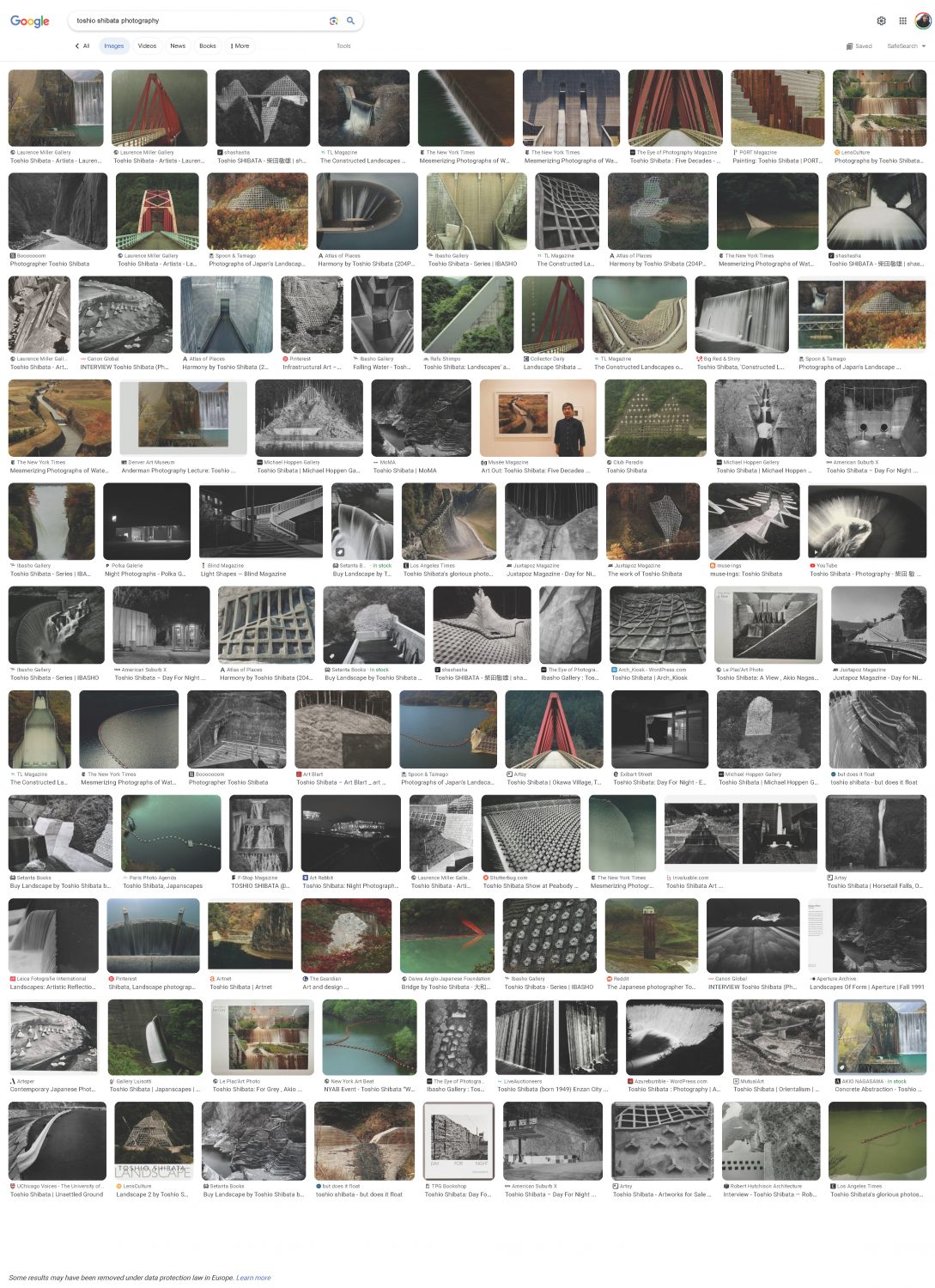
The photographs of Toshio Shibata achieve a unique harmony by focusing on the interweaving and equilibrium of natural forces with man-made objects and structures.
The question of beauty is personal of course. And the places I photograph are actually quite ordinary. They may be found in locations where the surroundings (mountains, sea, and sky) are unquestionably beautiful. But the things I photograph are not always beautiful in themselves.
To me, beauty is not the only reason for taking photographs. There are various reasons to click the shutter – for example form, texture, and graphical interest, depending on the situation. Whether viewers see my works are beautiful or not, I hope they will have feeling and inspire the viewer’s imaginative power…I want people to see my works freely with their own eyes, perceiving something deeper from the entire work, its movement, structure, texture.
SHIBATA, Toshio 2023. Japan. Munich, London, New York: Prestel. p195.
At the moment of taking a picture, I almost don’t see details. I concentrate on the overall structure, forms and movement, and before I lose sensation I capture this as soon as I can. In many cases, I only notice details later in the enlarged print; sometimes I only see it when someone points it out…
In printing, I can transform detail into a strong weapon.
SHIBATA, Toshio 2023. Japan. Munich, London, New York: Prestel. p196.
I think of my subjects like still lifes, separate from their surroundings. I aim to remove the subject from history and stories related to the land. In this way, I try to create images that are open to various interpretations. By eliminated the skies that exist in our real world, I hope to eliminate emotion or sentiment. Even though there are no clouds in my photographs, I feel strong sympathy with the idea of ‘”equivalents” – the idea to be free and reset subject matter from literal interpretation.
SHIBATA, Toshio 2023. Japan. Munich, London, New York: Prestel. p199.
Using a large format camera, he eliminates most references to scale, sky, and horizon while providing crisp detail and texture. Long exposures capture water’s strength and innate grace as it spills, crashes, and glides over constructed sluices and channels. Arching paths of highways are seen carving into mountainsides and sheer cliff faces are transformed into repeating patterns as they are interlaced with human engineering.
As the title Day For Night implies, the book shows a progression through a sequence of night-time photographs into a set of images made in the day. But in Shibata’s camera light and darkness swap roles. Intense light sources, both indoor and outdoor, make the nocturnal scenes even stranger than they would be if enveloped in darkness. The daylight pictures depict heavy masses of constructed earth and stone in a world that is anything but bright and airy. In the pivot between day and night lies a foreboding tunnel that subsumes both the luminous and the murky.
“The title gives another layer to the book, I knew that technique since my childhood through watching ‘Rawhide’ on TV but until now I’d never seen my own work with such an eye.”
The title “Boundary Hunt” refers to the intersection between natural and human landscapes. Landscape fragments – nets against landfalls, piles of stones, encrusted metal, blocks of cement – are set together with large monumental dams that are made to look small, skyless crops of combinations of landscape elements like trees against rocks and waterfalls. With the occasional dwarfed person with their back to the viewer.
This large paper back flexible book is a series of polaroid snapshots shot between 2000 and 2004 in Japan and the United States.
“The imperfection of the Type 55 film border has always fascinated me. When I look at the resulting image, I find myself on the boundary between a photograph and an art drawing”
from Toshio Shibata’s afterword (included in English).
The second video (Italian) discusses the importance of minimalism and negative space in Shibata’s black and white work, and Japanese photography in general. Arguing that the use of grey-black and white gives a sense of ‘morbidezza’, a word that in Italian art combines the senses of sensitivity/fragility with perishability/impermanence/death. The book has one photo on the right hand page of each spread, apart from one foldout panorama of multiple versions of the same image towards the end. This design emphasises the meditation on fragility.
‘Falling Water’ is a series of black and white images of dam infrastructure across Japan and the USA.
“About two decades ago, I had the opportunity to photograph a set of photos for the large vertical book DAM. To view my subject in vertical way gave me the impression that I was losing delicate materials in the photo. Despite my efforts, I couldn’t make the assignment in time. However, I continued photographing dams, and the result is this book.”
The book Painting reveals 16 unpublished colour photographs by Toshio Shibata, a Japanese photographer who is known for his rigorous and meticulous compositions. The representation of intimate yet spectacular landscapes — natural, and especially artificial — are at the core of Shibata’s work. In keeping with the tradition of painting that Shibata studied in his early years in 1968, this book celebrates the abstraction of beauty. It has been designed in a concertina format that can also be turned into a suspended object — just like a kakemono, a Japanese unframed scroll painting made on paper or silk and displayed as a wall hanging.
Landscape 2. Portland, Ore.: Nazraeli, 2008. ISBN978-1-59005-238-9. Color photographs.
Still in the Night. Koganei, Tokyo: Soh Gallery, 2008. Black and white night views, 1982–86 of expressways in Japan. Captions and text in Japanese and English.
Randosukēpu: Shibata Toshio (ランドスケープ: 柴田敏雄). Tokyo: Ryokō Yomiuri Shuppansha, 2008. ISBN978-4-89752-285-2. Black and white and color photographs.