Category: Landscape

  • Origins of the Picturesque and aesthetic consumerism

    In the second half of the eighteenth century, definitions of types of landscape or view, seen from an aesthetic or artistic point of view distinguished between:

    • the sublime (awesome sights such as great mountains)
    • the beautiful, the most peaceful, even pretty sights.

    See discussion in Part 1 Beauty and the Sublime

    In between came the picturesque, views seen as being artistic but containing ‘pleasing’ elements of wildness or irregularity. Together with Gothic and Celticism it became part of the romantic aesthetic of the growing numbers of leisured middle classes.  Improved road communications and travel restrictions on continental Europe saw an explosion of British domestic tourism in the 1780s and 1790s. Many of these picturesque tourists who flooded areas like the Lake District sketched or painted using Claude Glasses  or used the camera lucida.

    The word picturesque, meaning literally “in the manner of a picture; fit to be made into a picture”, was a word used as early as 1703 (Oxford English Dictionary), and derived from an Italian term pittoresco, “in the manner of a painter”. Prime examples are French landscape painters like Claude Lorrain. Gilpin’s Essay on Prints (1768) defined picturesque as “a term expressive of that peculiar kind of beauty, which is agreeable in a picture” (p. xii) and proposed a number of “principles of picturesque beauty”. Richard Payne Knight, Uvedale Price (1794  An Essay on the Picturesque as Compared with the Sublime and Beautiful) and Thomas Johnes, developed Gilpin’s ideas into more comprehensive theories of the picturesque and apply these more generally to landscape design and architecture advocating more organic shapes to views and structures such as follies and grottos.

    After 1815 when Europeans were able to travel again after the wars, Italy became a favourite destination for picturesque-hunters and artists. This reinforced ideas of the ‘picturesque’ in the sense of a view that has been ‘perfectly’ composed according to compositional and perspective theories (eg leading lines, golden mean) that were key developments in art in Renaissance Italy). Grand theories of wild natural beauty gave way to the tamer and more commercialised picturesque of the mid 19th century using these broad principles. These ideas also underlie standard compositional prescriptions in many books and magazine articles on techniques of landscape photography today.

    See Posts:

    Gilpin’s theory of the picturesque

    Francis Frith’s poscards.

    and weblinks:

    Susan Sontag describes this commercialisation of the picturesque as ‘aesthetic consumerism’ (Sontag, 1977, p.24). As Malcolm Andrews (1999) remarks, there is “something of the big-game hunter in these tourists, boasting of their encounters with savage landscapes, ‘capturing’ wild scenes, and ‘fixing’ them as pictorial trophies in order to sell them or hang them up in frames on their drawing room walls”. They ignore the complex social, political and economic interests and conflicts between classes, conservation and industrialisation, commercial interests and local people, those living and working in the countryside and those who simply enjoy it for leisure or regard it as part of their heritage.

    Fay Godwin suggests that ignoring the different interests and conflicts exacerbates polarisation of interests between users of the countryside: “I am wary of picturesque pictures. I get satiated with looking at postcards in local newsagents and at the picture books that are on sale, many of which don’t bear any relation to my own experience of the place… The problem for me about these picturesque pictures, which proliferate all over the place, is that they are a very soft warm blanket of sentiment, which covers everybody’s idea about the countryside… It idealises the country in a very unreal way.”
    (Fay Godwin 1986 South Bank Show Produced and directed by Hilary Chadwick, London Weekend Television quoted Alexander 2013 p84.)

     3.1: Reflecting on the picturesque

    Going beyond the picturesque requires thinking very carefully about what one is trying to say about ‘landscape’ and why. It also raises aesthetic challenges about how to communicate this in terms of following or subverting conventional theories of composition and the likely interpretation by different viewers.

  • Preconceptions about Landscape

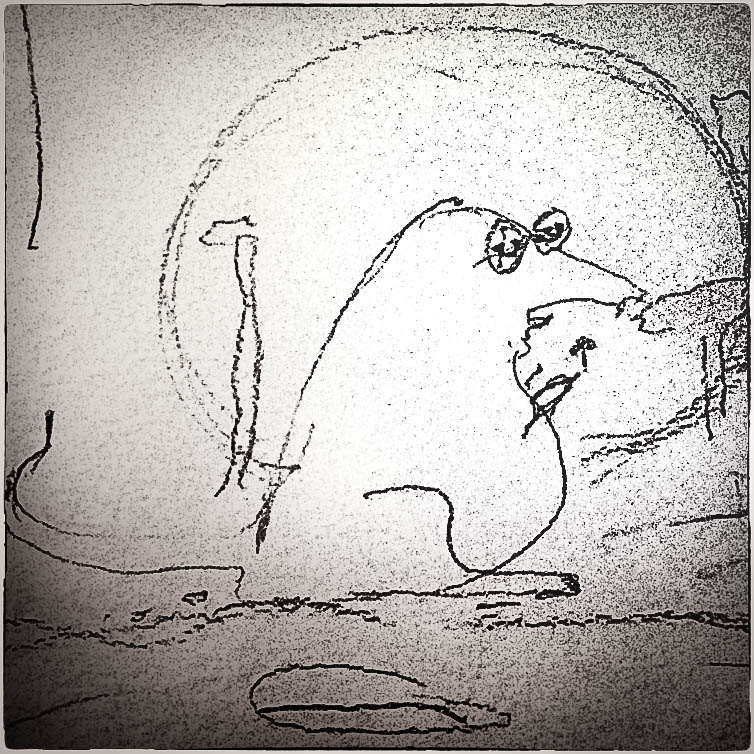
    TASK:Abandon technique. Pick up a pencil and draw a very rough sketch of a ‘landscape’ picture or brainstorm.

    I found this quite difficult because I have been doing landscape drawings and paintings for OCA Fine Art courses (See my Landscape Art and Prints on Zemniimages). These have broadened my own preconceptions of what landscape can be to anything from figurative panoramas, through expressionist close-up to near complete abstraction. Though this diversity is not yet reflected in my photography – one of the reasons I find this course exciting.

    • what shape is the picture? 19C conventions were usually landscape format with broad vistas. But some late 19C landscapes and also earlier drawings were much more focused on particular elements in portrait format eg trees. Japanese and Chinese landscapes were also  often vertical. There can also be very long thin panoramas, or tall thin verticals also.
    • what sort of terrain is depicted? 19C conventions and also Chinese and Japanese landscapes were concerned with mountains, trees, flat fields, sky, water, river. Sometimes cottages, houses, castles. 
    • what is in it?  Are there people? 19C conventions and before generally used landscape as a backdrop to religious or historical paintings. ‘Landscape paintings’ in both Western and Asian traditions generally had one or two people or a small group of people dwarfed by the natural elements. Sometimes they are excluded altogether eg  Monet’s waterlillies and abstract landscapes like Richter. 
    • how are the subjects arranged? According to rule of thirds composition. Pleasing. But might have high, low or central horizons, and diagonals and triangular relationships or swirling circles.
    • how might you describe the ‘mood‘ of the picture. Awestruck, calm, Turner’s turbulence.  David’s mystique. Whistler’s mistiness. Colour and dramatic distortions in Hockney.

     Rosalind Krauss ‘Photography’s Discursive Spaces: Landscape/View

    Compares two versions of the same image by Timothy O’Sullivan ‘Tufa Domes, Pyramid Lake (Nevada)’

    1868 photograph which later became a celebrated example of art photography for its abstract composition, and contrast between mistiness of the water and the detail of the foreground – ‘Twentieth century sensibility welcomes…as a model of the mysterious, silent beauty to which landscape photography had access during the early decades of the century’ ‘the mysterious beauty of the image is in this opulent flattening of its space’.

    1875 lithograph published in King Survey Report as a geological study. This increased the detail and thereby removed the mystery.

    She argues that different types of image are legitimate for different types of discourse. She examines the transition in painting, and a little later in photography, from early 18C landscape with feelings of depth that had been commissioned particularly to hang in houses of patrons, to flattened perspectives more suitable for displaying on larger exhibition gallery walls. ‘Transformation after 1860 into a flattened and compressed experience of space spreading laterally across the surface’. Voiding of perspective but with sharp value contrasts. Serial landscapes like Monet’s haystacks.

    But is an issue if the effects and our appreciation of a work does not relate to the original intention of the artist? eg in the case of O’Sullivan if what we value today are effects caused by the limitations of the photographic process that O’Sullivan would have changed if he could.

    Many 19C images were also intended to be viewed through stereoscopes. Shutting out surroundings to focus on the ‘view’ or sequence of ‘views’. Makers of stereo views often structured the image around a vertical marker in the fore-or middle-ground to center the space. Copyright was often with the companies, not with the photographer.

    Atget – need to understand the number, sequencing and repetition in relation to the way they were used and cataloguing systems. He himself did not give an artistic evaluation. What does this imply for our evaluation of his photography as art?

    When does a ‘view’ become a ‘landscape’?

  • Postcard Views

    Task:

    1. Gather a selection of postcards (6-12) that you’ve either bought yourself or received from other people. If you don’t have any, then try to borrow some from other people,or see what you can find on an internet search. Write a brief evaluation (around 300 words) of the merits of the images you find. Importantly, consider whether, as Fay Godwin remarked, these images bear any relation to your own experience of the places depicted in the postcards.

    “I am wary of picturesque pictures. I get satiated with looking at postcards in local newsagents and at the picture books that are on sale, many of which don’t bear any relation to my own experience of the place… The problem for me about these picturesque pictures, which proliferate all over the place, is that they are a very soft warm blanket of sentiment, which covers everybody’s idea about the countryside… It idealises the country in a very unreal way.” (Fay Godwin)

    It is now quite some time since I received or sent postcards – most things these days are done by Facebook posts. I looked for postcards in East Anglia seaside towns like Aldeburgh but most were art postcards, no photographs. Even in Cambridge it is difficult to get ‘straight’ postcards. Most are tinted or artist drawings. I feel the traditional postcard is probably going out of fashion with technological change. On the Internet search for ‘postcards’ shows many sites where you can send off your own photos and get them produced as cards – this seems to be the growing trend. The other trend of for vintage postcards and art postcards.

    In the end I resorted to a simple search for Google images of some places I am familiar with on the Norfolk and Suffolk coast.

    Hunstanton postcards

    I find these very tame and boring – the place itself is breezy with salt spray in your face, sounds of seagulls that eat your fish and chips chips, a very poignant out-of-season wrapped up feel on its fun fare and Seaworld, crashing waves against the sea defences and amazing light. It is one of the few places on the East Anglia coast that face West where you can see a sunset, and is also a place famous for seeing a sky full of geese flying to roost or migrating. But nothing of this was in the postcards. They mostly just showed:

    These images are not really ‘picturesque’ in Gilpin’s sense, more just promotion of seaside holidays. The pictures of castles are generally full frontal, with very little photographic artistry. Maybe imitating snapshots that holiday-makers themselves might take.

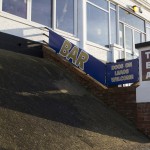
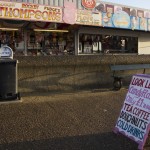
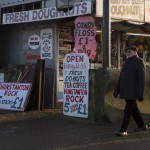
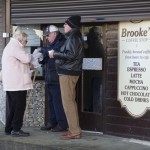
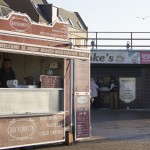
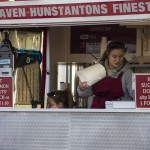
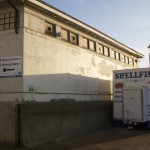
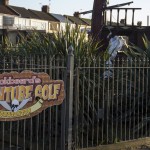
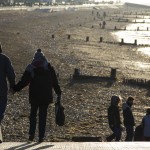
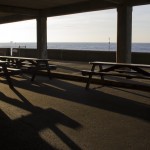
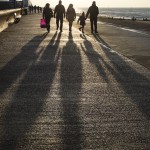
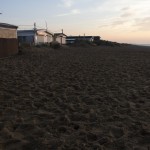
    Below are a selection of my own mixed ‘picturesque’ and social documentary images taken in early January out of season. I find these out of season images capture more of the spirit of the place – the light and long shadows, the way people enjoy themselves even when it is cold.

    Some other out of season images of Snettisham just down the coast. These are not picturesque – many are purposely underexposed – but do echo my memories of the place. This is possibly because of my memories of taking them – the act of taking images alters perception and memory itself.

    Aldeburgh in Suffolk

    This resort is better portrayed with rather more imagination – maybe because tourists there are rather more upmarket and it is a centre for art shops for the London weekend getaways with money – but still rather tame. Many of the street scenes use a very wide angle lens and leave out the traffic and parked cars – the streets are rarely that quiet.

    Cyclists walking in front of shop

    Fish and chip shop (very famous this one)

    Street view

    Some of what I consider to be the more interesting cards include:

    a  composite with different shaped and sized images of some of the major landmarks

    set of panoramas of different views from the seafront looking towards the town

    narrow panorama of the seafront houses

    narrow panorama of the tower

     the pier

    distant town view from the far beach.

    These cards do capture something of the light, the colour of the Dutch/Norfolk style houses as they look in the sunshine, the dramatic cloud forms (although the blue is too saturated) and the movement in the waves. These are more ‘picturesque’. What they fail to capture is the energy of the place and the people – all the children walking along the top of the sea wall, the different fashions people wear, the scrabble for parking in town (though plenty outside along the shoreline). They also fail to capture the drama of the windy cold days with people still enjoying a bracing walk on the shingle beach. And there is absolutely no social commentary – the parties of the rich with drunken and exclusive guests spilling out onto the streets from their holiday cottages.

    Below are some of my own more ‘picturesque images’ – I also have not so far dared to take pictures of drunken aristocracy. These for me capture more of the feel of the place – though many were taken with an old i-Phone and are not completely sharp.

    2. Write a brief response (around 200 words) to Graham Clarke’s comments above. Do you think it’s possible not to be a ‘tourist’ or ‘outsider’ as the maker of landscape images?

    “…the landscape photograph implies the act of looking as a privileged observer so that, in one sense, the photographer of landscapes is always the tourist, and invariably the outsider. Francis Frith’s images of Egypt, for example, for all their concern with foreign lands, retain the perspective of an Englishman looking out over the land. Above all, landscape photography insists on the land as spectacle and involves an element of pleasure.”

    Graham Clark (1997 p73)

    In its conventional sense as a noun, the land is inanimate space though it may have life in it – so the photographer is inevitably apart as an observer in the way they are not necessarily with documentary or street photography where the subjects of the photograph may participate in determining the meaning .If one takes ‘landscape’ as a verb and not a noun – an act of slicing parcels of space and thereby giving them some meaning – then also the photographer is always in some sense an observer and hence ‘outside’.

    But an observer is not necessarily superficial, privileged, a disinterested tourist or portraying land as spectacle for pleasure. Much depends on the intention of the photographer, their understanding of the complexities of the space they are ‘landscaping’ and the intended audience or market for the images. People may photograph the environment in which they live, or serve as a voice for other people living in the landscape – they are then less of an  outsider. Many photographers have also acted as advocates for preservation or restoration of landscapes devastated by commercial or other human exploitation – those images are far from pleasurable. Technically it is possible to select the content and composition, include even parts of the photographer’s body in the image, to increase the feeling of immersion and involvement. If the intended audience or market for the images is looking not for pleasure or commercial attraction, but to be informed of issues in the landscape/landscaping and the forces that shape it then the photographer often does in-depth research akin to documentary to select the images and meanings to communicate.


  • Psychogeography and Edgelands

    Initial reactions to ‘Wire’ and ‘Power’ – I found the descriptions evocative and also reminiscent of forbidden forays of my own early teenage life with my best friend or my dog into old bombed sites and semi-urban lanes on the outskirts of Manchester – with their potential threats of meeting with men in wait for teenage girls, gang knife fights between rival football teams and the odd murder.

    Many of the descriptions also resonate with areas along my daily walk in Cambridge that I have chosen for ‘Transitions’. And the book is definitely one source of inspiration to which I shall return many times as I progress with that project.

    But I agree with Marion Shoard:

    This book could perhaps have had more investigative rigour. The edgelands now need something beyond a merely subjective celebration of their identity. Far more than our towns and countryside, they are being subjected to ceaseless change. Wild space is being prettified at the expense of its character and creatures. Industrial ruins are being cleared away.

    We could be in the process of losing this landscape just as we are discovering its charms. Should we be trying to conserve it, as we conserve the best of rural environments? Or would any attempt to regulate this space destroy the wildness that makes it special?

    It is time for us to consider what relationship we want to see in the long term between our activity in the edgelands, their epic infrastructure, their unique wildlife and industrial archaeology and their peculiar place in our imagination. 

    Marion Shoard Guardian Review

    Robert Macfarlane Guardian review

  • Francis Frith

    Francis Frith postcards website

    edited from Wikipedia article

    Francis Frith Images

    Francis Frith  (1822 –1898) was an English photographer of the Middle East and many towns in the United Kingdom. Frith was born in Chesterfield, Derbyshire.  In 1850 he started a photographic studio in Liverpool, known as Frith & Hayward. A successful grocer, and later, printer, Frith fostered an interest in photography, becoming a founding member of the Liverpool Photographic Society in 1853. Frith sold his companies in 1855 in order to dedicate himself entirely to photography.

    Frith was “recorded” as a Quaker minister in 1872 (at this time there were little more than 250 recorded ministers in England and Wales). He served on numerous committees, and frequently spoke in favour of pacifism and abstinence.  In 1884, he published (with William Pollard and William Turner) A Reasonable Faith, a highly controversial pamphlet which challenged evangelical orthodoxy by questioning the factuality of the Bible. Francis Frith and his co-authors who began the liberalisation of the Quaker movement and paved the way for the philanthropic and educational reforms for which the movement is well known today.

    Middle East Travels

    He journeyed to the Middle East on three occasions, the first of which was a trip to Egypt in 1856 with very large cameras (16″ x 20″). He used the collodion process, a major technical achievement in hot and dusty conditions.

    During his travels he noted that tourists were the main consumers of the views of Italy, but armchair travellers bought scenes from other parts of the world in the hope of obtaining a true record, “far beyond anything that is in the power of the most accomplished artist to transfer to his canvas.” These words express the ambitious goal that Frith set for himself when he departed on his first trip to the Nile Valley in 1856.

    Restored albumen print of the Suez Canal at Ismailia, c. 1860

    The Hypaethral Temple, Philae, by Francis Frith, 1857; from the collection of the National Galleries of Scotland


    He also made two other trips before 1860, extending his photo-taking to Palestine and Syria.

    In addition to photography, he also kept a journal during his travels elaborating on the difficulties of the trip, commenting on the “smothering little tent” and the collodion fizzing – boiling up over the glass. Frith also noticed the compositional problems regarding the point of view from the camera. According to Frith, “the difficulty of getting a view satisfactorily in the camera: foregrounds are especially perverse; distance too near or too far; the falling away of the ground; the intervention of some brick wall or other common object… Oh what pictures we would make if we could command our point of views.” An image he took known as the “Approach to Philae” is just one example which elaborates his ability to find refreshing photographic solutions to these problems. (cited from “A World History of Photography”)

    Survey of Britain and Francis Frith & Co. 

    When he had finished his travels in the Middle East in 1859, he opened the firm of Francis Frith & Co. in Reigate, Surrey, as the world’s first specialist photographic and postcard publisher, a firm that became one of the largest photographic studios in the world. In 1860, he married Mary Ann Rosling (sister of Alfred Rosling, the first treasurer of the Photographic Society).

    The same year he embarked upon a colossal project—to photograph every city, town and village in the United Kingdom; in particular, notable historical or interesting sights. Initially he took the photographs himself, but as success came, he hired people to help him. Frith’s ‘views’ were predominantly of places with social or historical significance but also included a great number of more mundane but equally valuable street scenes.

    Frith died in Cannes, France at his villa on 25 February 1898.

    The ten-part BBC series Britain’s First Photo Album, presented by John Sergeant, was first shown on BBC2 in March 2012 and takes a look at the history of Francis Frith’s pioneering photographic work. A 320 page book also entitled Britain’s First Photo Album has been published. The Frith and Co. brand continues today, and it’s possible to purchase prints and other merchandise from the online store.

    Graham Clark (1997, p.73) remarks:
    “… the landscape photograph implies the act of looking as a privileged observer so that, in one sense, the photographer of landscapes is always the tourist, and invariably the outsider. Francis Frith’s images of Egypt, for example, for all their concern with foreign lands, retain the perspective of an Englishman looking out over the land. Above all, landscape photography insists on the land as spectacle and involves an element of pleasure.”


  • Illka Halso

    ‘I plan and visually construct buildings, which will protect nature from threats of pollution and what is more important, from actions of man. . . . When putting nature into a museum, you have to take under consideration the aspect of the audience/consumer. Nature becomes a joyride for tourists or a beautiful landscape turns into a meditative theatre show.’

    https://www.personsprojects.com/artists/ilkka-halso?x=bio

    Website

    http://ilkka.halso.net

    Ilkka Halso is a Finnish artist uses fabricated digital tableaux to  investigate the relationships between architecture, technology and nature, through photo-realistic renderings and collages set in natural environments. His artist’s statement begins tongue-in-cheek, with:
    “In order to protect and restore nature we need stronger means. Ilkka Halso has continued his conquest in order to save the world. He presents plans for a brighter and more durable millennium.”
    (www.ilkka.halso.net) In “Tree Works” and “Restoration” (2000-2005), light structures are built around existing trees with the aim of protecting them and, at the same time, of turning them into a sort of “living museum” of nature explorable by a public. Nature is somehow commodified and transformed into a spectacle to admire from very close. The architectural language is that of the scaffolding, transitional structures used to build a construction or to refurbish it: the act of connecting metal poles to natural environments engages a surreal discourse based on man’s paradoxical attempt to preserve what he’s currently destroying. In Ilkka Halso words:
    “I show ironic visions of mans relation to nature and his confidence in technology in solving problems caused by his own activities .I builded fictive restoration sites. Scaffoldings are covering objects of nature instead of houses and man-made objects. Trees, boulders, rock faces and fields are under repair.”
    In the Museum of Nature series, great biomes are in the process of being erected to protect areas of forest from pollution. Halso imagines a near future in which it is necessary to protect and preserve the natural environment with increasingly extreme interventions. He combines still photographs with 3D modelling software to realise his dystopian visions.
    I make plans and construct visually buildings, which protect nature from threats of pollution and what is more important from actions of man. I visualize shelters, massive buildings where big ecosystems could be stored as they are found today, in the present. These massive buildings protect forests, lakes and rivers from pollution and, more importantly, they protect nature from the actions of man himself. At the same time, I study different aspects of man’s relation to nature as though a rare, unique and endangered place.. While putting nature into a museum you have to take under consideration aspect of audience/ consumer. Nature becomes joyride for turists or beautyfull landscape turns into a meditative theatre show. Project is based on pessimistic vision of what is happening on earth. I am looking into future and I am not very happy about that. I am considering these pictures more as visual pamphlets than estetical images.
    In the recent ongoing series, Naturale, Halso has imagined a gigantic, Ark-like warehouse, containing secure samples of flora and crates of micro-ecosystems, ready for re-planting should the need arise.
    It’s typical for human beings to mould nature, justifying their actions with their aesthetic and economic aspirations. But nature can’t endure everything. In my photographs, control over nature has acquired a concrete form. The elements of nature have been rethought and have, for logistical purposes, been packed into modules that are easier to handle. The whole of nature is stored in a gigantic warehouse complex and the most common types of nature, from soil and flora to fauna can be easily assembled into working ecosystems. What’s happening? Has nature been evacuated to await better times, or has it been simplified into merchandise and absurd tableaux? I’m looking into the future. I don’t like what I see.

    Museum of Nature

    Works are visualized building plans, plans I do not want to see realized.

    http://ilkka.halso.net/pdf_download/Anatomy_of_Landscape_Dissection.pdf

    Combines photographs of nature with computer generated 3D-models.

    I visualize shelters, massive buildings where big ecosystems could be stored as they are found today, in the present. These massive buildings protect forests, lakes and rivers from pollution and, more importantly, they protect nature from the actions of man himself [sic]. At the same time, I study different aspects of man’s [sic] relation to nature as though a rare, unique and endangered place.

    While putting nature into a museum you have to take under consideration aspect of audience/ consumer. Nature becomes joyride for turists or beautyfull landscape turns into a meditative theatre show.

    Project is based on pessimistic vision of what is happening on earth. I am looking into future and I am not very happy about that. I am considering these pictures more as visual pamphlets than estetical images.

    Anatomy of Landscape

    With light as his tool, Ilkka Halso slices and cuts the landscape into biopsies, making cross-sections with a figurative scalpel. Even though the subject matter is the landscape, his images also speak of humans and their need to control and adjust the environment, including their perception and experience of it. Via an almost clinical approach the landscape becomes the material of the so called “scientific man’s” ways of perceiving and parsing nature.

    Panoramic collages and exploded views of photographs from different places in Finland.

    http://ilkka.halso.net/pdf_download/Anatomy_of_Landscape_Dissection.pdf

    Photographs are artificially lit from above in the darkness. Using a
    remote-controlled multicopter, flashlights are freely moved above the landscape, highlighting boundless details. From each location hundreds of frames of material are recorded, constituting massive amounts of data that can be manipulated in at least as many different ways.

    Other references

    https://www.personsprojects.com/artists/ilkka-halso?x=bio

  • Paul Shambroom

    website

    Shambroom is conducting a long-term investigation of power. This started with series on nuclear weapons, factories and corporate offices. He then focused on homeland security training and preparation. His images are influenced by painting traditions, including Dutch landscape painting.

    Meetings Series

    These photographs emphasize the theatrical aspects of meetings: There is a “cast”, a “set”, an “audience” (sometimes) and a “program” (the agenda). Seating arrangements, clothing and body language all provide clues to local cultural traits and political dynamics. The subjects play dual roles as private individuals and (sometimes reluctant) public leaders. Power may be relative, but the mayor of a town of 200 has much in common with the President of the United States. We see ourselves reflected (either positively or negatively) in our leaders, exemplifying both the highest ideals and lowest depths of the human spirit. Our reactions to them help define our perceptions of our own place in society, as insiders or outsiders, haves or have-nots
    Homeland Security

    This work examines issues of fear, safety and liberty in post-9/11 America. From 2003 – 2007 I am photographed facilities, equipment and personnel involved in the massive government and private sector efforts to prepare for and respond to terrorist attacks within the nation’s borders. First responders and law enforcement officers train in large-scale simulated environments such as “Disaster City” in Texas and “Terror Town”, an abandoned mining community in New Mexico purchased with funds from the Department of Homeland Security. Training scenarios, by necessity, involve simulated environments and threats. This blurring of fiction and truth mirrors the difficulty we have discerning between legitimate safety concerns and hyped-up fear.
    Treasure: Landscapes of the U.S. Strategic Petroleum Reserve

    Shambroom photographs the U.S. Strategic Petroleum Reserve (SPR) – emphasising the way that this is hidden – as ‘critical assets’ public attention is discouraged although access is not illegal. The Department of Energy agreed to let him photograph from outside the sites without hindrance and allowed me to visit inside one site, but only after lengthy negotiations.

    How does one photograph something that can’t be seen? My approach was to work from a distance to incorporate the land and water over the storage caverns, and include lots of sky. I took inspiration from 17th century Dutch landscape paintings, whose fluffy clouds and bucolic countryside spoke of that nation’s prosperity. For a while back in the twentieth century the United States enjoyed similar prosperity, with a seemingly limitless supply of petroleum to power industry and automobiles. The oil supply was truly “out of sight, out of mind”.

    Today it is very much on our minds. The hundreds of millions of barrels of oil beneath these idyllic landscapes offer a very thin veneer of protection to our economy and way of life. By government estimates, the Strategic Petroleum Reserve could replace foreign oil imports for 59 days. Then the tap would be empty.

    Lost

    “Lost” is a series of photographs derived from missing pet posters placed by owners in public places. These images have been degraded by environmental factors or printer malfunctions, resulting in serendipitous and unexpected color and texture. The additional partial loss (of the image) mirrors the ambiguous loss of a beloved family pet. The incorporation of short selections of text from the posters introduces unintentional humor and beauty in the form of found poetry. The words and images combine to transcend the particular family dramas represented in each image, and address more universal themes of loss and uncertainty.

  • Tim Simmons

    From Out West

    website: http://www.timsimmons.co.uk

    Simmons creates his nocturnal landscapes using fluorescent lamps and a range of post-production techniques. His images might be described as ‘hyper real’; they have an aesthetic that somehow seems to transcend photo-realism. They look almost artificial, like video game graphics.

    Tim Simmons established a successful career within the field of motor photography. Simmons’s innovative lighting methods that brought him to the attention of advertising agencies, who wanted to place cars within his out-of-this-world landscapes.

    His recent projects are more tightly cropped ‘vignettes’ or almost meditative viewpoints. Simmons locates his practice within a fine art context and has installed his images in temporary open-air exhibitions across the world, some of which, ironically, have been presented on billboards.

    See: http://www.timsimmons.co.uk/showkase/ulp-billboards-2011/

  • James Morris

    In Wales, particularly South Wales, the idea of ‘post-industry’ is poignant in the light of the well-documented, widespread decline in industrial activity in recent decades.

    In A Landscape of Wales (2010), James Morris explores the diverse landscape of the country, including the Gothic-looking remains of slate quarries and other sublime-inspiring features. Most interestingly, Morris looks at how the tourism and heritage industries, which continue to play a major part in the Welsh economy, relate to the landscape. Morris provides an excellent example of the inextricable link between topography and industry, which have in turn shaped the identity of a place and its people.  (Alexander course text p105)

    See Google Images

    See more from this series at:
    http://www.jamesmorris.info   (Flash-based site)

  • John Davies

    [wpdevart_youtube]BW44iNga8Fk[/wpdevart_youtube]John Davies website

    See more of Davies’s work

    John Davies (born 1949 in Sedgefield, County Durham, England) is a British landscape photographer. He is known for completing long-term projects documenting Britain and its industrial and urban landscape. He juxtaposes elements of history, industry and social activity within a single composition to critically examine our social geography.

    The British Landscape is his best-known body of work

    Fuji City Mount Fuji, Japan is a meditation on the balance between nature and industry.

    The shift in subject matter also developed into a fascination with urban regeneration and work on this includes his Metropoli Project, City State, and Cities on the Edge, the latter of which he curated, in addition to contributing images of his own.

    Not judgemental – ask questions. People have different reactions to different images. Doesn’t include many people, but images are about what people have done in the environment.

    The caption to Davies’s Ffestiniog Railway image reads:
    “The Ffestiniog Railway was originally built to transport local slate, but in
    1964, following new connections to the national railway network, trains
    began serving the Trawsfynydd nuclear power station. Although the
    decommissioning of Trawsfynydd began in 1991, the railway continued
    to be used daily to transport 50-ton flasks of nuclear fuel and waste to
    the Sellafield reprocessing plant in Cumbria. Sellafield stopped taking
    waste from Trawsfynydd in 1997.”

    Technique

    He is known for producing large photographic prints of images produced from high vantage points, using traditional darkroom techniques. His work in the 1980s primarily used medium format cameras, and work from the 1990s alarge format camera, although in recent years he has begun using dSLR and digital medium format cameras in his work as well.

    The stylistic components reference – with irony – the picturesque:

    • Davies’s photographs are nearly always taken from high vantage points that hint towards a welltrodden, formalised ‘viewpoint’, looking out across views with foregrounds, middle distance and backgrounds (usually a rolling hill).
    • He continues to work with black-and-white film, linking his work to the classical aesthetics of Adams and Weston.

    Liz Wells (2011, pp.170–71) identifies a potential problem with Davies’s relation to the picturesque:
    “… his work operates as a visual archive of post-industrial Britain. But his personal style is so marked that content risks becoming subservient within a generalised vision of industrial legacy in ways that work against any sense of the specificity of each site. There is a risk that political commentary is diluted rather than distilled, as the industrial becomes a strand within a new picturesque.”

    Biography

    Davies was born in Sedgefield, County Durham, in 1949. He grew up in coal mining and farming communities, and this combination of open space and industry was to become a persistent motif in his creative work. His early life was spent living in industrial landscapes in County Durham and Nottinghamshire.

    He studied Photography, first attending Mansfield School of Art to complete a Foundation Course, then studying at Trent Polytechnic (now Nottingham Trent University), graduating in 1974. Following this, he began working on long-term projects, seeking commissions and arts funding to support his work. He has worked closely with Amber/Side Collective on a number of commissions. In 1981, Davies won a one-year Photography Fellowship at Sheffield Polytechnic, and he became Senior Research Fellow at the Art School of University of Wales Cardiff (UWIC) in 1995.

    He has also become involved in local politics, as his interest in the use of public space has been both personal and professional. He lives with his partner and their daughter Alix in Liverpool, England.

    Books by Davies

    • Aggie Weston’s no.13. Belper, Derbyshire: Stuart Mills, 1977 ASIN B0007C4X2C.
    • The Valleys project. Cardiff: Ffotogallery, 1985.
    • On the edge of White Peak. Derbyshire Museum Services, UK, 1985.
    • In the wake of King Cotton. Rochdale Art Gallery, UK, 1986.
    • Mist Mountain Water Wind. London: Traveling Light, 1986. ISBN 0-906333-18-0.
    • A Green & Pleasant Land. Manchester: Cornerhouse, 1987. ISBN 0-948797-10-X soft cover ISBN 0-948797-15-0.
    • Autoroute A26, Calais – Reims. Douchy, France: Mission Photogaphique Transmanche, 1989. ISBN 2-904538-16-X.
    • Phase 11 (eleven). London: The Photographers’ Gallery; London: Davenport, 1991. ISBN 0-907879-27-6.
    • Broadgate. London: Davenport, 1991.
    • Cross Currents. Cardiff: Ffotogallery; Manchester: Cornerhouse, 1992. ISBN 0-948797-32-0.
    • Linea di Confine della Provincia di Reggio Emillia Laboratorio di Fotografia 5. Arcadia Edizioni & Assessorato alla Cultra del Comune di Rubiera, Italy, 1992.
    • Skylines. Valencia University, Imp. Mari Montanana, Spain, 1993.
    • Through fire and water: River Taff. Oriel (The Arts Council of Wales’ Gallery, Cardiff); National Museum & Galleries of Wales, 1997. ISBN 0-946329-45-1.
    • Sguardigardesani. Milan, Italy: Charta, 1999. ISBN 88-8158-223-6.
    • Temps et Paysage. Tarabuste / Centre d’art et du Paysage, 2000. ISBN 2-84587-010-8.
    • Visa III, Littoral / Le retour de la nature. Filigranes, 2001. ISBN 2-914381-17-4.
    • Seine Valley. Le Point du Jour Editeur / Pole Image Haute-Normandie, France, 2002. ISBN 2-912132-21-5.
    • The British Landscape. Chris Boot, 2006. ISBN 0-9546894-7-X.
    • Cities on the Edge. Liverpool: Liverpool University, 2008. ISBN 978-1-84631-186-4.
    • Urban Landscapes / Krajobrazy Miejskie. Poznań, Poland: Centrum Kultury ‘Zamek’, 2008.
    • European Eyes on Japan / Japan Today volume 10. EU-Japan fest / European Eyes on Japan, 2008.