Not just the eye. Uses the hand to pain in parts. Sculptural and 3D form. Liberate from computer screen. Different types of paper. Or use CAD.
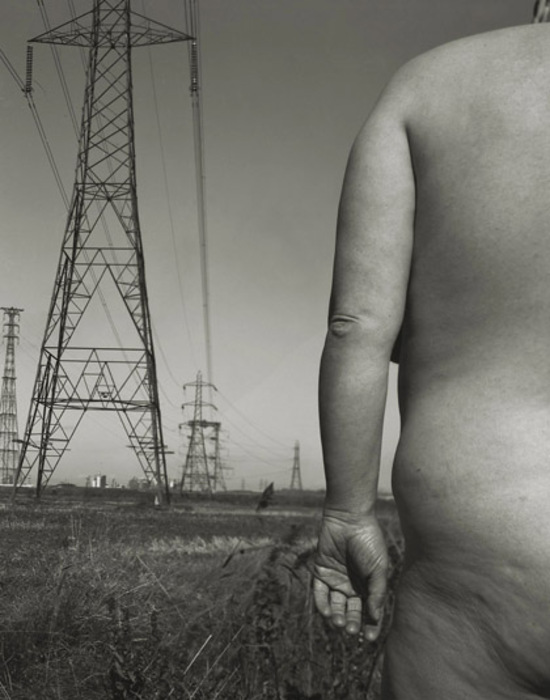
Body in the landscape, or landscape in the body
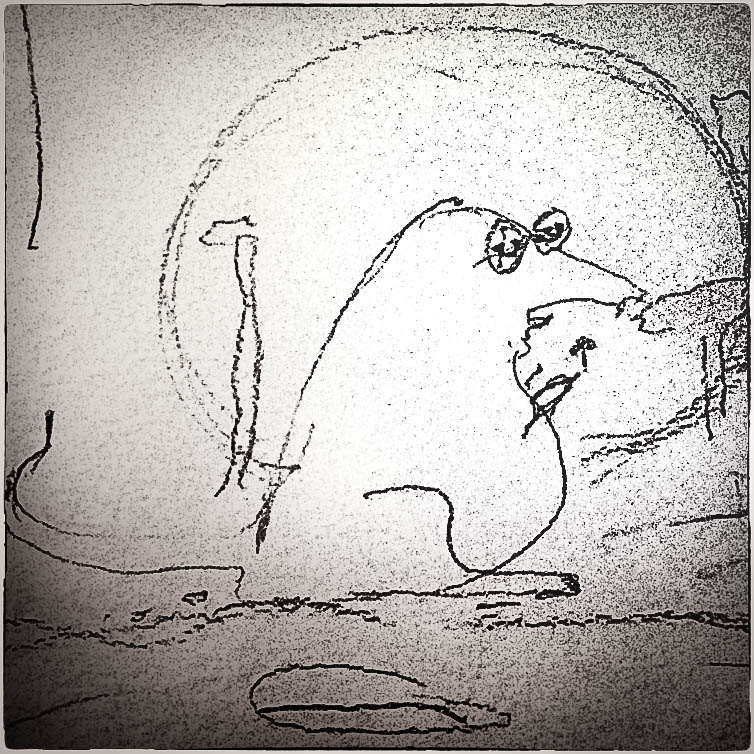
What does it mean to be both human and animal?
Wants to concentrate on unremarkable landscape – portrait of a field over a year. Landscape as a living being. And walk to a particular part of forest that changes through being cut down and exposes a particular view suddenly.
Pond 2011 installation at Crescent Arts Scarborough, UK, March 2011. video of frozen winter pond and trees. Occasional birds. Sheep in silhouette on the horizon.
The concept of ‘identity’ is central to most landscape photography – the cultural, historical, ecological and industrial factors shaping identities of people and places and the ways in which the two interact. ‘Identity’ is however not fixed. Individuals and groups of people are continually trying to reconcile multiple and changing identities as a means of making sense of their place in the world. Identities are constantly manipulated and contested by others in political processes. In the same way, meanings of ‘landscape’ and symbolic associations of places are also multi-layered, changing and often manipulated in attempts to shape power relationships between people and groups of people and peoples’ control over and use of ‘nature’ and other resources.
In deciding how to portray particular landscape/s key considerations are:
Who created, owns, uses and changes this landscape? How do these people relate to each other?
How is this ‘landscape’ distinguished from other similar places (who decides what is and what is not similar? by what criteria? why are those criteria important?)?
How do (different) users and inhabitants of a place feel towards (different aspects of) the landscape (pride, indifference, disrespect, fear of loss)?
What attitudes do (which) outsiders have towards it?
Underlying all these considerations must also be a consideration of:
Self-awareness on the part of the photographer of their own identity/ies and assumptions and power/desire (or lack of it) to manipulate and change things.
‘British-ness’, collective identities and the countryside
“The concept of the countryside is a significant element of the British identity. All countries have rural areas, but Britain’s is one of its ‘unique selling points’.” (Alexander p119)
Attitudes towards social issues like renewable energy or housing policy are often polarised by ‘Not in My Back Yard’ ‘visual impact’ on the land according to rather idealised ‘picturesque’ notions of what the landscape used to/should look like.
Personal identities and multiculturalism
British photographers have questioned established and stereotyped images of the British landscape and its heritage. Photographers like Godwin and Darwell manipulate aesthetics of the image, beauty in texture, pattern and atmosphere to keep the viewer’s attention – then guide it to pose more challenging and shocking questions about the landscape and peoples’ relationship to it. The effort of extracting meaning in this way also makes the images more memorable. See posts:
Environmental pollution and degradation:John DarwellDark Days (2001 Foot and Mouth Outbreak).
Relationship with animals:Clive Landen: sharp documentary style and brutal but images of death in Abyss (2001 Foot and Mouth Outbreak) and Familiar British Wildlife (series on roadkills).
Some activist photographers have been mainly concerned with industrial and post-industrial landscapes. Here big industry becomes the ‘new sublime’ to be feared and confronted in the hope of change and avoiding disaster.
Other photographers have avoided any overt messages, rather asking questions to which the viewer may have different answers. These take a gentler, more ‘picturesque’ approach.
Post-industrial spaces have also inspired a new kind of tourism: urban exploration of derelict factories and warehouses, abandoned hospitals and asylums, any kind of space that is shut up, difficult to get to (eg below ground) or in any other way off-limits or hazardous. “Leave nothing but footprints. Take nothing but photographs.”
There are dedicated websites and chatrooms, such as
In his 2003 essay, David Campany comments that:
“One might easily surmise that photography has of late inherited a major role as undertaker, summariser or accountant. It turns up late, wanders through the places where things have happened totting up the effects of the world’s activity.” (‘Safety in Numbness: Some remarks on the problem of “Late Photography”’ (in Campany (ed.), 2007)
This ‘aftermath’ approach dates back to the war photographers of the American Civil War and the Crimean War (1853–56), because of technological limitations of the time. Because of the large plate cameras and slow emulsions, it was not possible to photograph actual combat. Their images focused instead on portraits of soldiers, camp scenes and the aftermath of battles and skirmishes. Their images could not yet be reproduced en masse in the illustrated press, but some of these photographs were used as the basis for woodcut engravings for publications such as The Illustrated London News and Harper’s Weekly.
Although technology today makes it possible – though still difficult – to capture the heat of war and atrocities, this is not necessarily the most effective way of portraying the horrors of violence.
Examples of photographers using the ‘late’ approach in contemporary landscape include:
Richard Misrach‘s images of the American Desert show the aftermath of human activity but in a beautified distilled large format.
Sophie Ristelhueber ‘saerial images of the Afghan conflict show the scars left on the landscape
Paul SeawrightHidden cold ‘objective’ images of battle sites and minefields in Afghanistan
Willie Dohertymade very evocative images of the left detritus from conflicts during the Troubles and in the present day.
Other photographers have focused on the precursors – the tension in anticipation of violence. “not the ‘theatre of war’ but its rehearsal studio” (Campany, 2008, p.46). :
An-My Lê’s (to do) series 29 Palms (2004) documents US marine training manoeuvres at a range used to prepare soldiers ahead of deployment in Afghanistan and Iraq.
Broomberg and Oliver Chanarin in Chicago (2005) (to do) examine an Israeli military training ground
Paul Shambroom’s project Security (2003−07) studied the simulated training sites that are used by the US emergency services and Department of Homeland Security, nicknamed ‘Disaster City’ and ‘Terror Town’.
Sarah Pickering in UK has photographed training grounds for the fire and police service. Her images contain no people, aiming to seem like a film set ready for the action.
1. Read David Campany’s essay ‘Safety in Numbness’ (see ‘Online learning materials and student-led research’ at the start of this course guide). Summarise the key points of the essay and note down your own observations on the points he raises.
‘”There is a sense in which the late photograph, in all its silence, can easily flatter the ideological paralysis of those who gaze at it without the social or political will to make sense of its circumstance…If the banal matter-of-factness of the late photograph can fill us with a sense of the sublime, it is imperative that we think through why this might be. There is a fine line between the banal and the sublime, and it is a political line.” Campany p 192.
Campany reaches this conclusion first through a discussion of Meyerowitz’s photographs Aftermath and the BBC documentary in ‘Reflections on Ground Zero’.
[wpdevart_youtube]A8hN-aNWWBE[/wpdevart_youtube]
He questions the trend towards ‘photographing the aftermath of events – traces, fragments, empty buildings, empty streets, damage to the body and damage to the world’ and the way it has come to be prevalent in photojournalism as a response to the overwhelming use of video now as a record of unfolding events. Partly due also to the fact that photographers are now rarely allowed access to conflict sites – unlike for example in VietNam. One could add also since Campany’s 2003 article the ubiquitous use of mobile video phones by people involved in events now able to upload them almost instantaneously as a more ‘democratic’ and immediate (if often shakily filmed) perspective and record on what is happening.
He argues that it is the stillness of late photography that gives it its power – more memorable than events on the move. While its privileged status may be imagined to stem from a natural capacity to condense and simplify things, the effects of the still image derive much more from its capacity to remain open. It is that openness that can be paralysing ‘In its apparent finitude and muteness it can leave us in permanent limbo, suspending even the need for analysis and bolstering a kind of liberal melancholy that shuns political explanation.’
2. Look at some of Meyerowitz’s images available online from Aftermath: World Trade Centre Archive (2006). Consider how these images differ from your own memories of the news footage and other images of the time. Write a short response to the work (around 300 words), noting what value you feel this ‘late’ approach has.
Meyerowitz’s images were taken as the officially sanctioned record of the impact of the attack, partly as a memorial for the relatives but also a historical record. Their monumental ‘sublime beauty’ in the colours and the large cinematic format are apocalyptic – resonant of the paintings of artists like John Martin and Turner. Like much other ‘late photography’ there are few people. Those that are there are dwarfed by the enormity of the buildings, machinery and the hell volcanic fires. Meyerowitz claims that he did not make the images ‘I was told how to photograph it by the thing itself‘. As Campany points out, that means that he is not questioning his own background and assumptions that inevitably underlie his photographic skills and practice.
His approach is very different from that of another on-site photographer – a policeman John Bott. His images have more people in, and are more participatory social documentary of the clear-up activities.
Unlike Meyerowitz he did not get official permission – as he had done a lot of photography as part of his police work he had been asked to photograph the clear-up work by his boss. This was now leading to various legal complications. His health was seriously damaged by the photography work and he did not profit from the photos he took – proceeds being given to charity.
[wpdevart_youtube]vp5Zi16IRDg[/wpdevart_youtube]
I agree with Campany that the monumental aesthetic beauty in Meyerowitz’s images seems to anaesthetise and paralyse any political questioning of why the event occurred, and whether and why that particular type of historical record was needed. I was in India conducting an NGO workshop at the time of the attacks and first saw the news with colleagues. On the one hand they had all been through much more serious natural disasters – Gujarat Earthquake and periodically severe monsoon floods – where many more thousands of people had been killed both by the disaster itself, and then lack of emergency aid in the follow-up. Much of that unreported in the Western press. On the other hand, in the light of the ongoing war in Afghanistan, there was also high anti-American feeling. It was only when I got back two weeks later that I saw images at home.
I think that the apocalyptic nature seem to almost glorify the unintended martyrdom of the victims – matched by praise of the way in which the survivors lay their mourning images then get up and move on. They raise no questioning of events in the countries from which Al Quaeda perpetrators come, including but not only American actions, and how the conflict can really be resolved. To me they look very much like images I saw on the TV in Sudan some years later with the US ‘shock and awe’ opening of the Iraq War. But very different from the interviews with people on Al Jazeera Arabic channel of the impact. That time in video footage, some of it live.
This lack of questioning is not however inherent in ‘late photography’, but in the selection of the effects one photographs and their contextualisation in other images or documents that might portray a multiplicity of complex perspectives – even where a clear message in unlikely to be appropriate of effective.
————————————-
!!To be updated from Landscape Photography
In his 2003 essay, David Campany comments that:
“One might easily surmise that photography has of late inherited a major role as undertaker, summariser or accountant. It turns up late, wanders through the places where things have happened totting up the effects of the world’s activity.” (‘Safety in Numbness: Some remarks on the problem of “Late Photography”’ (in Campany (ed.), 2007)
This ‘aftermath’ approach dates back to the war photographers of the American Civil War and the Crimean War (1853–56), because of technological limitations of the time. Because of the large plate cameras and slow emulsions, it was not possible to photograph actual combat. Their images focused instead on portraits of soldiers, camp scenes and the aftermath of battles and skirmishes. Their images could not yet be reproduced en masse in the illustrated press, but some of these photographs were used as the basis for woodcut engravings for publications such as The Illustrated London News and Harper’s Weekly.
Although technology today makes it possible – though still difficult – to capture the heat of war and atrocities, this is not necessarily the most effective way of portraying the horrors of violence.
Examples of photographers using the ‘late’ approach in contemporary landscape include:
Joel Meyerowitz’s Aftermath images ofGround Zero in New York
Richard Misrach ‘s images of the American Desert show the aftermath of human activity but in a beautified distilled large format.
Sophie Ristelhueber ‘s aerial images of the Afghan conflict show the scars left on the landscape
Paul SeawrightHidden cold ‘objective’ images of battle sites and minefields in Afghanistan
Willie Doherty made very evocative images of the left detritus from conflicts during the Troubles and in the present day.
Other photographers have focused on the precursors – the tension in anticipation of violence. “not the ‘theatre of war’ but its rehearsal studio” (Campany, 2008, p.46). :
An-My Lê’s (to do) series 29 Palms (2004) documents US marine training manoeuvres at a range used to prepare soldiers ahead of deployment in Afghanistan and Iraq.
Broomberg and Oliver Chanarin in Chicago (2005) (to do) examine an Israeli military training ground
Paul Shambroom’s project Security (2003−07) studied the simulated training sites that are used by the US emergency services and Department of Homeland Security, nicknamed ‘Disaster City’ and ‘Terror Town’.
Sarah Pickering in UK has photographed training grounds for the fire and police service. Her images contain no people, aiming to seem like a film set ready for the action.
Before photography landscapes for mass market were available as etchings. Postcards were invented in the late 19th Century – objectifying places into commodities that could be consumed and collected for a reasonable price. People often collected postcards of places they could never travel to. By the 1870s Americans could buy photographic prints of faraway places in their local shop or mail order (Snyder in Mitchell, 2002 p179 q Alexander 2013 p89). Stereoscopic cards also became available. In order to create the 3D illusion these reinforced traditional views of separation of landscape focal planes into foreground, middle ground and background.
More recently, with the development of mass tourism since the 1950s, postcards were mass produced as souvenirs of places people visited and to send home ‘Wish You Were Here’. The main emphasis is on enjoyment and selling particular places as destinations that yet more tourists will want to come. They include very cheaply produced and printed cards, sometimes with landscape as the backdrop to humorous pictures of people enjoying – or making fools of – themselves. Some are also ‘boring’ both in subject matter and treatment – and in this way become quite intriguing.
There are also more expensive quality up-market colour images of sunsets, buildings and landscapes – particularly in more ‘exclusive’ destinations. Some of these follow ‘picturesque’ convention. Others seek to distinguish themselves from other postcards on the rack or nearby shopd by seeking new angles and composition. Some use new ways of digital processing that avoid earlier oversaturation and try to interprete views in a novel way for a more ‘discerning’ customer.
Increasingly, standard photographic postcards produced by local photographers seem to be giving way to artists’ cards and a trend for self-processing where people produce cards from their own images so they can record their own personal impressions.
Since the very beginning of photography, the city has provided opportunities for the photographer: landscape and other subject matter.
Detachment
Daguerre’s. ‘View boulevard du temple’. First example of photograph of a person. Only rendered because he must have remained relatively still to have his shoes shined.
“The images of Paris remain passive and mute, and establish not so much the tourist eye-view, hungry for sights to record, as one that was looking for things to record… his London images, for example Nelson’s Column (1843), keep the city at a distance and follow the eye in its way within the urban world.”
(Clarke, 1997, p.77)
A recurring line of investigation is that of the city, not just as one complete interconnecting unit, but layers of different cities within cities. Sometimes these elements are briefly exposed to one another, but often they are designed to restrain their inhabitants from uncomfortable contact with each other. Eg film In Time.
Read Snyder’s essay ‘Territorial Photography’ from W.J.T Mitchell ed 2002 Landscape and Power. Summarise Snyder’s key points.
Snyder’s argument:
In the 1830s and 1840s photography was dominated by wealthy upper class photographers trained within a fine art tradition. Their work was personal and intended for a small audience as there were no means for mass production. It aimed to express the photographer’s feelings towards the landscape depicted.
But from the mid to late 1850s a growing middle class clientele created a large and definable market for landscape photographs. This coincided with/was a motor for development of mass production techniques. As the costs of photography reduced, the photographers themselves increasingly came from the middle classes. Prints were increasingly sold by print houses near to sites of tourist interest, and other commercial outlets.
This led to a change in the understanding and techniques of photography itself. Middle class clients were interested in technological progress and wanted photographs that looked machine made with high degree of detail. Tendency towards glossy sepia.Photographs are seen to be disinterested reports.
Issue: ‘how to make a picture that was resolutely photographic yet, at the same time, beautiful or stunning …but that nevertheless could be convincingly experienced as aconventional, a product of scientific laws and photographic craft.’
‘entrepreneur whose job was to record pre-existing scenes in a thoroughly disinterested manner’
Watkins seeks to harmonise landscape with industrial progress – grand, sublime and quiet – a West American Eden. He produced large 20″ x 24″ negatives of very detailed views of Yosemite Park, Pacific Coast and sparsely settled areas of Utah and Nevada. The images of Yosemite emphasise accessibility and grandeur. Those of the Pacific coast depict it as unspoiled and unspoilable. There is no questioning of whose land it was, or what happened to the earlier native American settlers on the land.
O’Sullivan was not subject to commercial pressures. His pictures were antipicturesque showing the West as ‘a boundless place of isolation, of contrasts of blinding light and deep, impenetrable shadows’ – a ‘bleak, inhospitable land, god-foresaken, anaesthetising landscape’. Despite their detail, his images are not primarily scientific and ‘objective’, but often carefully constructed eg recording his own foot prints and carefully selecting particular elements of a view. Figures are present but have no clear role. He was rejected in his time till rediscovered by Ansel Adams in 1939.
Next, find and evaluate two photographs by any of the photographers Snyder mentions, but not specific examples that he addresses in the essay. Your evaluation (up to 250 words for each) should reflect some of the points that Snyder makes, as well as any other references. (Both the images below are under Creative Commons license)
This image makes the tock fill the frame, placing it on the centre line and looking upwards. The light is soft and inviting to a gentle mysterious mistiness at the summit. Shadow lines are also soft – rather like an ancient bone that adds the mystery of weathered age. The trees are quite large and invite the viewer to look up – as if inviting to climb. The curve of the trees around the bottom of the image suggest possibilities of a hidden way up behind the mountain.
This image of a similar subject is altogether more stark and forbidding. The rock is placed off-centre, showing the flat landscape beyond. The light is harsh with defined shadows to emphasise the sharp razor-like lines in the rock. It is absolutely clear there is no way up. The sky and sepia colour are burning hot – like a scene on the moon. The shrubs and small trees in the foreground are dwarfed – but note the semi-cropped larger tree on the left.
One of the most striking campaigns in relation to the developing mythology of the British rural landscape was a series of posters painted during 1942 by Frank Newbould (1887–1951).The resemblance between Newbould’s posters and travel advertising of the time is also worth noting. Substituting strap lines encouraging would be holidaymakers to explore their country with a command to defend it was a novel strategy.
Jo Spence (1934–92) had a highly politicised approach to photography, creating photographs that run counter to the idealised imagery offered by advertising. Spence often worked collaboratively and sought alternative distribution models, laminating work for durability and renting out her photography to conferences, libraries, universities and public spaces to broaden its audience. She also documented her own struggles with cancer.
Website: http://www.jospence.org‘Putting Myself in the Picture’ (Camden Press 1986) brought together her raw and confessional works to inspire a younger generation of photographers.
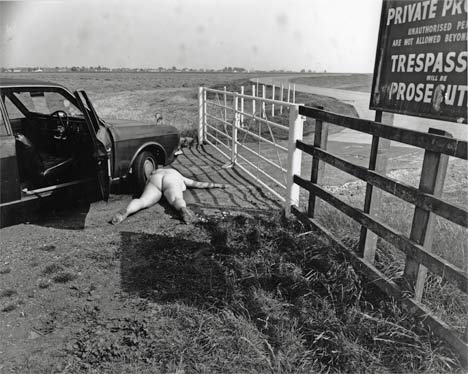
Remodelling Photo History (1982) a series of self-portraits in collaboration with Terry Dennett. The work consists of a series of diptychs where two photographs of Spence are juxtaposed. In some pairs, the first is a parody of a more traditional pictorial image; the second shot is less conventionally framed and the irony is articulated with less subtlety.
‘Industrialisation’ places the female figure between the viewer and the view beyond, challenging the male gaze and the objectification of women.
‘Victimisation’ “Here we see that the estate will not admit trespass, and that it stands in for the heroic (male) defender of the ground, repelling weak opposition at its border. Jo Spence failed to cross the barrier, allowing the absent landowner (through his gate and sign) to become hero, male, the creator of difference… her mockery diminishes the victory won by the landowner.” (John Taylor 1994, p.282 quoted Alexander p133)
————————————-
Jo Spence (1934–92) had a highly politicised approach to photography, creating photographs that run counter to the idealised imagery offered by advertising. Spence often worked collaboratively and sought alternative distribution models, laminating work for durability and renting out her photography to conferences, libraries, universities and public spaces to broaden its audience. She also documented her own struggles with cancer.
‘Putting Myself in the Picture’ (Camden Press 1986) brought together her raw and confessional works to inspire a younger generation of photographers. Remodelling Photo History (1982) a series of self-portraits in collaboration with Terry Dennett. The work consists of a series of diptychs where two photographs of Spence are juxtaposed. In some pairs, the first is a parody of a more traditional pictorial image; the second shot is less conventionally framed and the irony is articulated with less subtlety.
‘Industrialisation’ places the female figure between the viewer and the view beyond, challenging the male gaze and the objectification of women.
‘Victimisation’ “Here we see that the estate will not admit trespass, and that it stands in for the heroic (male) defender of the ground, repelling weak opposition at its border. Jo Spence failed to cross the barrier, allowing the absent landowner (through his gate and sign) to become hero, male, the creator of difference… her mockery diminishes the victory won by the landowner.” (John Taylor 1994, p.282 quoted Alexander p133)
John Thomson (14 June 1837 – 29 September 1921) was a pioneering Scottish photographer, geographer and traveller. He was an accomplished photographer in many areas: landscapes, portraiture, street-photography, architectural photography. He was one of the first photographers to travel to the Far East, documenting the people, landscapes and artifacts of eastern cultures for his Victorian audience. He was however more concerned with the socio-economic situation of the people whose land he visited than landscape as a subject in itself (Jeffrey, 1981, p. 64).
On his return home, his pioneering work documenting the social conditions of the street is regarded as a classic instance of social documentary which laid the foundations for photojournalism. He went on to become a portrait photographer of High Society in Mayfair, gaining the Royal Warrant in 1881. His publishing activities mark him out as an innovator in combining photography with the printed word.
The son of William Thomson, a tobacco spinner and retail trader, and his wife Isabella, Thomson was born the eighth of nine children in Edinburgh. After his schooling in the early 1850s, he was apprenticed to a local optical and scientific instrument manufacturer, thought to be James Mackay Bryson. During this time, Thomson learned the principles of photography and completed his apprenticeship around 1858. In 1861 he became a member of the Royal Scottish Society of Arts.
South East Asia 1862-1872: Singapore, Malaya, Sumatra, Siam, Cambodia and China
Singapore
In April 1862, Thomson left Edinburgh for Singapore to join his older brother William, a watchmaker and photographer, beginning a ten-year period spent travelling around the Far East. Initially, he established a joint business with William to manufacture marine chronometers and optical and nautical instruments. He also established a photographic studio in Singapore, taking portraits of European merchants, and he developed an interest in local peoples and places. He travelled extensively throughout the mainland territories of Malaya and the island of Sumatra, exploring the villages and photographing the native peoples and their activities.
After visiting Ceylon and India from October to November 1864 to document the destruction caused by a recent cyclone, Thomson sold his Singapore studio and moved to Siam. After arrival in Bangkok in September 1865, Thomson undertook a series of photographs of the King of Siam and other senior members of the royal court and government.
Prea Sat Ling Poun, Angkor Wat, 1865.
Inspired by Henri Mouhot’s account of the rediscovery of the ancient cities of Angkor in the Cambodian jungle, Thomson embarked on what would become the first of his major photographic expeditions. He set off in January 1866 with his translator H. G. Kennedy, a British Consular official in Bangkok, who saved Thomson’s life when he contracted jungle fever en route. The pair spent two weeks at Angkor, where Thomson extensively documented the vast site, producing some of the earliest photographs of what is today a UNESCO World Heritage Site.
Thomson then moved on to Phnom Penh and took photographs of the King of Cambodia and other members of the Cambodian Royal Family, before travelling on to Saigon. From there he stayed in Bangkok briefly, before returning to Britain in May or June in 1866.
While back home, Thomson lectured extensively to the British Association and published his photographs of Siam and Cambodia. He became a member of the Royal Ethnological Society of London and was elected a Fellow of the Royal Geographical Society in 1866, and published his first book, The Antiquities of Cambodia, in early 1867.
There have however been accusations of plagiarism. In 2001 Phiphat Phongraphiphon, a Thai independent researcher in historical photography, published claims that Thomson plagiarised works by Thai court photographer Khun Sunthornsathitsalak (Christian name: Francis Chit) and published them as his own. Evidence to Phiphat’s claims include an analysis of a photograph in which the temple Wat Rajapradit, which was built before Thomson arrived in Bangkok, is missing.
Travels in China 1868-1872
Island Pagoda, about 1871, from the album, Foochow and the River Min
Images from Travels in Chinahttps://www.youtube.com/embed/RXPC31yH1pQ?autoplay=0&theme=dark&loop=0&fs=1&showinfo=1&modestbranding=0&iv_load_policy=3&color=red&autohide=1&disablekb=0&enablejsapi=1&version=3 https://www.youtube.com/embed/FV-13nn1aAE?autoplay=0&theme=dark&loop=0&fs=1&showinfo=1&modestbranding=0&iv_load_policy=3&color=red&autohide=1&disablekb=0&enablejsapi=1&version=3 https://www.youtube.com/embed/v=zGgrQ6QKaGo?autoplay=0&theme=dark&loop=0&fs=1&showinfo=1&modestbranding=0&iv_load_policy=3&color=red&autohide=1&disablekb=0&enablejsapi=1&version=3
After a year in Britain, Thomson again felt the desire to return to the Far East. He returned to Singapore in July 1867, before moving to Saigon for three months and finally settling in Hong Kong in 1868. He established a studio in the Commercial Bank building, and spent the next four years photographing the people of China and recording the diversity of Chinese culture.
Thomson travelled extensively throughout China, from the southern trading ports of Hong Kong and Canton to the cities of Peking and Shanghai, to the Great Wall in the north, and deep into central China. From 1870 to 1871 he visited the Fukien region, travelling up the Min River by boat with the American Protestant missionary Reverend Justus Doolittle, and then visited Amoy and Swatow.
He went on to visit the island of Formosa with the missionary Dr. James Laidlaw Maxwell, landing first in Takao in early April 1871. The pair visited the capital, Taiwanfu, before travelling on to the aboriginal villages on the west plains of the island. After leaving Formosa, Thomson spent the next three months travelling 3,000 miles up the Yangtze River, reaching Hupeh and Szechuan.
Thomson’s travels in China were often perilous, as he visited remote, almost unpopulated regions far inland. Most of the people he encountered had never seen a Westerner or camera before. His expeditions were also especially challenging because he had to transport his bulky wooden camera, many large, fragile glass plates, and potentially explosive chemicals. He photographed in a wide variety of conditions and often had to improvise because chemicals were difficult to acquire. His subject matter varied enormously: from humble beggars and street people to Mandarins, Princes and senior government officials; from remote monasteries to Imperial Palaces; from simple rural villages to magnificent landscapes.
Street Life in London
Images from Street Life in LondonThomson returned to England in 1872, settling in Brixton, London and, apart from a final photographic journey to Cyprus in 1878, Thomson never left again. Over the coming years he proceeded to lecture and publish, presenting the results of his travels in the Far East. His publications started initially in monthly magazines and were followed by a series of large, lavishly illustrated photographic books. He wrote extensively on photography, contributing many articles to photographic journals such as the British Journal of Photography. He also translated and edited Gaston Tissandier’s 1876 History and Handbook of Photography, which became a standard reference work.
In London, Thomson renewed his acquaintance with Adolphe Smith, a radical journalist whom he had met at the Royal Geographical Society in 1866. Together they collaborated in producing the monthly magazine, Street Life in London, from 1876 to 1877. The project documented in photographs and text the lives of the street people of London, establishing social documentary photography as an early type of photojournalism. The series of photographs was later published in book form in 1878.
The Crawlers, London, 1876-1877
He was elected a member of the Photographic Society, later the Royal Photographic Society, on 11 November 1879. With his reputation as an important photographer well established, Thomson opened a portrait studio in Buckingham Palace Road in 1879, later moving it to Mayfair. In 1881 he was appointed photographer to the British Royal Family by Queen Victoria, and his later work concentrated on studio portraiture of the rich and famous of High Society, giving him a comfortable living. From January 1886 he began instructing explorers at the Royal Geographical Society in the use of photography to document their travels.
After retiring from his commercial studio in 1910, Thomson spent most of his time back in Edinburgh, although he continued to write papers for the Royal Geographical Society on the uses of photography. He died of a heart attack in 1921 at the age of 84. In recognition of his work, one of the peaks of Mount Kenya was named “Point Thomson”.
A large collection of his glass negatives was donated to the Wellcome Library. Some of Thomson’s work may be seen at the Royal Geographical Society’s headquarters in London.https://www.youtube.com/embed/1iHxiVW3wjA?autoplay=0&theme=dark&loop=0&fs=1&showinfo=1&modestbranding=0&iv_load_policy=3&color=red&autohide=1&disablekb=0&enablejsapi=1&version=3
Selected publications
China Through the Lens of John Thomson 1868 -1872, River Books 2010.
The antiquities of Cambodia, 1867
Views on the North River, 1870.
Foochow and the River Min, 1873.
Illustrations of China and its people, 1873-1874 [1]
Street life in London, 1878
Through Cyprus with a camera in the autumn of 1878, 1879