
Tag: environmental activism

  • Clare Hewitt

    Clare Hewitt is a Photographer based in Birmingham, a Senior Lecturer in Photography at The University of the West of England, Bristol, and Archivist for Vanley Burke with Art360 Foundation and The Feeney Archive Project.

    After completing a degree in Law at Oxford Brookes University, she went on to study Commercial Photography at the Arts University Bournemouth.

    Everything in the Forest is the Forest

    https://clarehewitt.co.uk/everything-in-the-forest-is-the-forest/#0

    Clare’s practice often focusses on ideas relating to loneliness, isolation and collaboration. In Everything in the forest is the forest, she has worked with a community of 12 oak trees to visually understand how they thrive through connection and communication, to inspire similar behaviour amongst human beings. Everything in the forest is theforest was selected to be exhibited at Landskrona Foto Festival, Sweden, in September 2022.

    EVERYTHING IN THE FOREST IS THE FOREST

    Clare Hewitt was awarded a GRAIN Bursary in 2019 to support the development of Everything In The Forest Is The Forest, with particular focus upon the making of work in the woodland and developing the work as a collaborative project.   Clare began to look at the affects of isolation through working with a community of individuals and a woodland of oak trees.

    As well as developing 24 pinhole cameras, supported by STEAMHouse, which were located high in the oak trees in the form of bird boxes, Clare also developed methodologies to make work utilising the forest floor and the roots of trees.

    The pinhole cameras and the other various approaches were ongoing for more than 12 months.

    Although trees appear to be individual organisms above ground, scientific research shows that their complex communication methods facilitate survival, nurture and pass on wisdom, and send warnings when they are under attack. In a time when loneliness is increasing, segregation is being encouraged politically, and isolation driven through technology, there is much that can be learnt from the unity of the forest.

    Clare is now working towards a major show of the work that will tour nationally.

    Other work

    In her work in progress, Kamera, Clare exchanges letters with a prisoner on death row in Kentucky, including a landscape photograph with each letter sent. The images become part of his cell walls, and he responds with letters, stories, drawings and occasional photographs.

    Clare’s work has been selected for awards including Magenta Foundation’s Flash Forward, the British Journal of Photography’s Portrait of Britain, the Royal Photographic Society’s International Photography Exhibition, and inclusion in the Taylor Wessing Portrait Prize exhibition. She was the recipient of the GRAIN Bursary Award 2019, and received a special mention in Krakow Photomonth’s ShowOFF 2022.  Her work has also been exhibited at The Palace of Westminster, Midlands Arts Centre, The Royal Albert Hall, The Royal Photographic Society and Library of Birmingham.

    Clare Hewitt is a photographer based in Birmingham.   In 2011 she was selected for Fresh Faced and Wild Eyed at The Photographers’ Gallery, and has since been exhibited at the National Portrait Gallery as part of the Taylor Wessing Portrait Prize, 2013. In 2016 and 2017 she was included in the Magenta Foundation’s Flash Forward emerging photographer selection for Eugenie and Kamera, and the British Journal of Photography’s nationwide Portrait of Britain exhibition. Clare has been shortlisted for the Royal Photographic Society’s IPE #161, and selected for 209 Women, a photographic portrait project that marks the centenary of women achieving the vote in the UK in 1918.
  • Natasha Myers

    Natasha Myers is Associate Professor of Anthropology at York University.

    She convened the Plant Studies Collaboratory in 2010 to serve as a node for collaborative interdisciplinary research on plant-based ecologies and economies. 

    Her first book, Rendering Life Molecular: Models, Modelers, and Excitable Matter (Duke 2015) is an ethnography of an interdisciplinary group of scientists who make living substance come to matter at the molecular scale. This book maps protein modeling techniques in the context of the ongoing molecularization of life in the biosciences. It explores how protein modelers’ multidimensional data forms are shifting the cusp of visibility, the contours of the biological imagination, and the nature of living substance. What, it asks, does life become in their hands?

    Becoming Sensor in Sentient Worlds

     I like to think of art practices as forms of dissensus that can rearrange our sensoria and sense making. I think about disrupting the intention of the camera, the logic of the grid in ecology, and producing data forms that cannot be arrayed along a chart or graph, that resist quantitative analysis. Becoming Sensor is about disrupting modes of attention and forms of knowing about the more-than-human that are so entrenched in settler common sense. It’s a kind of de-schooling, an unlearning, which can help us forget everything that we thought we knew about “nature.”

    Plants also provoke rethinking the senses, sensing, and sense making. People tend to think plants can’t communicate because they have no eyes, ears, or mouths. We wanted to render our bodies available to sensing plant sentience, sensing what plants are up to, how they move and grow, and tune into their sensibilities and gestures.

    https://culanth.org/fieldsights/becoming-sensor-an-interview-with-natasha-myers

    Becoming Sensor is about disrupting modes of attention and forms of knowing about the more-than-human that are so entrenched in settler common sense. It’s a kind of de-schooling, an unlearning, which can help us forget everything that we thought we knew about “nature.”

    EVANS, Meredith. 2020. “Becoming Sensor in the Planthroposcene: An Interview with Natasha Myers.

    Art in the Planthroposcene: Refuse the aesthetics of ruin porn, which constrains our imaginaries about plants expressing their powers to sites of cultural decay and times of human extinction. Cultivate, instead, a taste for Planthroposcene porn: art that keeps people in the game by staging intimate relations among plants and people. MYERS, Natasha. October 2018 p.9.

    Becoming Sensor aims to make strange the ways that the conventional ecological sciences have not only been deployed to colonize land, but also to colonize our imaginations; how they evacuate all other ways of knowing the living world, most especially those local and Indigenous knowledges that are attuned to the sentience of lands and bodies.

    https://becomingsensor.com

  • Stephen Gill

    Overview

    https://www.stephengill.co.uk/portfolio/portfolio/nggallery/album-1-2/Night-Procession/thumbnails

    “Stephen Gill has learnt this: to haunt the places that haunt him. His photo-accumulations demonstrate a tender vision factored out of experience; alert, watchful, not overeager, wary of that mendacious conceit, ‘closure’. There is always flow, momentum, the sense of a man passing through a place that delights him. A sense of stepping down, immediate engagement, politic exchange. Then he remounts the bicycle and away. Loving retrievals, like a letter to a friend, never possession… What I like about Stephen Gill is that he has learnt to give us only as much as we need, the bones of the bones of the bones…”

    Iain Sinclair

    Stephen Gill (b. 1971, Bristol, UK) became interested in photography in his early childhood, thanks to his father and interest in insects and initial obsession with collecting bits of pond life to inspect under his microscope.

    https://www.stephengill.co.uk/portfolio/portfolio/nggallery/album-1-2/Night-Procession/thumbnails

    night procession

    Ghostly images of animals caught in trailcam footage.

    https://www.nobodybooks.com/product/night-procession-portfolio

    Birds

    Photographs of single birds in everyday locations. The birds themselves are photographed very small, so the viewer has to search through the images of urban decay to find them.

    https://www.nobodybooks.com/product/birds-portfolio

    The Pillar

    Birds taking off, and flying around a post in a field.

    https://www.nobodybooks.com/product/the-pillar-portfolio

    Pigeons

    https://www.nobodybooks.com/product/pigeon-portfolio

    Abstract

    Photographs of light filtered through colourful gloops and textures, apparently of decaying substances.

    https://www.nobodybooks.com/product/please-notify-the-sun-portfolio

    A series of disappointments

    Scrumpled newspaper looking like animals and figures.

    https://www.nobodybooks.com/product/a-series-of-disappointments-portfolio

  • Land Art

    ‘Land art’  is a conceptually-based approach approach to making art that emerged in the 1970s. The nature of earth and land art requires the media of film and photography to document outcomes and incorporates aspects of performance art and sculpture.

    Land Art: The focus is not on describing the place itself, but representing the artist’s experience of visiting or travelling to or through it.

    • Hamish Fulton
    • Richard Long
    • Christo wrapping’ works
    • Jeanne-Claude wrapping’ works

    Earth art: involves direct intervention with, and often use of, the raw materials of a landscape (e.g. rocks, plants, mud), and is generally made or presented in situ. In Malcolm Andrews’ words:

    “The work of the Earth Artists cannot easily be identified with this or that particular object which the hands of the artist have made, but more with the relationship between that object (sometimes a mere rearrangement of on-site stones, for instance, or a line drawn on the desert floor) and the otherwise untouched site. The ‘landscape art’ in this case is that relationship.” (Andrews, 1999, p. 204 q Alexander 2013 p71)

    Robert Smithson (1938–73), celebrated for his Spiral Jetty (1970) which is almost 0.5km in length and extends into the Great Salt Lake in Utah.

    In relation to photography this raises the possibilities of manipulating the scene – going beyond simply tidying up strands of grass or intruding branches to constructing images to photograph – along the lines of Mohammad Barouissa’s constructed scenarios of conflict based on research and then staged. One could envisage something similar for eg environmental issues, or simply aesthetic effect.

    A further element used by some land artists, and also painters like Kurt Jackson, are words added to images – might be handwritten or typed in an appropriate font and overlaid in Photoshop. Or simply titling and putting alongside the image as a meta-narrative. This could complement or give ironic contrast to the image.

    Project 2.5: Text in art

  • Clive Landen

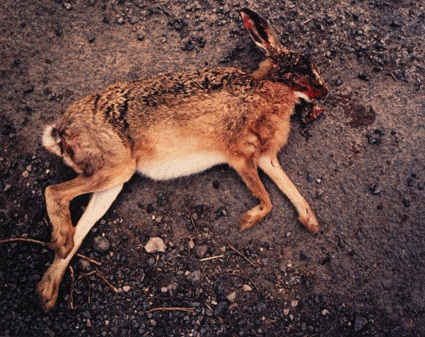
    Clive Landen is a British wildlife photographer concerned with our relationship with animals. His pictures are quite explicit and upsetting to view, but he photographs horror with profound sensitivity and an almost painterly quality that makes us really look at the subject matter.

    The Abyss  series about the 2001 Foot and Mouth outbreak (only one photograph now available on line?). Landen began this project because restrictions meant that he couldn’t pursue his work on the relationship between the land and hunting. The impetus also came from childhood memories of the foot and mouth outbreak of 1967. Whilst the body of work is a pertinent historical document, it is also a personal one. Landen collaborated with the military and was seconded to a regiment, which allowed him free rein to access the sites where cattle were being burned and buried. He describes a photograph of one dead sheep amongst many as a “portrait of the sheep which looks benign, at peace.” (Landen (2007) in Source no. 51.)   His landscape containing a row of dead dairy cows and skeletons of trees is one of the most moving of the series. The pall of smoke that clung to these sites is visible, providing an almost painterly, pictorialist quality.

    Familiar British Wildlife series of images of roadkills. Article Source magazine  Camera Club images


  • Landscape as a Call to Action

    Photography, and the manipulation of photographs, is often used to highlight and raise political questions. Landscape photography in particular is often used in environmental activism – images of environmental degradation, urban squalor. In NGO advertising (eg GreenPeace) photographs are often manipulated to juxtapose elements that are then countered by a caption.

    • Peter Kennard produces explicit political photomontage in the dadaist tradition linked to political campaigning organisations – for example his ‘Hay Wain with Cruise Missiles’ (1980)
    • Edward Burtynsky produces large-format photographs of industrial landscapes altered by industry – an ‘industrial sublime’ creating tension between awe-inspiring beauty and the compromised environments he depicts.
    • Mitch Epstein also uses large format, but less ‘beautiful’ images that do not aim to convey a specific message, and are more documentary in juxtaposing complex narratives.
    • Dana Lixenberg in works like the Last Days of Shishmaref uses landscape and portrait photography alongside working with environmentalists and local activists to produce powerful participatory social documentary.
    • Ikka Halso uses digital montage, including 3D, to build dystopian landscapes that raise questions about the ways in which human beings are attempting to control nature.

    Exercise 3.4: A persuasive image

  • Dana Lixenberg

    My work is partly about the inevitable downside and consequences of capitalism which can result in a sense of alienation…actually I am part of it, and even people I photograph are part of this system and keep it going. I think [capitalism] has become a given because you can see how former and current communist countries are going the same way. I’m really aware of that, and want to face the realities and the downsides of that system that I find also attractive.

    I find that the [documentary] portraits and landscapes are really about slowing down, cutting out all the noise and really taking time to contemplate the world around me every time with new eyes. The plain and the everyday is often very exciting to me. It can reveal a lot about life. I’m really inspired by details and I am usually more inspired by non-dramatic settings. Some of my images may seem boring, where there is nothing obvious going on, but I like playing with that, being on the fringes of boring.

    While I have no expectation that I can influence social change or that I can ever make a concrete impact with the photographs, I do feel it’s kind of empowering to give the people you photograph a timeless presence in the larger world.

    Google images


    Interview for Mossless magazine

    Overview: http://www.thelastdaysofshishmaref.com/shishmaref3/cms/cms_module/index.php

    Film presentation:  http://www.thelastdaysofshishmaref.com/shishbook/shishbook_release-1.1.11/MainView.html 

    The Last Days of Shishmaref (2008) by Dana Lixenberg mixes landscape with formal portraits and still life to create a dynamic portrait of an Alaskan community that is under imminent threat from the sea due to the increasingly later freeze of the protective permafrost that encircles the island. The traditions of this community, mostly of Inuit origin, are just as much under threat as the precarious strip of land. The images in the book are informed with essays by geographers and environmentalists.

    Lixenberg’s trademark is a 4×5 camera and tripod. This gives an intensity of experience between the photographer and those she photographs that she feels is not there with other types of cameras. She enjoys illustrating contrast in her work and portraying people in pure form.

    Biography

    Dana Lixenberg (born in Amsterdam, The Netherlands,1964) lives and works in New York and Amsterdam. Lixenberg originally went to New York to become an au pair and then discovered photography at a night school class. She studied Photography at the London College of Printing in London (1984-1986) and at the Gerrit Rietveld Academie in Amsterdam (1987-1989).

    Her breakthrough in the U.S. came in 1993, when she was awarded a project grant by the Fonds BKVB (The Netherlands Foundation for Visual Arts, Design and Architecture) for a series of portraits at the Imperial Courts Housing Project in Los Angeles,CA. She was soon getting commissions from a wide variety of magazines such as Vibe, The New York Times Magazine, The New Yorker, Newsweek and The Telegraph magazine amongst many others.

    Lixenberg continuously worked on long term personal projects, mostly focused on individuals and communities on the margins of society. Lixenberg has been the recipient of several project and publication grants in the Netherlands.

    • 1999 she was the subject of a documentary titled: Dana Lixenberg, thru dutch eyes 
    • 2005 she was featured in an episode of the documentary series ‘Hollands Zicht’ (Dutch Vision) both for Dutch television.
    • 2005 Jeffersonville, Indiana was awarded Best Dutch Book Design,
    • 2008 The Last Days of Shishmaref, was also awarded Best Dutch Book Design, 2008.

    Since 2008 Lixenberg has been revisiting the Imperial Courts Housing Project in Los Angeles for a follow up to the series from 1993. In spring 2015 Huis Marseille, Amsterdam will organize a large scale exhibition of Imperial Courts coinciding with the release of a publication.

    Other work

    Lixenberg photographs people from all social classes.

    I’ve never taken a different  approach between photographing celebrities and un-known individuals,  The fragility of life is experienced by all. ..When shooting people who have had a lot of media exposure I’m not interested in reinforcing their public image. I try to really see the person that’s in front of me, the way they are at that particular moment stripped from all the surrounding distractions like their entourage and to slowly bring them to a place where they don’t present a persona basically where they don’t try to hard. 

    In addition to ordinary people, Lixenberg has photographed a number of American celebrities, including Prince and Whitney Houston.

    Lixenberg is also a film director and directed the Dutch singer Anouk’s 2005 video ‘One Word’