Category: Theory and Concepts

  • Sally Mann

    Sally Mann (born 1951) was named America’s best photographer by Time magazine in 2001. Her early work included black and white images of her own children which caused a degree of controversy, especially those images in which they adopted ‘adult’ poses, like the
    1989 image below.

    If you’re interested in finding out more about Sally Mann and some of the technical aspects of her work, the following link is to the first part of a three-part series What Remains: The Life and
    Work of Sally Mann. Follow the links on YouTube for Parts 2 and 3.
    http://www.youtube.com/watch?v=XNEd93H4pPY

    This link will take you to some photographs that Mann has taken of her husband of 40 years who has muscular dystrophy:
    http://www.youtube.com/watch?v=ACVN0bKze4Q

    Exercise: Mixed messages: Candy cigarette

    This is a more challenging image than any you’ve been asked to analyse previously because of the interplay between the young subject and the adult pose. As before, go through the various elements of the photograph one by one and note down how they
    contribute to the meaning that you take from the image – whatever that is. For example, you might think that Mann is deliberately challenging conventional attitudes to the portrayal of children or that she’s commenting on the child’s transition to adulthood.

    This image is called Candy Cigarette. Does that influence your interpretation of the image?

    This was a highly controversial image in 1989 when it was produced. What do you think the reaction would be to it today?

    Make notes in your learning log or blog. It might be interesting to go on the student forum and find out what other students have made of this image.

  • Exercise: Jack Nicholson

    Analyse Bailey’s portrait of Jack Nicholson. Take a good look at
    the portrait first. What mood does it convey? Who is this person?
    What was Bailey trying to do? As before, analyse the various
    elements independently then think

  • Portraits without People

    ‘Portraits without people’ sounds like a contradiction in terms but it refers to the collection of
    important and contextually relevant objects arranged and placed in a relationship to each other
    to convey the personality of the individual or a concept or an idea.
    You can use any items that mean something to you or that reflect your sitter’s life or personality.
    It could be a collection of parental keepsakes or familiar items from a childhood holiday
    destination. There may be music involved. It could be a multi-media piece with the portrait
    visually displaying the significant items accompanied by an imported smell (synthetic, easily
    bought these days).
    Take a look at the work of Robert Weingarten (born 1941) who uses photography to build
    complex compositions. He tends to illustrate myths and legends interspersed with themes from
    the lives of individuals.
    Visit: http://robertweingarten.com/home.html
    On the website you can listen to Weingarten talking about his work and how he goes about
    creating his portraits – unbound as he names them.

    Annie Leibovitz (born 1949) has investigated people and her own understanding of them
    through photographing their spaces and objects, as you can see from this TV interview:
    www.youtube.com/watch?v=kZsDcVJCccE
    For more on Annie Leibovitz:
    www.npg.org.uk/annieleibovitz/index.htm
    www.nytimes.com/library/photos/leibovitz/interview.html

  • Basics of portraiture

    Portraiture  is a conscious act of more than one person. It is consensual.
    “It is, however, not so much what is depicted as the relationship between the photographer and subject that is significant. Academic painting sanctioned the image of the body in terms of official classic tradition and so does early academic photography, but it does so in terms of its promise of the actual. An image of a body as distinct from the painting of a body insists on a privileged access normally shared only between the artist and (his) model.” (Clark p.124)

    Photography in its infancy drew heavily on the painting tradition and a knowledge of portrait painting techniques can support us in mastering portrait photography. That’s why it’s important to look at other photographers’ and artists’ work in some detail.

    Listen to Robert Amft on the relationship between painting and photography:
    http://www.youtube.com/watch?v=8RN-aN4LQgU
    http://robertamft.com/art-of-amft/photography

    Amft does prism images and portraits, and digital mosaics.

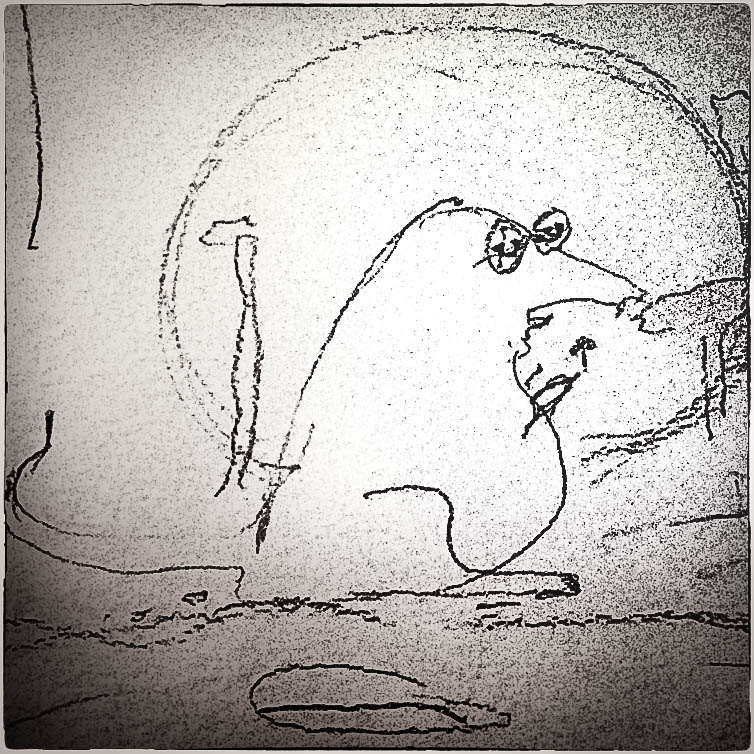
    Exercise: Draw a Portrait

    The body in the photograph

    The relationship between photographer and sitter is a one-to-one relationship that has predetermined external pressures that the photographer needs to manage during the work.

    • Do we pay a photographer to produce this portrait that shows us as handsome or beautiful?
    • or do we pay a photographer to produce the truth?

    A very common issue with photographers is whether or not they should photograph people they know. Working as a photographer with those we live with or work with is often very frustrating; they won’t do as you ask, they expect you to finish in a matter of seconds, and so on.

    The sitter who is a stranger is likely to have a number of questions:
    • What is the truth? Will I like it?
    • If sitting at the photographer’s request, why me?
    • What does the photographer see?
    • How will I be portrayed – as clever, intellectual, rich, powerful, ordinary, or even sleazy, cheap or hopeless?
    Difficult questions and not a frame shot as yet.


    Read Chapter 6 of Graham Clarke’s The Photograph, especially pp.123–43.
    This is a very good piece on the body and its use within a range of genres of photographic imagery.

    Controlling the elements of portraiture

    But despite its consensual nature,  portraiture is in the control solely of the photographer???; the sitter can’t see what is happening. This is unlike other areas of work, such as editorial or fashion photography, which often happens in settings that the photographer has no control over.

    Painting portraits has provided artists with a way of earning a living since the Renaissance. Aspiring painters with a sufficient level of skill and aptitude would be apprenticed to a great master’s studio (provided they could meet the cost of indenture). Typically, the master painted the faces while the students painted the bodies or perhaps the background detail.

    sfumato:  a technique   to produce the softness and the skin tones necessary for the photorealism their clients demanded.

    The photographer for the most part controls the background, pose, clothes, props, lighting and exposure in the consensual act of portrait photography. Of course, these are not really separate
    issues – they are inter-related. Change the clothes or the background and you have a very different feel or meaning to the work. People respond to costume and situation and the image
    will change accordingly.

    So, if all these elements are interlinked, where do we start with this multi-functional task which in practice can resemble a circus plate spinning act – get one thing
    right and another is wrong?

    Quality of light

    A good starting point is the quality of light that falls on the subject.

    chiaroscuro: the nature of the light falling on a subject. In harsh light the tonal range decreases. In soft light the tonal range increases – hence the use of softboxes in commercial studios.Let’s return to painting.

    Early photographers’ portrait studios used something they
    called ‘north light’ from the direction of the roof windows, using blinds and curtains to control where the light fell.

    We can use light and dark – contrast and tones – to create shapes and form to portray three-dimensional subjects. A common device in both painting and photographic portraits (eg Rembrandt self-portraits) is to show one  side of the face  with soft daylight falling on it. On the other side, the shadow of the nose meets the cheek shadow but the eye is still in the light.  The face looks rounded or three-dimensional. This can be achieved with a soft light on both sides but exposure becomes critical. You have to ensure that the lighting ratio across the face does not exceed 4:1. That is 8 stops difference for a hand print; if reproduced in a magazine this will have to be considerably reduced.

    As a painter Rembrandt has artistic licence – that is, to have shadow areas where he wanted them, vignetting the centre, and small soft pools of light where he saw fit. The genius is that it looks plausible and natural.

    David Saffir and Sally Wiener Grotta discuss how their photography has been inspired by Rembrandt’s Night Watch at http://www.youtube.com/watch?v=XJN0pdSv__U

    Bill Truran’s portrait of a little girl (more like Vermeer lighting)

    The sun is the natural light source that all artificial lighting tries to reproduce but the sun isn’t always the same – it gives us different results on different days dependent upon the time of year and the weather. On a bright day it throws hard shadows, on a grey day soft shadows. Contrast in tone is the issue here. On a sunny day shadows are deep/dark and highlights are bright so there is high contrast. On a cloudy day shadows are mild and highlights are scarce so there is
    low contrast.

    Outdoor portrait photography

    John Freeman: http://www.youtube.com/watch?v=jYlpLRA8Mbw
    (www.johnfreeman-photographer.com/ is Japanese!!)

    If you’re making a portrait it is perfectly feasible to use the sun as your light source.

    But if the subject is facing the sun you may well end up with squinting or some other facial expression that you’d rather avoid. When shooting a subject against the light never look at the sun through your lens – it can severely damage your eye.

    It’s normal practice to pose your subject with their back to the sun and use a reflector. In technical terms, this means that you have a main or key light (the reflector) – the light you want to work with – and a secondary light source (the sun) exposing the background and lighting the edges of your subject (e.g. modelling light on the subject’s shoulder or lighting the hair).

    Because the reflector isn’t the brighter of the two lights you need to consider your exposure. Where do you meter from? Meter from the face. You can do this by setting your camera to spot meter or – as many professionals still do – by using a light meter. Expose for the face; if you get this right everything else should fall into place.

    Exercise: Outdoor Portraits
     

  • Rembrandt

    Rembrandt had a studio with fantastic quality daylight; the window light was soft and he used reflector sheets to bounce light back where he wanted it. In other words he used soft controlled light which is what the studio softboxes of today http://www.rembrandthuis.nl/cms_pages/index_main.html

    Rembrandt creative commons website

    Exercise: The Night Watch
    The painted portrait had to show the viewer what was important either to the sitter or the creator. This was done in some cases by pose, in some by costume or uniform or significant items with inherent meaning, or simply by position – being higher up than others or at the optimum positional point of the image. Look carefully at Rembrandt’s famous painting The Night Watch, commissioned by Frans Banning Cocq, the figure in the centre foreground.

    Before you follow the link below, make some notes in your learning log about how the artist uses the elements listed above (background, pose, clothes, props, light). What effect does
    he create? What does the portrait say about Banning Cocq?
    Look particularly at the use of light and dark in this huge portrait. How might you create similar effects photographically?
    Now follow the link: https://www.youtube.com/watch?v=N9jj74aOr_Q

  • Exercise: A self-portrait

    This exercise aims to develop your analytical skills in defining how to portray someone, but this time the subject is you.

    Write 150 words about yourself and select a stance from this to bring to the camera.

    In terms of lighting, etc., use a friend or family member to practise and then set the camera up on a tripod and either use a timer or ask someone to press the button when you tell them. It’s still your image – you set it up, did the posing, lighting, costume, hair, etc.

    Produce three images that tell the viewer all about you – as you see yourself.

    Now ask friends or colleagues what they think your strengths and weakness are. Ask them what defines your character to them, how they see you. Produce three images from your friends’ points of view.

    Write the experience up in your learning log. Do the images coincide in terms of your own and your friends’ impressions of you? In other words, were you trying to photograph the ‘same’ person in each case or someone completely different? Then look again at the images and see if they coincide visually. Try and analyse your findings.

  • Exercise: Identity: There’s only one…

    Yes it’s a football chant but it also reflects your uniquenesss, your identity.
    What are you about? Why are you –you? What makes you different from other people? What makes you the same?
    For this exercise, use either a mobile phone or a small but cheap digital compact. No DSLR or bridge cameras. You’ll also need a large lump of Blu-Tack or plasticine to put your camera on or stick the camera into. This is your tripod – it will stick into corners, on shelves, etc., where you would struggle to put a full-sized tripod.
    Photograph yourself for three days. If you can, take roughly one photograph per hour.
    If you miss an hour you can’t take two shots in the next. And you can’t repeat it if it goes wrong, if somebody moved, etc. Aim to show your feelings, your moods, your quirks, your belongings, your environment – the things that make you into you.
    Produce eight images that, together, create a profile of you and explain what there is to know about you when read from left to right in a particular order.

  • Sam Taylor-Wood

    Sam Taylor-Wood has become one of the UK’s leading photographic artists and is now establishing herself as a film director.

    Much of Taylor-Wood’s work explores feelings and emotion.

    • Gracefully Suspended self-portrait series explores the feeling and perhaps euphoria of weightlessness.
    • Men Crying exposes the vulnerability and emotional side of wellknown film actors.


    Taylor-Wood  has been described as a post-feminist artist. Some of her work in which she has appeared naked, for example Leda and the Swan, has attracted feminist criticism.

    For the more commercial side of STW visit: http://www.youtube.com/watch?v=8thrvcrEOuU


  • Miru Kim

    New York-based photographer Miru Kim is fascinated by city life.

    Naked City Spleen series features Kim herself naked in city locations across the world, including New York, Paris
    and Berlin.

    The Pig That Therefore I Am.

    http://vimeo.com/19871003
    http://www.mirukim.com/photosPig.php
    http://www.mymodernmet.com/profiles/blogs/naked-city-spleen-by-miru-kim-1

  • Laurie Toby Edison

    American photographer Laurie Toby Edison (born 1942) has engaged with gender and body image in her books:

    Women En Large: Images of Fat Nudes (1994) and

    Familiar Men: A Book of Nudes (2004).

    More recent work includes Women of Japan which features clothed portraits of women from different social backgrounds.

    Visit the website for more images and an insight into Edison’s practice:
    http://laurietobyedison.com/video.asp
    Listen to a video of Edison talking about the values and practice of her work:
    http://video.google.com/videoplay?docid=-4596714865921868323&hl=en#